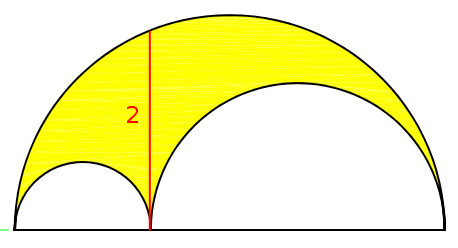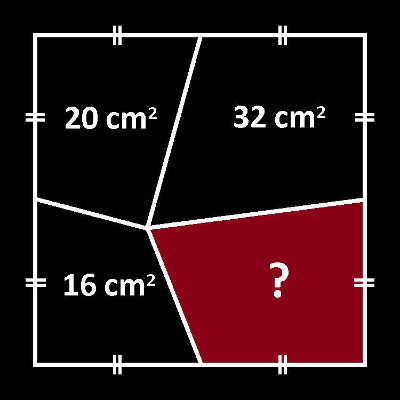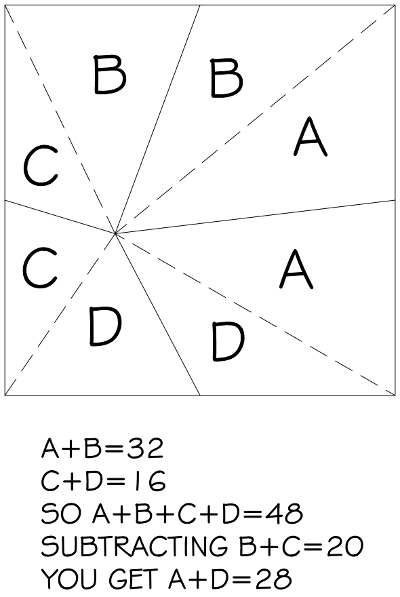
You own a goat and a meadow. The meadow is in the shape of an equilateral triangle each side of which is 100 meters long. The goat is tied to a post at one corner of the meadow. How long should you make the tether in order to give the goat access to exactly half the meadow?
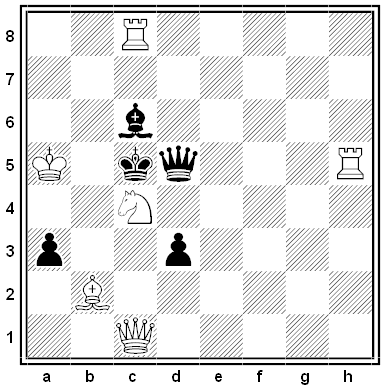
If White withdraws his light-squared bishop along the b1-h7 diagonal, then Black is facing two mate threats: White can move his king off the a-file, discovering mate by the a8 rook, or he can move his dark-squared bishop off the first rank, discovering mate by the h1 queen. A few sample lines:
1. Bf5 Rxa8+ 2. Ba7#
1. Bf5 Rxh1 2. Kb3#
1. Bf5 Rh4 [ready to block a rook check or take the queen] 2. Bh2#
1. Bf5 Rd8 [ready to block a queen check or take the rook] Bd4#
(If 1. Bf5 c2 then 1. Bd4#!)
At first it looks as though Black is doomed, but he does have one resource. If after e.g. 1. Bf5 he plays 1. … Rg8 then White has no way to mate on the next move: If the white king discovers check, Black can simply take the rook, and if the g1 bishop discovers check by the queen, the rook can interpose.
The answer is 1. Bg6!, the only initial bishop move that blocks the rook’s route to g1 and keeps both mate threats alive.
Created by Franz Armbruster in 1967, “Instant Insanity” was the Rubik’s Cube of its day, a simple configuration task with a dismaying number of combinations. You’re given four cubes whose faces are colored red, blue, green, and yellow:
The task is to arrange them into a stack so that each of the four colors appears on each side of the stack. This is difficult to achieve by trial and error, as the cubes can be arranged in 41,472 ways, and only 8 of these give a valid solution.
One approach is to use graph theory — draw points of the four face colors and connect them to show which pairs of colors fall on opposite faces of each cube:
The first graph shows which colors appear on the front and back of each cube, the second which colors appear on the left and right. Each arrow represents one of the four cubes and the position of each of the two colors it indicates. So, for example, the black arrow at the top of the first graph indicates that the first cube will have yellow on the front face and blue on the rear.
This solution isn’t unique, of course — once you’ve compiled a winning stack you can rotate it or rearrange the order of the cubes without affecting its validity. B.L. Schwartz gives an alternative method, through inspection of a table, as well as tips for solving by trial and error using physical cubes, in “An Improved Solution to ‘Instant Insanity,'” Mathematics Magazine 43:1 (January 1970), 20-23.
For a puzzlers’ party in 1993, University of Wisconsin mathematician Jim Propp devised a “self-referential aptitude test,” a multiple-choice test in which each question except the last refers to the test itself:
1. The first question whose answer is B is question
(A) 1
(B) 2
(C) 3
(D) 4
(E) 5
2. The only two consecutive questions with identical answers are questions
(A) 6 and 7
(B) 7 and 8
(C) 8 and 9
(D) 9 and 10
(E) 10 and 11
3. The number of questions with the answer E is
(A) 0
(B) 1
(C) 2
(D) 3
(E) 4
The full 20-question test is here, the solution is here, and an interesting collection of solving routes is here.
A problem from the 1996 mathematical olympiad of the Republic of Moldova:
Twenty children attend a rural elementary school. Every two children have a grandfather in common. Prove that some grandfather has not less than 14 grandchildren in this school.
Consider the grandfather with the largest number of grandchildren, and suppose, for a contradiction, that that number is less than 14. There’s a child at the school who isn’t his grandchild, and each of his grandchildren shares a grandfather with that child. They can’t all share the same grandfather, because then that man would surpass our “maximal” grandfather. So there’s some third grandfather to divide that duty with him.
Now, every student we haven’t spoken about shares a grandfather with one that we have. And that leaves room for no fourth grandfather; every student in the school must count some two of these men as his grandfathers.
We have 40 grandfatherings to assign to these 20 students, and 40 = 3 × 13 + 1, so try as we might, we can’t assign 13 or fewer to each of the three men. One of them must have at least 14 grandchildren.
(This is all laid out more rigorously at the link below, page 371.)
Six sheets are set out in a room. Each identifies a different date in the same month. Weekdays are printed in black and Sundays in red. Six people will enter the room, one by one. Before the first one enters, one sheet is turned face down. Candidate 1 is then asked if she can deduce the color of the inverted sheet by examining the other sheets. Her answer, yes or no, is written on the back of the inverted sheet, followed by her number, 1. When 1 departs, a second sheet is turned face down. Candidate 2 enters and is asked whether she can deduce the color of the second sheet by considering her predecessor’s answer and the four face-up sheets. Her answer is noted in its turn, and this process continues — when the sixth candidate enters, she sees six face-down sheets, the first five of which bear the answers of the first five candidates. If all five of these answers are no, can Candidate 6 answer yes?
Yes. The fact that Candidate 1 wrote no means that she can’t have seen more than four red sheets — if she’d seen five then she would have written yes, because a month cannot have more than five Sundays, and this fact would have told her that her own sheet was black.
Similarly, the fact that Candidate 2 wrote no means that she can’t have seen more than three red sheets, because if she’d seen four red sheets (sheets 3, 4, 5, and 6) then she could infer that sheet 2 must be black, as Candidate 1 could not have seen five red sheets, per the reasoning above.
And so on: Since Candidates 3, 4, and 5 all wrote no, they can have seen at most 2, 1, and 0 red sheets. And if Candidate 6 knows that Candidate 5 saw 0 red sheets, she can announce that her own sheet was black.
(From Roland Sprague, Recreation in Mathematics, 1963.)
Well, whose turn is it? If White has the move he can mate immediately with the pawn. But if it’s White’s turn, then Black must just have moved, and there’s no legal move he can just have made. So it must be Black’s turn to move, and after 1. … axb6 the black pawn can scurry down the board to the queening square, just beyond the reach of the pursuing king. Black wins.
The Germans call this the Vielväter (“many fathers”) position, because the idea has inspired literally thousands of problems.
Look, a giraffe! Can you move one matchstick to produce another giraffe? That is, move one matchstick to produce another instance of this figure, perhaps rotated or reflected.
A problem from the Graham Dial, a publication of Graham Transmissions Inc., via L.A. Graham’s The Surprise Attack in Mathematical Problems (1968):
Little Euclid went with his father to visit a friend who ran a small ranch. The rancher told them that he and his partner used to herd cattle but had then sold the herd for as many dollars per head as there were head in the herd. With the proceeds they had bought as many sheep as they could at $10.00 per sheep, and with the money that remained they bought a dog. Later the rancher and his partner decided to split up evenly, so they added the dog to the herd and each of them took the same number of animals.
Euclid surprised him by saying, “I hope you paid him $2.00 to even things up.”
“Why, yes, I did,” the rancher said, “but how did you know? I haven’t told you any of the numbers or prices.” Can you prove that Little Euclid had to be correct?
First, three observations: (1) The number of dollars that the men received for the herd of cattle was a perfect square. (2) The number of sheep they bought was odd, because it was necessary to throw in the dog in order to divide the animals evenly. (3) Since they bought an odd number of sheep at $10.00 per head, the next-to-last digit in the square payment from observation (1) must be odd.
Now, as it happens, in any perfect square, if the next-to-last digit is odd, the last figure must be a 6. The simplest way to see this is to consider that any number can be expressed as 10a + b, where a comprises all the digits except the last and b is the last digit (0 to 9). The square of this number is 100a2 + 20ab + b2. But 100a2 has zeros in the last two places, and 20ab has a zero in the last place and is preceded by an even number. So, in order for the square to have an odd digit in the next-to-last position, b2 must have an odd first digit, and the only possibilities are 42 = 16 and 62 = 36.
In either case, the dog cost $6.00, and the rancher owed his partner $2.00 for accepting a $6.00 dog in place of a $10.00 sheep.