
The Wikipedia article on the Ship of Theseus has changed entirely since its inception.
Oddities
Casting Call
I turn off the light when I leave the room and I turn it on again when I come back in a moment later. Is the shadow of the statue on the table the same one before and after the light is off? If we say it’s the same, then we accept the existence of strange, intermittent entities (in the same family as the flashing of the turn-signal light on a car). If we don’t like that idea, then we have to say that there are two different things: the shadow that was present before I turned off the light and the shadow present after I turn it on again. What’s different about them?
— Roberto Casati, The Shadow Club, 2003
(We might distinguish the two by observing that different photons are hitting the statue, but this seems to mean that a new shadow is produced every instant, and that doesn’t sound right either.)
In Other News
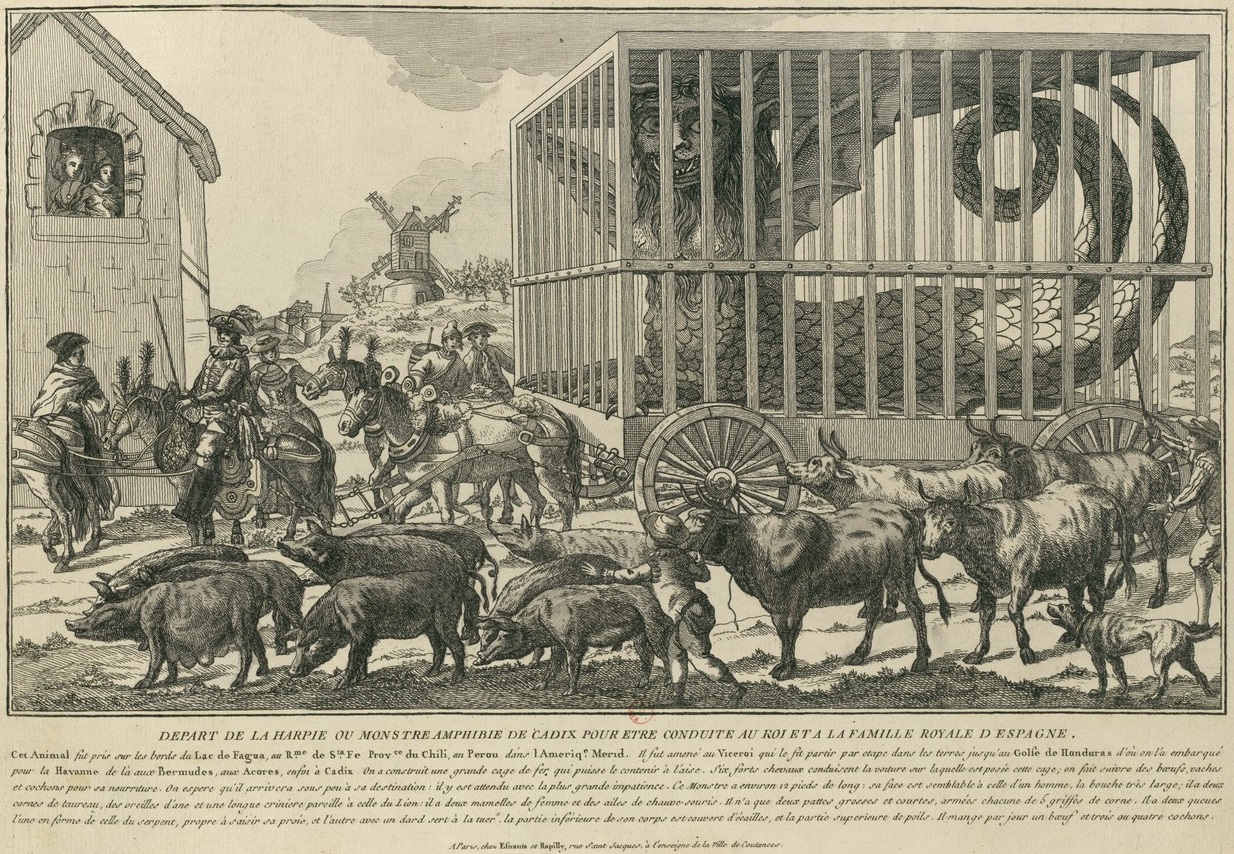
This monster was found in the kingdom of Santa Fe, Peru, in the province of Chili and in the Lake of Fagua, located in the lands of Prosper Voston. It emerged during the night in order to devour the swine, cows and bulls of the area. Its length is eleven feet; its face is roughly that of a man; its mouth is as wide as its face; it is provided with teeth two inches long; it has twenty-four-inch horns like those of a bull; its hair reaches to the ground; it has four-inch ears like those of an ass; it has two batlike wings; its thighs and legs are twenty-five inches long and its claws eight; it has two tails, one very flexible and provided with rings that help it seize its prey, and the other ending in a dart which helps it kill; its entire body is covered with scales. The monster was captured by many men who had laid traps into which it fell. It was entangled in nets and brought alive to the viceroy, who succeeded in nourishing it with a steer, a cow, a bull, given to it every day with three or four swine, to which it is quite partial. As it would be necessary to load too great a quantity of cattle to nourish it during the crossing, which takes at least five or six months to pass Cape Horn, the viceroy has sent orders along the entire land route to provide for the needs of this unique monster while making it march by stages to the Gulf of Honduras, where it will embark for Havana. From there to the Bermudas, to the Azores, and in three weeks it will disembark at Cadiz. From Cadiz it will be taken by short trips to the royal family. It is hoped that the female will be captured so that the species will not die out in Europe. The species seems to be that of harpies, heretofore considered legendary.
— Courier de L’Europe, Oct. 22 and 29, 1784
(Another hoax, but a widely credited one. From the Bibliothèque Nationale: “This monster frequently emerged from Lake Fagua at night to devour pigs, cows and bulls. It has even been caught using nets; but needs feeding daily with an ox, cow or bull and three or four pigs.”)
The Europa Redux Manuscript
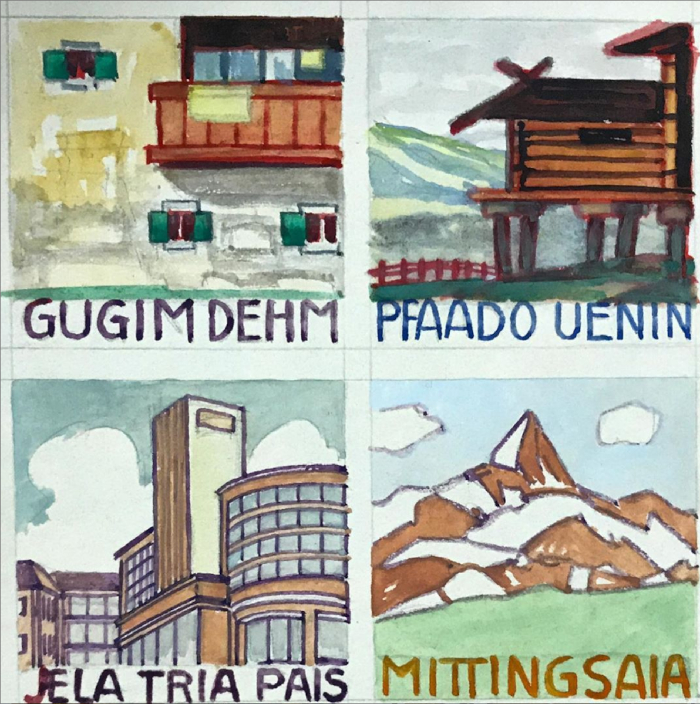
In 2020 Brooklyn’s Honey & Wax Bookseller came into possession of a strange manuscript consisting of 7,000 illustrations, each 3 centimeters square. The images fill 106 loose sheets that often mimic European tourist brochures, and most bear captions that resemble no known language. The manuscript appears to have been created in Switzerland in the 1940s, but no one knows who created it or why. Notre Dame historian of science Robert Goulding wrote, “The fact that [the words] don’t seem to conform to any language or phonemes in any language is suspicious … suggesting to me that they are either a cipher, or there is some method or algorithm used to generate the words.”
Lacunae
Demetri Martin’s 2012 book This Is a Book contains a page marked “This page unintentionally left blank.”
The first page of this edition of Jean-Paul Sartre’s 1944 essay Anti-Semite and Jew is marked “This Page Intentionally No Longer Blank”.
At the start of Australian children’s author Andy Griffiths’ 1999 book Just Stupid!, a cartoon snail tells the reader, “This page would be blank if I were not here telling you that this page would be blank if I were not here telling you that …”
Reza Amirkhani’s 2000 novel Man-e-oo contains a whole chapter of blank pages.
Idries Shah’s The Book of the Book spends 10 pages explaining why the pages that follow are important; these pages prove to be blank.
Don Novello’s 1977 book The Lazlo Letters ends with several otherwise empty pages marked “FREE PAPER!”
This 32-page pamphlet, published in 1880, was entirely blank:

It worked — William Gladstone defeated Lord Eskdaill in an upset victory at Midlothian.
Science Marches On
From a 1915 examination of Darkie, a blind New Zealand terrier who barked answers to his master’s queries:
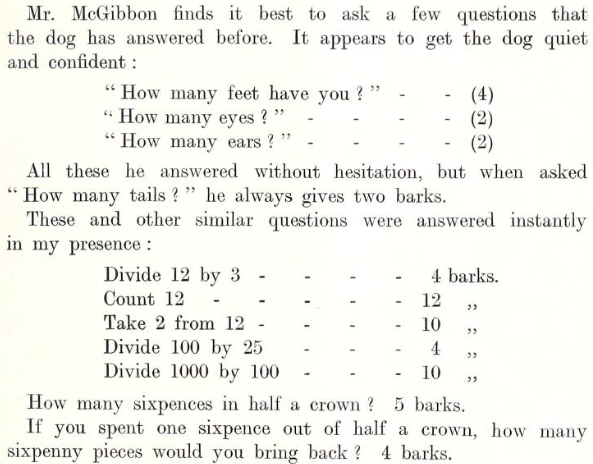
From the local Lyttelton Times, June 12:
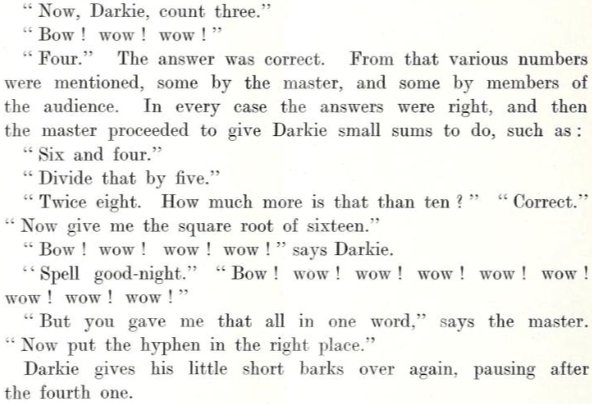
Apparently the dog was also clairvoyant:
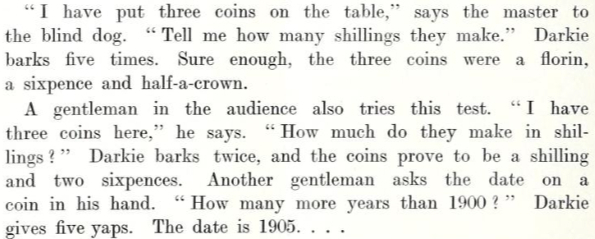
Further questions successfully answered: “How many roods in one acre? How many furlongs in one mile? How many ounces in one pound avoirdupois? How many troy ounces? How many lbs. in one stone? What is the day of the month? What is the month of the year? What is the year over 1900?”
The Society for Psychical Research raised the prospect that the dog was merely continuing to respond until it received a cue to stop, as other performing animals had been discovered to do. It asked its New Zealand correspondent to test this hypothesis, but as far as I can tell he never did.
Tableau
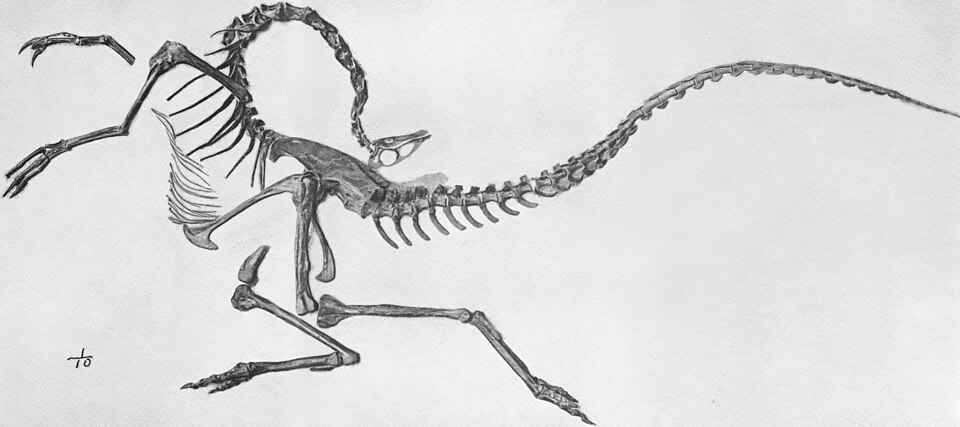
Dinosaur fossils are often found in this dramatic posture, with the head thrown back, the tail extended, and the mouth wide open. The reason isn’t clear. It could be caused by muscle spasms during the animal’s death throes, or the contraction of neck ligaments after death, perhaps facilitated by immersion in water. It’s called the opisthotonic death pose.
Perspective
Artist Jeff Lieberman designs “Impossible Corners,” a wall art illusion that exploits the same principle as this mistrustful dragon.
In a Word
locodescriptive
adj. describing a particular place or places
hippocrepiform
adj. shaped like a horseshoe
elsewhither
adv. in a different direction
mirific
adj. working wonders; wonderful
The Rochester Institute of Technology contains a portal to another dimension. In 2013, student Michael Lacanilao deliberately set out to create a record of an “Escherian stairwell” on campus that forms a perpetual downward loop.
Lacanilao has long since graduated, but the stairwell is still commemorated on the school’s website.
(Thanks, Colin.)
Offensive Escargot
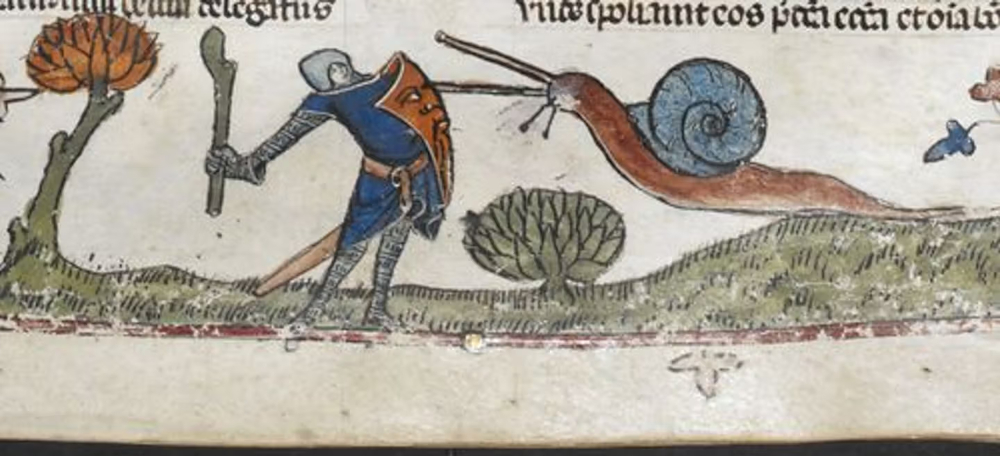
In the illuminated manuscripts of the 13th and 14th centuries, the margins are often decorated with images of armed knights fighting snails. “This has created a good deal of puzzlement amongst art historians and book historians, wondering just what do they mean?” University of York scholar Kenneth Clarke told the BBC.
“The basic idea is the overturning of existing or expected hierarchies,” suggested University of Chicago art historian Marian Bleeke. “It is supposed to be surprising and even funny — I think we get that implicitly today,” she says. Art historian Lilian Randall found 70 examples in 29 books, most printed between 1290 and 1310, commonly in France.
Perhaps the fight represents a struggle between classes, or illustrates cowardice. Possibly it’s political comment whose meaning has been lost. It may even represent the Resurrection. The meaning is still a matter of debate.
The British Library has a gallery.
(Thanks, Carsten.)