Futility Closet

"King, Queen, Knave": Solution

Posted in Literature, Puzzles by Greg Ross on March 30th, 2008

nabokov chess problem solution

Solution to King, Queen, Knave, from last Sunday:

White's last move must have been an underpromotion, with a pawn on d7 capturing a knight on c8. If we retract that move we get the position above, and if the pawn instead now captures the rook on e8 and promotes to a knight, it gives mate. This is the only legal possibility that meets the requirements of the problem.

Nabokov writes, "There is some mild magic in the retrospective transformation of White R into Black Kt, and Black R into White Kt, with the symmetry of the pieces (and White's defense of c7) retained."


King, Queen, Knave

Posted in Literature, Puzzles by Greg Ross on March 23rd, 2008

nabokov chess problem

Vladimir Nabokov composed chess problems. Here's a clever one from 1932: "White retracts its last move and mates in one."

This is an instance of retrograde analysis: Of the many legal moves that White might just have made, only one can be revised to yield an immediate mate. Can you find it?

I'll save the answer for next Sunday.


The Vengeance of Nitocris

Posted in Death, Literature by Greg Ross on March 20th, 2008

http://commons.wikimedia.org/wiki/Image:Tennessee_Williams_NYWTS.jpg

Tennessee Williams had a routine for taking eyedrops. He'd put the bottle cap in his mouth, lean back, and place drops in each eye.

He was doing this in his room in New York's Hotel Elysee in 1983 when the cap slipped into his throat.

He choked to death.


Mob Rule

Posted in Literature, Society by Greg Ross on March 19th, 2008

When Charles Lamb's farce Mr. H failed disastrously on opening night, he joined in the hissing — because, he said, he was "so damnably afraid of being taken for the author."


Strange Meeting

Posted in Death, Literature, Oddities by Greg Ross on March 17th, 2008

During World War I, Wilfred Owen's younger brother Harold was an officer on the British cruiser HMS Astraea. While anchored off West Africa shortly after the armistice, he claims he had "an extraordinary and inexplicable experience":

I had gone down to my cabin thinking to write some letters. I drew aside the door curtain and stepped inside and to my amazement I saw Wilfred sitting in my chair. I felt shock run through me with appalling force and with it I could feel the blood draining away from my face. I did not rush towards him but walked jerkily into the cabin–all my limbs stiff and slow to respond. I did not sit down but looking at him I spoke quietly: 'Wilfred, how did you get here?' He did not rise and I saw that he was involuntarily immobile, but his eyes which had never left mine were alive with the familiar look of trying to make me understand; when I spoke his whole face broke into his sweetest and most endearing dark smile. I felt not fear–I had none when I first drew my door curtain and saw him there–only exquisite mental pleasure at thus beholding him. He was in uniform and I remember thinking how out of place the khaki looked amongst the cabin furnishings. With this thought I must have turned my eyes away from him; when I looked back my cabin chair was empty … I wondered if I had been dreaming but looking down I saw that I was still standing. Suddenly I felt terribly tired and moving to my bunk I lay down; instantly I went into a deep oblivious sleep. When I woke up I knew with absolute certainty that Wilfred was dead.

He later learned that his brother had been killed the preceding week.

See also A Sign and "That Apparition, Sole of Men".


Ninth Life

Posted in Literature by Greg Ross on March 14th, 2008

Agonizing over how to put down his ailing cat, Alexander Woollcott consulted Dorothy Parker.

She said, "Try curiosity."


Literary Reunions

Posted in Literature, Oddities by Greg Ross on March 7th, 2008

Browsing in a Paris bookshop in the 1920s, the novelist Anne Parrish came upon an old copy of Jack Frost and Other Stories, a favorite from her childhood in Colorado. When she showed it to her husband, he found it was her own copy, inscribed with her name and address.

George Bernard Shaw once came across one of his own books in a used bookstore in London. He was surprised to find his own inscription inside — he had presented the book "with esteem" to a friend. He immediately bought the book and had it wrapped and delivered again, after adding a second inscription: "With renewed esteem, George Bernard Shaw."


An Inadvertent Effigy

Posted in Literature, Oddities by Greg Ross on February 25th, 2008

http://commons.wikimedia.org/wiki/Image:Coleridge.jpeg

In 1813 Samuel Coleridge received the news of his own death. A gentleman in black had hanged himself from a tree in Hyde Park; authorities had found no money or papers in his pockets, but his shirt was marked "S. T. Coleridge."

According to Charles Robert Leslie in Autobiographical Recollections, "Coleridge was at no loss to understand how this might have happened, since he seldom travelled without losing a shirt or two."


Hung Jury

Posted in Literature by Greg Ross on February 21st, 2008

In Don Quixote, Cervantes tells of a bridge at one end of which stand a gallows and a tribunal charged with enforcing this law:

If anyone crosses by this bridge from one side to the other he shall declare on oath where he is going to and with what object; and if he swears truly, he shall be allowed to pass, but if falsely, he shall be put to death for it by hanging on the gallows erected there, without any remission.

The tribunal allows many travelers to pass freely, as it is easy to see that their declarations are truthful. But one day a man appears who swears that he has come expressly to die upon the gallows.

"It is asked of your worship, señor governor, what are the judges to do with this man?"


A Sign

Posted in Literature, Oddities by Greg Ross on February 20th, 2008

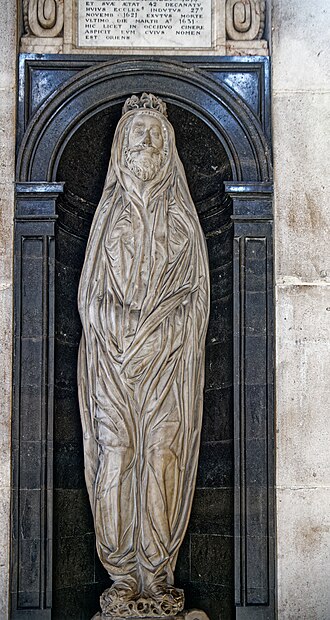
In 1612, John Donne accompanied Sir Robert Drury to Paris, leaving his pregnant wife in London.

Two days after their arrival there, Mr. Donne was left alone, in that room in which Sir Robert, and he, and some other friends had dined together. To this place Sir Robert return'd within half an hour; and, as he left, so he found Mr. Donne alone; but, in such Extasie, and so alter'd as to his looks, as amaz'd Sir Robert to behold him: insomuch that he earnestly desired Mr. Donne to declare what had befaln him in the short time of his absence? to which, Mr. Donne was not able to make a present answer: but, after a long and perplext pause, did at last say, I have seen a dreadful Vision since I saw you: I have seen my dear wife pass twice by me through this room, with her hair hanging about her shoulders, and a dead child in her arms: this, I have seen since I saw you. To which, Sir Robert reply'd; Sure Sir, you have slept since I saw you; and, this is the result of some melancholy dream, which I desire you to forget, for you are now awake. To which Mr. Donnes reply was: I cannot be surer that I now live, then that I have not slept since I saw you: and am, as sure, that at her second appearing, she stopt, and look'd me in the face, and vanisht.

Donne and Drury immediately sent a messenger to London. He returned to say that Mrs. Donne had borne a dead child at the hour her husband thought he had seen her in Paris.

(From Izaak Walton, Life of Dr John Donne, 1675)