A problem from the qualification round of the 2004/2005 Swedish Mathematical Contest, via the April 2009 issue of Crux Mathematicorum:
The cities A, B, C, D, and E are connected by straight roads (more than two cities may lie on the same road). The distance from A to B, and from C to D, is 3 km. The distance from B to D is 1 km, from A to C it is 5 km, from D to E it is 4 km, and finally, from A to E it is 8 km. Determine the distance from C to E.
This solution is by Titu Zvonaru of Comănești, Romania. The sum of the distances AB, BD, and DE (3 + 1 + 4) equals the distance AE (8), so cities A, B, D, and E lie on the same straight road. The square of distance AC (25) equals the sum of the squares of CD and AD (9 + 16), so by the converse of the Pythagorean theorem CD is perpendicular to AD. This means that CD and DE are the legs of a right triangle, and Pythagoras shows that hypotenuse CE is 5 km.
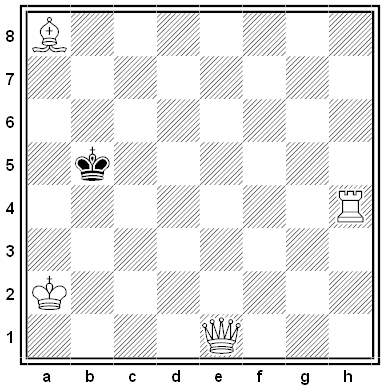
Note that the king can’t choose any other square. The eighth rank must remain free for the queen; e7 and f6 are vulnerable to knight checks; 1. Ke6 would block the queen’s check in the second variation; and 1. Kg6 would block the bishop’s diagonal in the first and second.
This divides the plane into three regions, here colored red, yellow, and blue. Placing the third house into any of these regions denies it access to the correspondingly colored utility. So the task is impossible.
Pleasingly, the task can be accomplished on a Möbius strip:
08/31/2025 UPDATE: Reader Guy Bolton King points out that Mathsgear sells a mug embossed with the puzzle. The joke here is that this makes the puzzle solvable — like the torus, the mug is of topological genus 1, “a blob with 1 hole in it,” so it admits the same solution.
And reader Shane Speck writes, “My sneaky solution … has always hinged on the fact that in reality, houses don’t all have separate pipes, and popping on a shared water pipe instantly reduces the problem to the status of incredibly trivial”:
“The problem doesn’t, after all, say you can’t do that… :)”
Mark two points on a line and label them 0 and 1, in that order. Now: In one move you can add or remove two neighboring points marked 0 0 or 1 1. Through a series of such moves, is it possible to arrive at a single pair of points labeled 1 0?
No. Below each 1, write the number of 0s to the right of it, then add up these numbers. At the start, this sum is 0, an even number, and after each move it remains even (either it remains unchanged or it increases or decreases by 2). The goal state would produce an odd sum, 1. So the task is impossible.
From Arthur Engel, Problem-Solving Strategies, 2008.
Victorian riddler (and Bishop of Winchester) Samuel Wilberforce offered this conundrum:
I have a large Box, with two lids, two caps, three established Measures, and a great number of articles a Carpenter cannot do without. – Then I have always by me a couple of good Fish, and a number of a smaller tribe, – besides two lofty Trees, fine Flowers, and the fruit of an indigenous Plant; a handsome Stag; two playful animals; and a number of a smaller and less tame Herd: – Also two Halls, or Places of Worship; some Weapons of warfare; and many Weathercocks: – The Steps of an Hotel; The House of Commons on the eve of a Dissolution; Two Students or Scholars, and some Spanish Grandees, to wait upon me.
All pronounce me a wonderful piece of Mechanism, but few have numbered up the strange medley of things which compose my whole.
Lewis Carroll seems to have loved it — he circulated copies to his friends and published this solution in 1866:
The Whole — is Man.
The Parts are as follows.
A large Box — The Chest.
Two lids — The Eye lids.
Two Caps — The Knee Caps.
Three established Measures — The nails, hands and feet.
A great number of articles a Carpenter cannot do without, — Nails.
A couple of good Fish — The Soles of the Feet.
A number of a smaller tribe — The Muscles (Mussels).
Two lofty Trees — The Palms (of the hands).
Fine Flowers — Two lips, (Tulips), and Irises.
The fruit of an indigenous Plant — Hips.
A handsome Stag — The Heart. (Hart).
Two playful Animals — The Calves.
A number of a smaller and less tame Herd — The Hairs. (Hares).
Two Halls, or Places of Worship — The Temples.
Some Weapons of Warfare — The Arms, and Shoulder blades.
Many Weathercocks — The Veins. (Vanes).
The Steps of an Hotel — The Insteps. (Inn-steps).
The House of Commons on the eve of a Dissolution — Eyes and Nose. (Ayes and Noes).
Two Students or Scholars — The Pupils of the Eye.
Some Spanish Grandees — The Tendons. (Ten Dons).