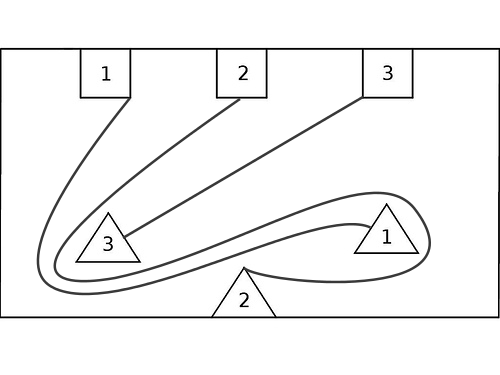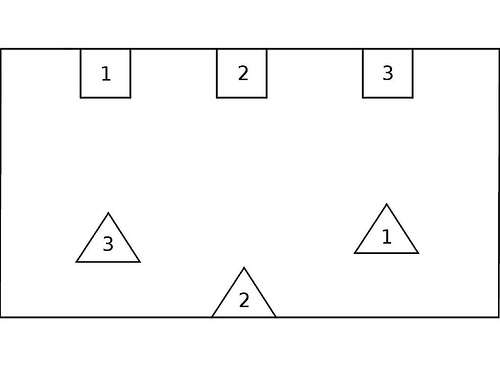
Here’s a simplified version of a classic puzzle by Sam Loyd. Connect each square to its triangle with a line. The lines must stay within the boundary and may not cross one another.

Here’s a simplified version of a classic puzzle by Sam Loyd. Connect each square to its triangle with a line. The lines must stay within the boundary and may not cross one another.

Fill one glass with wine and another with water. Transfer a teaspoonful of wine from the first glass into the second. Then transfer a teaspoonful of that mixture back into the first glass. Now, is there more wine in the water or water in the wine?
Most people will predict it’s the former, but in fact the two quantities will always be the same. Can you see why?
Only two U.S. state names can be typed with a single hand on a normal keyboard. What are they?
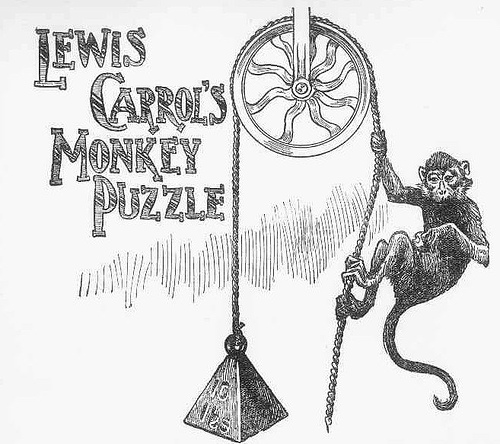
“Here is a quaintly told problem in mechanics, which, despite its apparent simplicity, is said to have caused Lewis Carroll considerable disquietude,” writes Sam Loyd in his Cyclopedia of 5000 Puzzles, Tricks, and Conundrums (1914). He quotes Carroll:
If, to a rope, passed over a loose pulley, is suspended a ten-pound counter weight, which balances exactly with a monkey eating an apple, swinging at the other end, what would be the result if the monkey attempts to climb the rope?
“It is very curious to note the different views taken by good mathematicians,” Carroll noted. “Price says the weight goes up with increasing velocity. Both Clifton and Harcourt maintain that the weight goes up at the same rate of speed as the monkey; while Sampson says that it goes down.”
So which is it? Be warned, Loyd’s thinking is inconclusive.
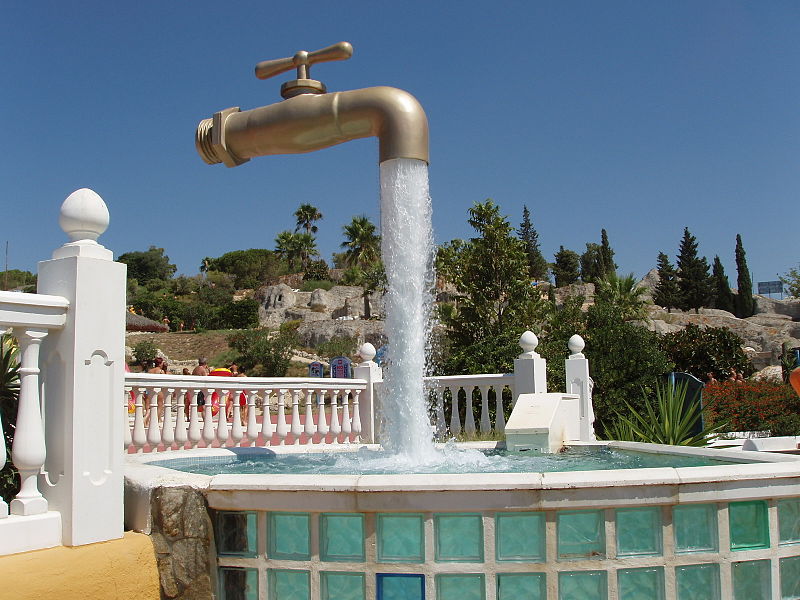
A “magic tap” continuously fills a basin in El Puerto de Santa María, Spain. How is this possible?
What happens when an irresistible force meets an immovable object?
It can’t happen. If a force is irresistible, then by definition there’s no such thing as an immovable object (and vice versa).
This puzzle has been attributed both to Lewis Carroll and to Albert Einstein:
Who drinks water? Who owns the zebra?
No one knows much about Diophantus, the Greek mathematician, but in the sixth century a math puzzle purported to give his epitaph:
“This tomb holds Diophantus. Ah, what a marvel! And the tomb tells scientifically the measure of his life. God vouchsafed that he should be a boy for the sixth part of his life; when a twelfth was added, his cheeks acquired a beard; He kindled for him the light of marriage after a seventh, and in the fifth year after his marriage He granted him a son. Alas! late-begotten and miserable child, when he had reached the measure of half his father’s [total] life, the chill grave took him. After consoling his grief by this science of numbers for four years, he reached the end of his life.”
At what age did he die?
The maker doesn’t need it.
The buyer doesn’t use it.
The user doesn’t know he’s using it.
What is it?
A child releases a toy boat in a stream that flows at 3 miles an hour. At that instant, a kayaker 14 miles downstream begins paddling upstream at 7 miles per hour. How long will it take him to reach the toy?