In this original logic puzzle by the Japanese publisher Nikoli, the goal is to connect lattice points to draw a closed loop so that each number in the grid denotes the number of sides on which the finished loop bounds its cell, as above: Each cell bearing a “1” is bounded on 1 side, a “2” on 2 sides, and so on.
Here’s a moderately difficult puzzle. Can you solve it? (A loop that merely touches a cell’s corner point without passing along any side is not considered to bound it.)
A puzzle by University College London mathematician Matthew Scroggs: A princess lives in a row of 17 rooms. Each day she moves to a new room adjacent to the last one (e.g., if she sleeps in Room 5 on one night, then she’ll sleep in Room 4 or Room 6 the following night). You can open one door each night. If you find her you’ll become her prince. Can you find her in a finite number of moves?
Here’s one way to do it. Imagine a chessboard with 17 files and a large number of ranks. Each file represents one room, and each rank represents one night. On each night (rank), mark the room (square) where the princess is sleeping. Because the princess moves to an adjacent room each day, the marker will always move “diagonally” on the board, and hence will always occupy squares of the same color.
Check the 17th room on the first night, the 16th on the second night, and so on. Suppose the 17th square in the first row is white. If the princess started on a white square, this will find her, as the diagonal you’re drawing must eventually intercept her path.
If you reach Room 1 without finding her, this means she’s been traversing black squares. Go immediately back to Room 17 (which will be represented by a black square on row 18), and work your way down as before. This time your paths must cross.
From Raymond Smullyan: Every inhabitant of this island either a knight or a knave. Knights always tell the truth, and knaves always lie. Further, every inhabitant is either mad or sane. Sane inhabitants always answer questions correctly, and mad ones always answer incorrectly. You meet an inhabitant of the island and want to know whether he’s sane or mad. How can you determine this with a single yes-or-no question?
Ask, “Are you a knight?” A sane knight will say yes, a mad knight will say no, a sane knave will say yes, and a mad knave will say no. So a sane inhabitant will answer yes and a mad inhabitant will answer no.
From Logical Labyrinths, 2009. Obligatory John Finnemore sketch:
From the prolifically interesting Catriona Shearer: The red line is perpendicular to the bases of the three semicircles. What’s the total area shaded in yellow?
At first it appears there’s not enough information, but there is! No matter the relative sizes of the two smaller semicircles, the area of the shaded region is π.
It’s easy to solve this by writing a program to try all possibilities, but reasoning it out is tricky. Donald Aucamp gives one solution in MIT Technology Review, March 2002.
03/18/2019 UPDATE: I should have explained that the double asterisks in the denominators are two-digit numbers. Interestingly, there are two other interpretations that both yield answers! Reader Nick Berry sent this:
I have picked one color (black or white) and one shape (square or circle). A symbol that possesses exactly one of the properties I have picked is called a THOG. The black circle is a THOG. For each of the other symbols, is it (a) definitely a THOG, (b) undecidable, or (c) definitely not a THOG?
Cognitive psychologist Peter Wason invented this puzzle in 1979 to demonstrate some weaknesses in human thinking. In pilot studies, 0 of 10 student barristers were able to solve it correctly, with one arguing for more than an hour against the correctness of Wason’s solution. Seven of 14 medical students solved it, taking an average of 6.3 minutes. (“This is quite an impressive result.”) One young doctor solved it in his head in about a minute and said, “I would not let any doctor near me who couldn’t solve that problem.” What’s the answer?
In saying “I have picked one color and one shape,” in effect I am saying, “I have picked one of the symbols.” I can’t have chosen the black circle, because we know that symbol has only one of the required attributes. The symbol I’ve chosen must be either the black square or the white circle. Either way, the white square would match my choice in exactly one particular, so it’s definitely a THOG. If I’ve chosen the black square then the black square has both chosen attributes and the white circle has neither; equally, if I’ve chosen the white circle then the white circle has both chosen attributes and the black square has neither. Either way, neither of these symbols is a THOG. So the white square is definitely a THOG and the other two symbols definitely aren’t.
“In one sense the THOG problem is utterly trivial,” writes Wason. “And yet it is non-trivial in the sense that it is astonishingly easy for some individuals and astonishingly difficult for others. At the very least it does seem a cogent test of formal operational thought in an abstract sphere.” See the link below for more details.
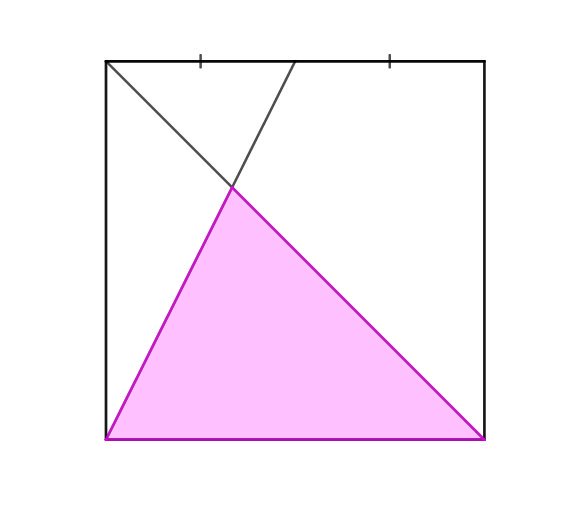
Draw a line from each vertex to the interior point where the four regions meet. This divides each region into two triangles. On each side of the large figure (north, south, east, and west), two of these triangles are neighbors and have the same area (because they have the same base and height) (here’s a figure).
The four triangles that make up the northeast and southwest regions have the same area as the four triangles that make up the northwest and southeast regions. This means that each pair of diagonally opposite regions makes up half the total area of the figure. So the missing area is 28 cm2.
02/24/2019 Reader Bill Bowser sent this diagram (thanks, Bill):
You’re holding a penny, and you’re standing on an infinite plane. The plane bears a grid of squares, each of which is twice the width of the penny. If you roll the penny out onto the grid, what is the probability that it will come to rest entirely within a square? (Assume the lines are of negligible thickness.)
If the penny is to lie entirely within a square, then its center must fall within a square region one radius from the square’s edge. That region is the width of a penny, or one-fourth the square’s total area. So the probability is 1/4.