Science & Math
Upside Down

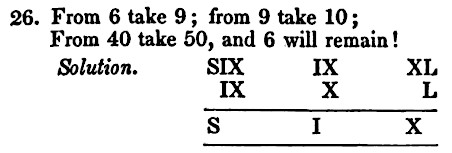
A doubly true equation by Basile Morin.
Grime Dice
This remarkable phenomenon was discovered by Cambridge mathematician James Grime. Number five six-sided dice as follows:
A: 2, 2, 2, 7, 7, 7
B: 1, 1, 6, 6, 6, 6
C: 0, 5, 5, 5, 5, 5
D: 4, 4, 4, 4, 4, 9
E: 3, 3, 3, 3, 8, 8
Now, on average:
A beats B beats C beats D beats E beats A
and
A beats C beats E beats B beats D beats A.
Interestingly, though, if each die is rolled twice rather than once, then the first of the two chains above remains unchanged except that D now beats C — and the second chain is reversed:
A beats D beats B beats E beats C beats A.
As a result, if each of two opponents chooses one of the five dice, a third opponent can always find a remaining die that beats them both (so long as he’s allowed to choose whether the dice will be rolled once or twice).
(Ward Heilman and Nicholas Pasciuto, “What Nontransitive Dice Exist Among Us?,” Math Horizons 24:4 [April 2017], 14-17.)
“Have You Seen This One?”
From Pi Mu Epsilon Journal, November 1950:
(1/2)3 < (1/2)2.
Taking the logarithm to the base 1/2 of each member of the above inequality, we write
3 log1/2(1/2) < 2 log1/2(1/2).
But logbb = 1. Therefore
3 < 2.
Blowback

Several claimants have been put forth as the originators of the modern tropical cyclone ‘naming’ system. Australian weather meteorologist, Clement L. Wragge, is one of the best-established holders of the title. … Most ingeniously, he gained a measure of personal revenge by christening some of the nastiest storms with politicians’ names such as Drake, Barton, and Deakin. Modern hurricane researcher Chris Landsea noted that, by using such a personal naming system, Wragge could publicly describe a politician (say one who was less than generous with weather-bureau appropriations) as ‘causing great distress’ or ‘wandering aimlessly about the Pacific.’
— Randy Cerveny, Freaks of the Storm, 2006
All in the Wrist
All Right Then

According to Frank M. Chapman’s Color Key to North American Birds (1912), the hooded warbler sings You must come to the woods, or you won’t see me.
Mnemonics

Ohm’s law states that V = IR, where V is the voltage measured across a conductor, I is the current through the conductor, and R is the conductor’s resistance. In the image mnemonic at left (easily remembered by the word “viral”), covering any of the unknowns gives the formula in terms of the remaining parameters: V = IR, I = V/R, R = V/I.
Wikimedia user CMG Lee has devised other mnemonics in the same style for high-school physics students (right). For example, F = ma, m = F/a, a = F/m. In the corresponding SVG file you can hover over a symbol to see its meaning and formula.
Many Worlds

An illusion by University of Texas engineer David Novick: All the spheres have the same light-brown base color (RGB 255,188,144). The intervening foreground stripes seem to impart different hues. See this Twitter thread for the same image with the foreground stripes removed.
Good Advice
Have the love and fear of God ever before thine eyes; God confirm your faith in Christ and that you may live accordingly, Je vous recommende a Dieu. If you meet with any pretty insects of any kind keep them in a box.
— Sir Thomas Browne, letter to his son, 1661