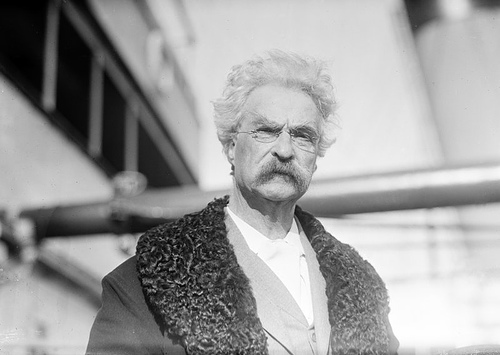
“Only kings, presidents, editors, and people with tapeworms have the right to use the editorial ‘we.'” — Mark Twain

“Only kings, presidents, editors, and people with tapeworms have the right to use the editorial ‘we.'” — Mark Twain
A monkey has one chance in 19,928,148,895,209,409,152,340,197,376 of correctly typing the first 20 letters of Hamlet (ignoring punctuation, spacing, and capitalization).
And Hamlet contains more than 130,000 letters.
Curious how a new book was selling, Victor Hugo wired his publisher:
?
He got this reply:
!

Virgil’s Aeneid contains arguably the first written reference to pizza:
Their homely fare dispatch’d, the hungry band
Invade their trenchers next, and soon devour,
To mend the scanty meal, their cakes of flour.
Ascanius this observ’d, and smiling said:
“See, we devour the plates on which we fed.”
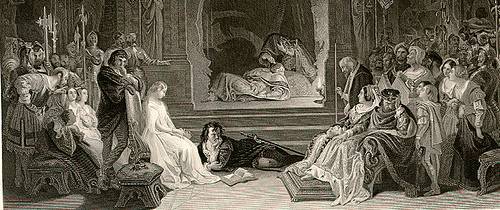
Hamlet’s “to be or not to be” soliloquy, in Klingon:
taH pagh taHbe’. DaH mu’tlheghvam vIqelnIS.
quv’a’, yabDaq San vaQ cha, pu’ je SIQDI’?
pagh, Seng bIQ’a’Hey SuvmeH nuHmey SuqDI’,
‘ej, Suvmo’, rInmoHDI’? Hegh. Qong — Qong neH —
‘ej QongDI’, tIq ‘oy’, wa’SanID Daw”e’ je
cho’nISbogh porghDaj rInmoHlaH net Har.
yIn mevbogh mIwvam’e’ wIruchqangbej.
Hegh. Qong. QongDI’ chaq naj. toH, waQlaw’ ghu’vam!
HeghDaq maQongtaHvIS, tugh nuq wInajlaH,
volchaHmajvo’ jubbe’wI’ bep wIwoDDI’;
‘e’ wIqelDI’, maHeDnIS. Qugh DISIQnIS,
SIQmoHmo’ qechvam. Qugh yIn nI’moH ‘oH.
It either endures, or it does not endure. Now, I must consider this sentence.
Is it honorable, when one endures the torpedoes and phasers of agressive fate?
Or, when one obtains weapons to fight a seeming ocean of troubles,
And when, by fighting, one finishes them? One dies. One sleeps. One merely sleeps.
And when one sleeps, it is believed that one can finish the pain of the heart
And the thousand revolts which one’s body must succeed to.
We are certainly willing to initiate this way to finish life.
One dies. One sleeps. When one sleeps, perhaps one dreams. Well, this situation seems to be the obstacle!
What we can soon dream of, while sleeping in death,
Having thrown away from our shoulders the cargo of the mortal —
When we consider that, we must retreat. We must endure disasters,
Because this idea makes us endure them. It lengthens the life of the disasters.
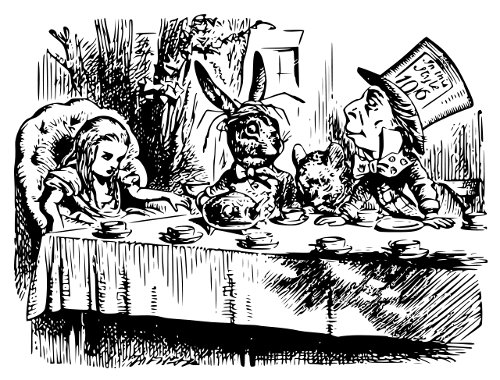
Everyone likes a good riddle. In Chapter 7 of Alice’s Adventures in Wonderland, the Mad Hatter poses a famous one: “Why is a raven like a writing desk?” Lewis Carroll intended that it should have no solution, but puzzle maven Sam Loyd offered these anyway:
In 1896, Carroll proposed an answer himself: “Because it can produce a few notes, tho they are very flat; and it is nevar put with the wrong end in front!” (“Nevar” is “raven” spelled backward.)
In 1732, Alexander Pope gave a greyhound to King George II, to be kept at the royal kennels near Hampton Court. He engraved this on the dog’s collar:
I am his Highness’ dog at Kew;
Pray tell me, sir, whose dog are you?
“I mean, it’s a great story. It’s got some great things in it. I mean, there’s something like eight violent deaths.” — Mel Gibson, on reasons to like Hamlet

A man said to the universe:
“Sir, I exist!”
“However,” replied the universe,
“The fact has not created in me
“A sense of obligation.”
— Stephen Crane
A desperate letter from Edgar Allan Poe to his Philadelphia publishers, Aug. 13, 1841:
Gentlemen, — I wish to publish a new collection of my prose Tales with some such title as this —
“The Prose Tales of Edgar A. Poe, Including ‘The Murders in the Rue Morgue.’ The ‘Descent into the Maelstrom,’ and all his later pieces, with a second edition of the ‘Tales of the Grotesque and Arabesque.'”
The “later pieces” will be eight in number, making the entire collection thirty-three — which would occupy two thick novel volumes.
I am anxious that your firm should continue to be my publishers, and, if you would be willing to bring out the book, I should be glad to accept the terms which you allowed me before — that is — you receive all profits, and allow me twenty copies for distribution to friends.
They turned him down in three days flat. A century later, at a 1944 auction, the letter itself fetched $3,000.