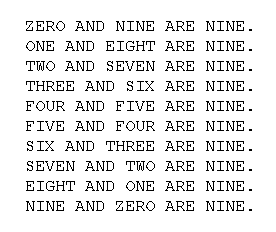
Of all the odd numbers, which would appear first in a dictionary?
EIGHT BILLION EIGHT HUNDRED EIGHT MILLION EIGHT HUNDRED EIGHT THOUSAND EIGHT HUNDRED EIGHTY-FIVE (8,808,808,885).
(Thanks, Michael.)
Of all the odd numbers, which would appear first in a dictionary?
EIGHT BILLION EIGHT HUNDRED EIGHT MILLION EIGHT HUNDRED EIGHT THOUSAND EIGHT HUNDRED EIGHTY-FIVE (8,808,808,885).
(Thanks, Michael.)
When, at the General Peace of 1814, Prussia absorbed a portion of Saxony, the king issued a new coinage of rix dollars, with their German name, EIN REICHSTAHLER, impressed on them. The Saxons, by dividing the word, EIN REICH STAHL ER, made a sentence of which the meaning is, ‘He stole a kingdom!’
— William T. Dobson, Poetical Ingenuities and Eccentricities, 1882
zenzizenzizenzic
n. a number raised to the eighth power
A medal struck of the 17th-century Swedish king Gustavus Adolphus included this motto:
ChrIstVs DuX ergo trIVMphVs
Rearrange the capital letters and you get MDCXVVVII, or 1627, the year in which the medal was stamped.
That’s a chronogram, and a pretty tame one, as these things go. In 1634 the Society of Jesuits at Brussels composed a remarkable congratulation to Ferdinand on his arrival in the Netherlands as governor; it contains 100 hexameters, every one of which is a chronogram adding to 1634:
AngeLe CoeLIVagI MIChaeL, LVX VnICa CaetVs.
Pro nVtV sVCCInCta tVo CVI CVnCta MInIstrant.
SIDera qVIqVe poLo gaVDentIa sIDera VoLVVnt. …
“Genius,” wrote Thomas Carlyle, “is an infinite capacity for taking pains.”
aidle
v. “to earn one’s bread indifferently well”
(Charles Mackay, Lost Beauties of the English Language, 1874)

Bach’s name forms a musical motif. The German note B is equivalent to the English B-flat, and H indicates B natural. So if you revolve this cross counterclockwise, the note at the center takes successively the German values B (treble clef), A (tenor clef), C (alto clef), and H (treble clef).
Bach himself used the four-note motif as a subject in The Art of Fugue, and it’s appeared since in works by Schumann, Liszt, Rimsky-Korsakov, Poulenc, and Webern.
Punch has favored the world with the following song, sung before her Britannic Majesty by a Chinese lady. It looks rather difficult at first; but if the reader studies it attentively, he will see how easy it is to read Chinese:–
Ohc ometo th ete asho pwit hme,
Andb uya po undo f thebe st,
‘Twillpr oveam ostex cellentt ea,
Itsq ua lit yal lwi lla tte st.‘Tiso nlyf oursh illi ngs apo und,
Soc omet othet eama rtan dtry,
Nob etterc anel sewh erebefou nd,
Ort hata nyoth er needb uy.
— Charles Carroll Bombaugh, Gleanings for the Curious from the Harvest-Fields of Literature, 1890
The Rev. Ralph William Lyonel Tollemache-Tollemache (1826–1895) got a bit carried away in naming his children:
Lyulph’s name forms an acronym, LYONEL THE SECOND. In Finnegans Wake, Joyce parodied this with Helmingham Erchenwyne Rutter Egbert Crumwall Odin Maximus Esme Saxon Esa Vercingetorix Ethelwulf Rupprecht Ydwalla Bentley Osmund Dysart Yggdrasselmann — whose initials spell HERE COMES EVERYBODY.
mislive
v. to lead a wicked life
TO BE LET,
To an Oppidan, a Ruricolist, or a Cosmopolitan, and may be entered upon immediately:The House in STONE Row, lately possessed by CAPT. SIREE. To avoid Verbosity, the Proprietor with Compendiosity will give a Perfunctory description of the Premises, in the Compagination of which he has Sedulously studied the convenience of the Occupant. It is free from Opacity, Tenebrosity, Fumidity, and Injucundity, and no building can have greater Pellucidity or Translucency — in short, its Diaphaneity even in the Crepuscle makes it like a Pharos, and without laud, for its Agglutination and Amenity, it is a most Delectable Commorance; and whoever lives in it will find that the Neighbors have none of the Truculence, the Immanity, the Torvity, the Spinosity, the Putidness, the Pugnacity, nor the Fugacity observable in other parts of the town, but their Propinquity and Consanguinity occasion Jocundity and Pudicity — from which, and the Redolence of the place (even in the dog-days), they are remarkable for Longevity. For terms and particulars apply to JAMES HUTCHINSON, opposite the MARKET-HOUSE.
— “Dub. News.,” quoted in Charles Carroll Bombaugh, Gleanings for the Curious from the Harvest-Fields of Literature, 1890