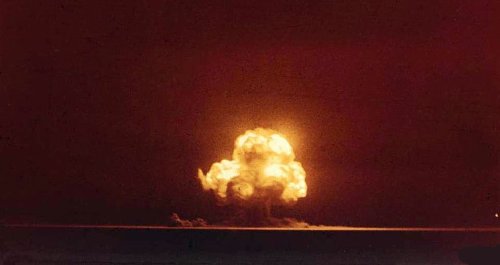
In August 1945, about 500 Manhattan Project alumni founded the Association of Los Alamos Scientists to educate the public about nuclear energy.
They stressed the first syllable of the acronym.

In August 1945, about 500 Manhattan Project alumni founded the Association of Los Alamos Scientists to educate the public about nuclear energy.
They stressed the first syllable of the acronym.

The following anagram on the original name of Napoleon I, the most renowned conqueror of the age in which he lived, may claim a place among the first productions of this class, and fully shows in the transposition, the character of that extraordinary man, and points out that unfortunate occurrence of his life which ultimately proved his ruin. Thus: ‘Napoleon Bonaparte’ contains ‘No, appear not on Elba.’
— Kazlitt Arvine, Cyclopaedia of Anecdotes of Literature and the Fine Arts, 1856

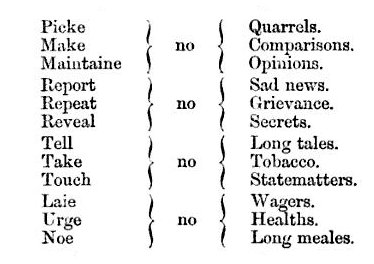
When Edward VI succeeded to the throne at age 9, William Thomas, clerk of the council, set him 85 questions on history and policy to answer at his leisure. “For though these be but questions, yet there is not so small an one among them, as will not administer matter of much discourse, worthy the argument and debating.” Samples:
Thomas closes by suggesting that Edward keep the questions to himself, since it is better “to keep the principal things of wisdom secret, till occasion require the utterance.”

One day the elderly soldier [Arthur Wellesley, first Duke of Wellington] chanced on a small boy weeping bitterly and on asking the cause the child began to explain that he was going away to school next day … not waiting to hear more the Duke read him a severe lecture on his attitude, which was cowardly, unworthy of a gentleman and not at all the way to behave, etc. At last the little boy managed to explain he was not crying because he was going to school, but he was worried about his pet toad, as no one else seemed to care for it and he wouldn’t know how it was. The Duke, a just man, apologized to the child for having wronged him, and being human as well as just, took down the particulars and promised to report himself about this pet. In due course the little boy at school received a letter saying ‘Field-Marshal the Duke of Wellington presents his compliments to Master —– and has the pleasure to inform him that his toad is well.’
— G.W.E. Russell, Collections and Recollections, 1963
“One of the lessons of history is that nothing is often a good thing to do and always a clever thing to say.” — Will Durant

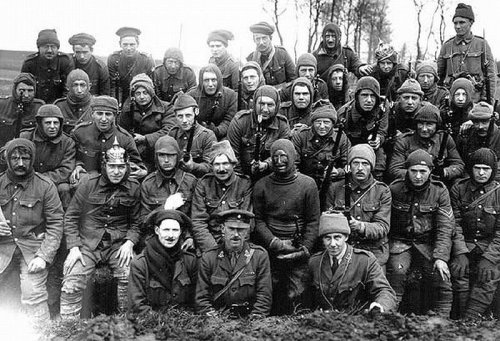
After the First Battle of Manassas, a reporter for the Richmond Dispatch discovered a Confederate soldier tending to a wounded Union infantryman.
“Yes, sir, he is my brother Henry,” he said. “The same mother bore us, the same mother nursed us. We met for the first time in four years. I belong to the Washington Artillery, from New Orleans–he to the First Minnesota Infantry. By the merest chance I learned he was here wounded, and sought him out to nurse and attend to him.”
“Thus they met,” the reporter wrote, “one from the far North, the other from the extreme South–on a bloody field in Virginia, in a miserable stable, far away from their mother, home and friends, both wounded–the infantry man by a musket ball in the right shoulder, the artillery man by the wheel of a caisson over his left hand. Their names are Frederick Hubbard, Washington Artillery, and Henry Hubbard, First Minnesota Infantry.”

“The sound of Niagara Falls outdates our most cherished antiquities.” — J.O. Urmson
In 1809, the Spanish town of Huéscar declared war on Denmark during the Napoleonic wars over Spain.
The war was forgotten until 1981, when a local historian discovered the declaration.
In 172 years of warfare, not a single person had been killed or injured.

Button Gwinnett was a relatively obscure member of the Continental Congress when he signed the Declaration of Independence in August 1776. Nine months later he was killed in a duel.
That makes his signature one of the most valuable in the world, comparable to those of Julius Caesar and William Shakespeare. Only 51 examples exist. This January it was discovered that he’d signed a Wolverhampton marriage register in 1757, five years before departing England for America. That autograph was valued at £500,000.

On Oct. 25, 1944, during battle in the Philippine Sea, Chester Nimitz sent this message to William Halsey, asking for his location:
TURKEY TROTS TO WATER GG FROM CINCPAC ACTION COM THIRD FLEET INFO COMINCH CTF SEVENTY-SEVEN X WHERE IS RPT WHERE IS TASK FORCE THIRTY FOUR RR THE WORLD WONDERS
The language before GG and after RR is nonsense added to discourage cryptanalysis. Unfortunately, Halsey’s radio officer neglected to remove the trailing phrase, and Halsey read:
Where is, repeat, where is Task Force Thirty Four? The world wonders.
“I was stunned as if I had been struck in the face,” Halsey wrote later. “The paper rattled in my hands, I snatched off my cap, threw it on the deck, and shouted something I am ashamed to remember.” Furious at Nimitz’ “gratuitous insult,” he delayed an hour before rejoining the battle. He learned the truth only weeks later.
(Thanks, Ankit.)