In a solar eclipse, the moon casts its shadow on Earth. In a lunar eclipse, Earth casts its shadow on the moon.
Solar eclipses are more common than lunar eclipses, but we tend to have the opposite impression. Why?
|
SelectClick for Answer> |
Because the moon’s shadow is smaller than Earth’s, a total solar eclipse is visible only from within a relatively narrow latitude on Earth’s surface, while a lunar eclipse is visible from anywhere on the night side of the planet. For the same reason, a total solar eclipse lasts for only a few minutes at any given location, while a lunar eclipse lasts for several hours.
|
Aug 20, 2012 | Categories: Puzzles

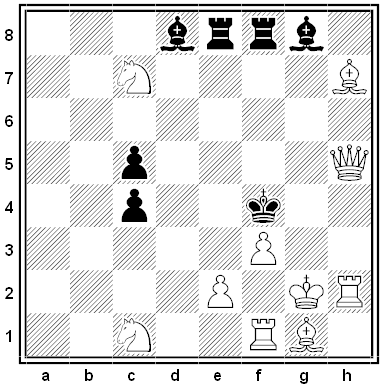
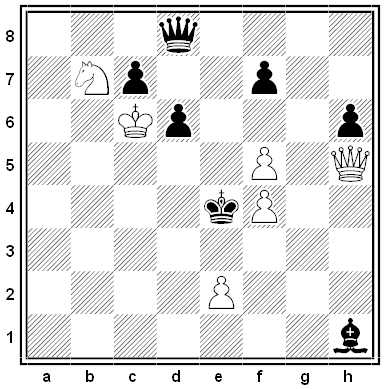
By Philip Hamilton Williams, Evening News and Post, 1895. White to mate in two moves.
Aug 17, 2012 | Categories: Puzzles
Mount Everest rises 29,029 feet above sea level, and Ecuador’s volcano Chimborazo rises only 20,702 feet. But because Earth bulges at the equator, Chimborazo is actually farther from the center of the planet. If we could connect the two peaks with a water pipe, in which direction would the water flow?
|
SelectClick for Answer> |
Sea level gives us a convenient equilibrium water level. Since Everest rises higher, the water would flow toward Chimborazo.
|
Aug 12, 2012 | Categories: Puzzles

By W. Timbrell Pierce, 1873. White to mate in two moves.
Aug 10, 2012 | Categories: Puzzles
Imagine two concentric roulette wheels, each divided into 100 sectors. Choose 50 sectors at random on each wheel, paint them black, and paint the rest white. Prove that we can now position the wheels so that at least 50 of the aligned sectors match.
|
SelectClick for Answer> |
Follow a sector on the inner wheel through a complete revolution: That sector will find exactly 50 matches. The same is true for each of the 100 sectors on the wheel; altogether, as the wheel turns through 100 positions, there will be 100 × 50 = 5,000 matches. This means that the average number of matches per position is 50, so a position must exist with at least 50 matches.
|
Aug 9, 2012 | Categories: Puzzles

A carnival worker is asked to paint the deck of a carousel. Because the center of the carousel is occupied by machinery, he can’t measure its diameter or even its radius. The best he can do is to take the measurement shown in green, which is 42 feet.
He’s explaining this apologetically when his supervisor stops him. “That’s all the information we need,” he says. “That’s enough to tell us how much paint to buy.”
How did they go about it?
|
SelectClick for Answer> |

The area of the deck is the area of the large circle minus the small circle. That’s πA2 – πB2, or π(A2 – B2).
We don’t know A or B, but we do know the length of the green line. That’s 42. So the Pythagorean theorem can tell us that B2 + 212 = A2, and hence that 212 = A2 – B2. Happily, we can plug this directly into the equation above and get our answer: The area of the deck is 212π, or 441π square feet — regardless of the size of the carousel!
Remarkably, this is true — so long as the green chord stays locked in position between them, the two circles can assume any size and the difference in their areas will remain constant. A similar principle holds in three dimensions.
In The Universal Book of Mathematics, David Darling writes, “An even more amazing fact is that if you slide a chord of fixed length around any convex shape C so that the chord’s midpoint traces out another figure D, the area between C and D doesn’t depend on what shape you started with.”
(Thanks, Dave.)
|
Aug 8, 2012 | Categories: Puzzles
Alice gets a rocket-powered pogo stick for her birthday. She jumps 1 foot on the first hop, 2 feet on the second, then 4, 8, and so on. This gets alarming. By judicious hopping, can she arrange to return to her starting point?
|
SelectClick for Answer> |
No. After n hops, Alice will have traveled at most 1 + 2 + 4 + … + 2n-1 = 2n – 1 feet from the starting point. But her very next hop will carry her 2n feet. So she must always overshoot the goal.
|
Aug 7, 2012 | Categories: Puzzles

You’re alone on a desert island and want to lay out a course for some snail races. Unfortunately, you have only an 8.5 x 11 inch sheet of paper. How can you use it to measure exactly 3 inches?
|
SelectClick for Answer> |
Here are two ways:
- “Dog-ear” the page, folding one corner across to the opposite side. The area below the dog-eared portion measures 8.5 x 2.5. Reopen the paper and fold this 8.5 x 2.5 portion up into the page. The area that remains uncovered measures 8.5 x 6; it can be folded in half to produce a height of 3 inches.
- Fold the paper in half to make a doubled sheet measuring 5.5 x 8.5. Now “dog-ear” this doubled page, folding one corner across to the opposite side. The area below the dog-eared portion measures 5.5 x 3.
|
Aug 6, 2012 | Categories: Puzzles

You and a friend are playing a game. Between you is a pile of 15 pennies. You’ll take turns removing pennies from the pile — each of you, on his turn, can choose to remove 1, 2, or 3 pennies. The loser is the one who removes the last penny.
You go first. How should you play?
|
SelectClick for Answer> |
Consider what happens if you leave your opponent 5 pennies. At that point, no matter how many he removes, you can play so as to leave the final penny to him. Now, if leaving him 5 pennies is a worthy target, then by the same principle so is leaving him 9 pennies: No matter how he plays, he must now give you the opportunity to leave him with 5. And going one step further, aiming for 13 pennies will ensure that you can reach 9, then 5, and victory. So, on your first turn, take 2 pennies.
|
Aug 5, 2012 | Categories: Puzzles
I release a fish at the edge of a circular pool. It swims 80 feet in a straight line and bumps into the wall. It turns 90 degrees, swims another 60 feet, and hits the wall again. How wide is the pool?
|
SelectClick for Answer> |

It sounds as if there’s not enough information to solve this, but there is if you remember that when a right triangle is inscribed in a circle, its hypotenuse is the diameter. The pool is 100 feet wide.
|
Aug 4, 2012 | Categories: Puzzles

By Bertha Fleischmann. White to mate in two moves.
Aug 3, 2012 | Categories: Puzzles

Fifty-five chameleons live on a tropical island. Thirteen are green, 19 are brown, and 23 are gray. Whenever two chameleons of different colors meet, both change to the third color. Is it possible that all 55 chameleons might eventually be the same color?
|
SelectClick for Answer> |
Yes. Let x, y, and z be the number of green, brown, and gray chameleons, and consider the remainders left when each of the quantities x-y, x-z, and y-z is divided by 3. These remainders won’t change as the chameleons vary their colors. This means that if two populations are to reach 0 simultaneously, they must differ now by a multiple of 3. In this case two do: The populations of green and brown chameleons differ by 6, so it’s possible for both to disappear without any leftovers:
13, 19, 23
15, 18, 22
17, 17, 21
… and then green and brown chameleons can disappear in pairs until all have turned gray.
From Dick Hess, All-Star Mathlete Puzzles, 2009.
|
Jul 31, 2012 | Categories: Puzzles

What’s the longest month of the year in London?
Jul 30, 2012 | Categories: Puzzles
Fourteen ladders stand in a row. At the foot of each ladder is a monkey; at the top is a banana. Festooning the ladders are an arbitrary number of ropes. Each rope connects a rung on one ladder to a rung on another, but no rung receives more than one rope.
At a signal all 14 monkeys begin climbing. If a monkey encounters a rope it climbs along it to the other end and then continues climbing upward. Show that every monkey gets a banana.
|
SelectClick for Answer> |
Imagine the process in reverse. If Monkey 1 reaches Banana G and then descends again according to the same rules, it will return to the foot of Ladder 1; its path is uniquely determined. Further, because there’s no occasion for loops or dead ends, each monkey will eventually reach the top of some ladder. If every monkey reaches a goal, and no two monkeys reach the same goal, then every monkey gets a banana. The solution generalizes to any number of ladders.
|
Jul 28, 2012 | Categories: Puzzles

By F.C. Collins. White to mate in two moves.
Jul 27, 2012 | Categories: Puzzles
You have 13 reels of magnetic tape, one empty reel, and a machine that will wind tape from a full reel to an empty one, reversing its direction. You need all 13 tapes reversed on their original reels. Show how this can be done, or prove that it’s impossible.
|
SelectClick for Answer> |
It’s impossible. Each of the 13 reels must go through an even number of transfers in order to finish with its original tape. (Likewise, the empty reel must go through an even number of transfers to remain empty.) But each of the 13 tapes must be transferred an odd number of times to end up reversed. So the total number of transfers must be both even and odd, an impossibility.
|
Jul 23, 2012 | Categories: Puzzles

Which of these triangles has the greater area?
Jul 21, 2012 | Categories: Puzzles

By H. Van Beek, Chemnitzer Wochenschach, 1926 (special prize). White to mate in two moves.
Jul 20, 2012 | Categories: Puzzles

A tank of water has two holes of equal area, one at top and one at bottom. The top one leads to a downspout, so that both holes discharge their water at the same level. Ignoring friction, which hole produces the faster flow of water?
You actually don’t need to know the physics in order to solve this — it yields to an insight.
|
SelectClick for Answer> |

The water flows from both openings at the same rate. If it didn’t, we could connect the two to create a perpetual-motion machine.
(From Lewis Epstein’s Thinking Physics Is Gedanken Physics, 1989.)
|
Jul 19, 2012 | Categories: Puzzles, Science & Math

Foaled in 1773, this thoroughbred racehorse bore the unlikely name of Potoooooooo.
How was it pronounced?
Jul 16, 2012 | Categories: Puzzles

By P. Klett. White to mate in two moves.
Jul 13, 2012 | Categories: Puzzles

A shoelace is lying on the floor, and I’m too nearsighted to see how the lace crosses itself at points A, B, and C. If I pull on the ends, what’s the probability that it will produce a knot?
|
SelectClick for Answer> |
One in four. There are three intersections, so there are eight possible ways the lace can cross itself. Of these, only two (over/under/over and under/over/under) will produce a knot.
|
Jul 10, 2012 | Categories: Puzzles

In 1908, two years before drawing against Emanuel Lasker for the world chess championship, Carl Schlechter published this problem in the Allgemeine Sportzeitung. White to mate in two moves:
Jul 6, 2012 | Categories: Puzzles

What location on this line segment has the smallest sum of distances to the labeled points?
|
SelectClick for Answer> |
Consider first the endpoints, A and K: The sum of the distances to these two points will be the same for any point between them. Similarly, any point between B and J will have the same total distance to points A, K, B, and J. Proceeding in this way and taking the points in pairs, we find that every point between E and G produces the same total distance to the outermost 10 labeled points. That leaves only F. So the answer is that point F has the minimum total distance to the labeled points.
Strangely, this means that we can shift the points around without affecting this result. If points A through E crowded F closely on the left, and point K were 90 light-years away on the right, point F would still yield the smallest total sum, so long as the points appeared in the order shown above.
|
Jun 30, 2012 | Categories: Puzzles