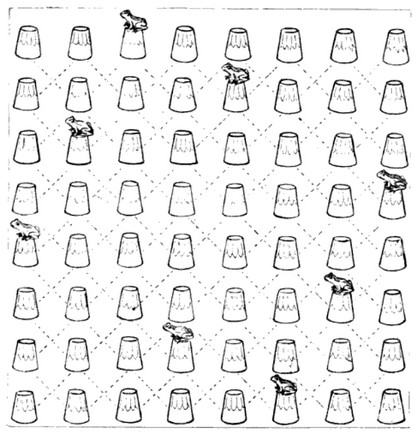
Round Trip
A man eats breakfast at his camp, then travels due south. After going 10 miles in a straight line he stops for lunch. Then he sets out again due south. After going 10 miles in a straight line he finds himself back at camp. Where is he?
Wait, What?
When the day after tomorrow is yesterday, today will be as far from Sunday as today was from Sunday when the day before yesterday was tomorrow. What day is it?
“Grammatical Puzzle”
Let the rich, great, and noble banquet in the festal halls,
And pass the hours away, as the most thoughtless revel;
Then seek the poor man’s dreary home, whose very dingy walls
Proclaim full well to all how low his rank and level.
“Take away one letter from a word in the above stanza, and substitute another, leaving the word so metamorphosed still a word of the English language; and, by that change, totally alter the syntactical construction of the whole sentence, changing the moods and tenses of verbs, turning verbs into nouns, nouns into adjectives, and adjectives into adverbs, &c., and so make the entire stanza bear quite a different meaning from that which it has as it stands above.”
Varying Reports
Which statements on this list are true?
- Exactly one statement on this list is false.
- Exactly two statements on this list are false.
- Exactly three statements on this list are false.
- Exactly four statements on this list are false.
- Exactly five statements on this list are false.
- Exactly six statements on this list are false.
- Exactly seven statements on this list are false.
- Exactly eight statements on this list are false.
- Exactly nine statements on this list are false.
- Exactly ten statements on this list are false.
Strange Math
Two problems that will make you want to throw a chair at someone, from John Jackson, Rational Amusements for Winter Evenings, 1821:
I.
If from six ye take nine, and from nine ye take ten
(Ye youths, now the mystery explain;)
And if fifty from forty be taken, there then,
Shall just half a dozen remain.
II.
One third of twelve, if you divide,
By just one fifth of seven,
The true result (it has been tried,)
Exactly is eleven.
How? Why?
War

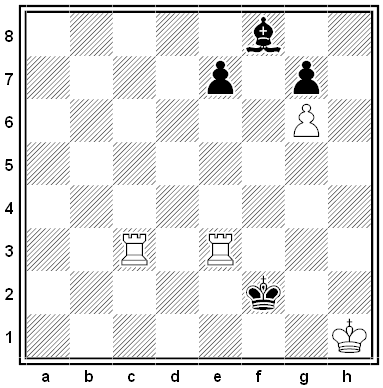
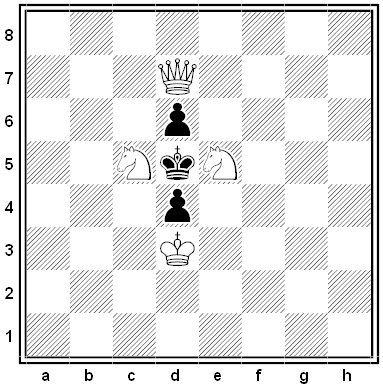
By Charles Tomlinson. White to play and mate in 4 moves, giving check on every move and forcing Black to do the same.
Lightning Addition
A (probably apocryphal) story tells that, as a 10-year-old schoolboy, Carl Friedrich Gauss was asked to find the sum of the first 100 integers. The tyrannical schoolmaster, who had intended this task to occupy the boy for some time, was astonished when Gauss presented the correct answer, 5050, almost immediately.
How did Gauss find it?
There Goes the Neighborhood
A Martian sand lizard can reproduce itself in a single day. Start with a single sand lizard and on succeeding days you’ll have 2, then 4, and so on. In 30 days you’ll have 536,870,912 lizards.
How long would it take to reach that number if you started with two lizards?
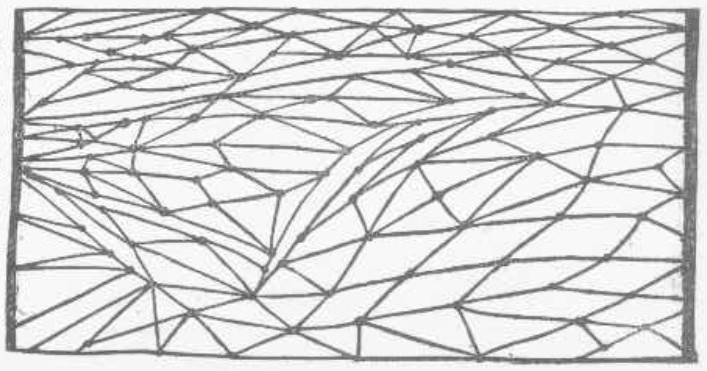
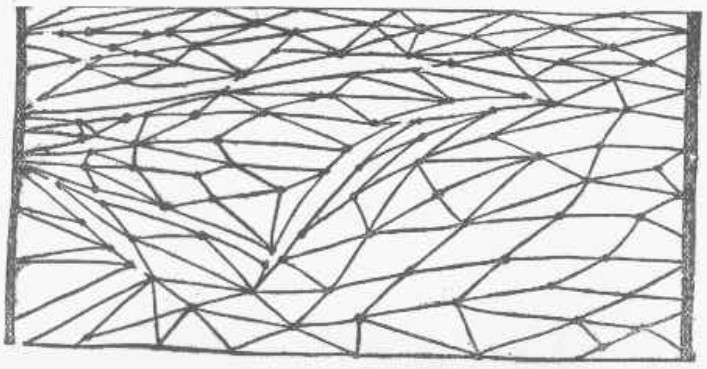
“The Scissors Entangled”

“An old but a capital puzzle.” How can you extricate the scissors from the twine?
Steadfast

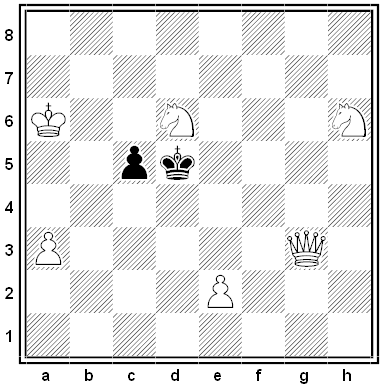
By W. Bone. White to move and mate in four.
The catch: He must mate with the queen — and she’s glued to the board.
Measuring the River

A traveler reaches a river at the point A and wishes to know the width across to B. As he has no means of crossing the river, what is the easiest way of finding its width?
From Henry Dudeney.
Fire Escape
You’re new to hell, and you’re given a choice: You can go directly to the fourth circle, or you can play simultaneous chess games against Alexander Alekhine and Aron Nimzowitsch. Alekhine always plays black and smokes a pipe of brimstone. Nimzowitsch plays white and wears cufflinks made of human teeth. Neither has ever lost.
If you can manage even a draw against either player, you’ll be set free. But if they both beat you, you’ll go to the eighth circle for eternity.
What should you do?
“Who Can Read Franklin’s Cipher?”
Benjamin Franklin wrote from Passy, in 1781, a letter to M. Dumas. He said:— ‘I have just received a 14, 5, 3, 10, 28, 2, 76, 203, 66, 11, 12, 273, 50, 14, joining 76, 5, 42, 45, 16, 15, 424, 235, 19, 20, 69, 580, 11, 150, 27, 56, 35, 104, 652, 20, 675, 85, 79, 50, 63, 44, 22, 219, 17, 60, 29, 147, 136, 41, but this is not likely to afford 202, 55, 580, 10, 227, 613, 176, 373, 309, 4, 108, 40, 19, 97, 309, 17, 35, 90, 201, 100, 677.’ This has never been deciphered. The state department at Washington has no key to it. I submit it for the consideration of the whole world.
– Elliott Sandford, New York World, cited in Henry Williams, A Book of Curious Facts, 1903
The English Officer
Here’s a poser adapted from a 1923 intelligence test:
“I was so sorry to hear of Harold’s death, Mary.”
“Thank you, Mildred.”
“May I ask the circumstances?”
“Of course. He had fallen asleep in church during the sermon and was dreaming that an executioner was approaching to cut off his head. He had witnessed some rather gruesome things during the Boxer Rebellion in China some years ago, you know. Just as the sword was falling, I happened to touch him on the back of his neck with my fan, to awaken him. The shock was too great, and he fell forward dead.”
What’s wrong with this story?
King Walk

By J. Kling. White to mate in 64 moves, forcing the black king to occupy every square on the board:
1. Rb8+ Ka7 2. Qc7+ Ka6 3. Qb7+ Ka5 4. Qb6+ Ka4 5. Rc4+ Ka3 6. Qe3+ Ka2 7. Rc2+ Ka1 8. Ra8+ Kb1 9. Rcc8 Kb2 10. Qc1+ Kb3 11. Ra3+ Kb4 12. Qc3+ Kb5 13. Rc5+ Kb6 14. Qa5+ Kb7 15. Rd3 Kb8 16. Rb5+ Kc8 17. Qa8+ Kc7 18. Qb8+ Kc6 19. Rb6+ Kc5 20. Qd6+ Kc4 21. Rd4+ Kc3 22. Qb4+ Kc2 23. Re6 Kc1 24. Rc4+ Kd1 25. Qb1+ Kd2 26. Qc1+ Kd3 27. Rc3+ Kd4 28. Qe3+ Kd5 29. Re5+ Kd6 30. Qc5+ Kd7 31. Rf3 Kd8 32. Rd5+ Ke8 33. Qc8+ Ke7 34. Qd8+ Ke6 35. Rd6+ Ke5 36. Rf7 Ke4 37. Qf6 Ke3 38. Qd4+ Ke2 39. Rh6 Ke1 40. Re7+ Kf1 41. Qg7 Kf2 42. Rh1 Kf3 43. Qg1 Kf4 44. Qg2 Kf5 45. Qg3 Kf6 46. Qe5+ Kg6 47. Qe6+ Kg5 48. Qf7 Kg4 49. Rh5 Kg3 50. Qf5 Kg2 51. Qf4 Kg1 52. Rg5+ Kh1 53. Qe4+ Kh2 54. Kf7 Kh3 55. Qg2+ Kh4 56. Rg4+ Kh5 57. Re5+ Kh6 58. Qc6+ Kh7 59. Ke8 Kh8 60. Rh4+ Kg7 61. Kd8 Kg8 62. Rg5+ Kf7 63. Rh7+ Kf8 64. Qf6#

“A Cube Paradox”

A puzzle from Henry Dudeney:
I had two solid cubes of lead, one very slightly larger than the other, just as shown in the illustration. Through one of them I cut a hole (without destroying the continuity of its four sides) so that the other cube could be passed right through it. On weighing them afterwards it was found that the larger cube was still the heavier of the two! How was this possible?
The Crossroads
Traveling between country towns, you arrive at a lonely crossroads where some mischief-maker has uprooted the signpost and left it lying by the side of the road.
Without help, how can you choose the right road and continue your journey?
“Cutting the Cheese”

A puzzle from Henry Ernest Dudeney:
Here is a simple question that will require just a few moments’ thought to get an exact answer. I have a piece of cheese in the shape of a cube. How am I to cut it in two pieces with one straight cut of the knife so that the two new surfaces produced by the cut shall each be a perfect hexagon? Of course, if cut in the direction of the dotted line the surfaces would be squares. Now produce hexagons.
Card Trick

Take … a common visiting-card, and bend down the two ends, and place it on a smooth table, as represented in the annexed diagram, and then ask any one to blow it over.
This seems easy enough; yet it is next door to an impossibility. Still, it is to be done by blowing sharply and not too hard on the table, about an inch from the card.
– Frank Bellew, The Art of Amusing, 1866
“To Take a Man’s Waistcoat Off Without Removing His Coat”
The waistcoat should first be unbuttoned in the front, and then the buckle at the back must be unloosed. The operator, standing in front of the person operated upon, should then place his hands underneath the coat at the back, taking hold of the bottom of the waistcoat, at the same time requesting the wearer to extend his arms at full length over his head. Now raise the bottom part of the waistcoat over the head of the wearer (if the waistcoat be tight it will be necessary to force it a little, but this must not be minded so long as the waistcoat is not torn); the waistcoat then will have been brought to the front of the wearer, across his chest. Take the right side bottom-end of the waistcoat, and put it into the arm-hole of the coat at the shoulder, at the same time putting the hand up the sleeve, seizing the end, and drawing it down the sleeve; this action will release one arm-hole of the garment to be removed. The next thing to be done is to pull the waistcoat back again out of the sleeve of the coat, and put the same end of the waistcoat into the left arm-hole of the coat, again putting the hand up the sleeve of the coat as before, and seizing the end of the garment. It may then be drawn quite through the sleeve, and the puzzle is accomplished.
— Cassell’s Complete Book of Sports and Pastimes, 1896
The Locked Gift

I want to mail a necklace to my wife, but anything sent through the mail will be stolen unless it’s sent in a padlocked box. A box can bear any number of padlocks, but neither of us has the key to a lock owned by the other. How can I mail the necklace safely to my wife?