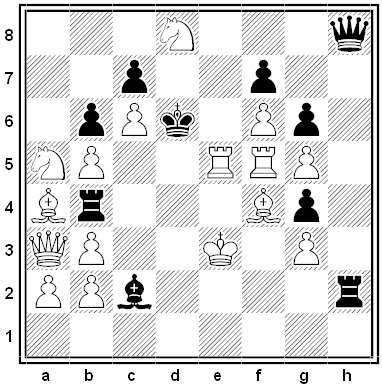
By Sam Loyd. White to mate in two moves.
|
SelectClick for Answer> |
1. Qa8! and the queen or the rook must mate.
From E.B. Cook et al., American Chess-Nuts, 1868.
|
Dec 24, 2011 | Categories: Puzzles
A riddle by Jonathan Swift:
We are little airy creatures,
All of different voice and features:
One of us in glass is set,
One of us you’ll find in jet,
T’other you may see in tin,
And the fourth a box within;
If the fifth you should pursue,
It can never fly from you.
What are we?
Dec 22, 2011 | Categories: Puzzles
A problem from the Soviet Mathematical Olympiad:
Two hundred students are arranged in 10 rows of 20 children. The shortest student in each column is identified, and the tallest of these is marked A. The tallest student in each row is identified, and the shortest of these is marked B. If A and B are different people, which is taller?
|
SelectClick for Answer> |
B is taller:
- If A and B stand in the same row, then B is taller, since we know that B is the tallest student in his row.
- If A and B stand in the same column, then again B is taller, since we know that A is the shortest student in his column.
- If A and B share neither a row nor a column, then let C be the student who’s in the same column as A and the same row as B. Then C is shorter than B (who is the tallest in his row) and taller than A (who is the shortest in his column), so B > C > A.
In every case, then, B is taller than A.
|
Dec 20, 2011 | Categories: Puzzles

By Paul Loquin. White to mate in two moves.
|
SelectClick for Answer> |
1. Nb7, followed by 2. Qe4#.
From Le Palamède, via Charles Tomlinson, Amusements in Chess, 1845.
|
Dec 18, 2011 | Categories: Puzzles
Put the integers 1, 2, 3, … n in any order and call them a1, a2, a3, … an. Then form the product
P = (a1 – 1) × (a2 – 2) × (a3 – 3) … × (an – n).
Now: If n is odd, prove that P is even.
|
SelectClick for Answer> |
If n is odd then the sequence (1, 2, 3, … n) begins and ends with an odd number. This means it contains one more odd number than even. Likewise (a1, a2, … an), which are only the same numbers in a different order. This means that two odd numbers must end up in the same bracket — there are not enough even numbers available to pair each with an odd. And if two odd numbers appear in the same bracket, they’ll produce an even difference and hence an even product.
From Ross Honsberger, Ingenuity in Mathematics, 1970.
|
Dec 17, 2011 | Categories: Puzzles
Two men are brothers-in-law if one is married to the other’s sister. What is the largest possible group of men in which each is brother-in-law to each of the others?
|
SelectClick for Answer> |
Three. Three men can be mutual brothers-in-law if A marries B’s sister, B marries C’s sister, and C marries A’s sister. But D has no way to join this group. He cannot ask his sister to marry A, B, or C, because they are already spoken for. And if he himself marries the sister of, say, A, then he cannot be a brother-in-law to C unless C or D is A’s brother, which implies a violation of the law against consanguinity. (If a man may marry his own sister, then there’s no limit to the number of mutual brothers-in-law.)
(David L. Silverman, “A Problem of Relations,” Journal of Recreational Mathematics 3:3, July 1970)
|
Dec 15, 2011 | Categories: Puzzles

An ant will always position itself so that it’s precisely twice as far from vinegar as from honey. If we put a dab of vinegar at A and a dab of honey at B and we release a troop of ants, what formation will they take up?
Dec 11, 2011 | Categories: Puzzles

A.J. Fink, Good Companions, February 1917. White to mate in two moves.
Dec 10, 2011 | Categories: Puzzles
From Miscellanea Curiosa: or, Entertainments for the Ingenious of Both Sexes, January 1734:
One evening, as I walk’d to take the Air,
I chanc’d to overtake two Ladies fair;
Each by the Hand a lovely Boy did lead,
To whom in courteous Manner thus I said:
Ladies! so far oblige me as to shew
How near akin these Boys are unto you?
They, smiling, quickly made this dark Reply,
Sons to our Sons they are, we can’t deny:
Though it seem strange, they are our Husbands’ Brothers,
And likewise each is Uncle to the other:
They both begot, and born in Wedlock were,
And we their Mothers and Grandmothers are.
Now try if you this Mystery can declare.
|
SelectClick for Answer> |
Two widow Ladies married were,
Each to the other’s Son;
And they both pregnant did appear
E’er one full Year was run.
The Consequence of which did prove,
To each a charming Boy;
This did cement their Husband’s Love,
And added to their Joy.
By this Event likewise it’s plain
They did commence Grandmothers,
And that their Husbands did obtain
Two young delightful Brothers.
A Brother you may justly call
Each, to the other’s Father:
Uncles they were reciprocal,
You easily may gather.
|
Dec 8, 2011 | Categories: Puzzles
Will a prime number ever appear in this series?
9
98
987
9876
98765
987654
9876543
98765432
987654321
9876543210
98765432109
987654321098
9876543210987
…
|
SelectClick for Answer> |
No. Eliminate the even numbers and those ending in 5. The sum of the digits in each of the remaining numbers will always produce a multiple of 3, so the numbers themselves will always be divisible by 3.
|
Dec 6, 2011 | Categories: Puzzles

By Geoffrey Mott-Smith, New York Sun, 1932. White to mate in two.
|
SelectClick for Answer> |
The resourceful 1. Qe5 threatens 2. Qb8#, and now:
1. … Rxe5 2. b7#
1. … Rd6 2. Qe8#
1. … Re8 2. Qxe8#
1. … Rxb6+ 2. Nxb6#
1. … Nc6 2. b7#
|
Dec 3, 2011 | Categories: Puzzles

A problem by Hungarian mathematician Laszlo Lovász:
A track has n arbitrarily spaced fuel depots. Each depot contains a quantity of gasoline; the total amount of gas is exactly enough to take us around the track once. Prove that, no matter how the gas is distributed, there will be a depot at which an empty car can fill up, proceed around the track picking up gas at each depot, and complete a full round trip back to its starting depot.
|
SelectClick for Answer> |
Imagine taking a practice run in a car that has plenty of gas. Along the way the car will pick up exactly enough gas to take it once around the track, so it will complete the practice run with the same amount of fuel that it started with. If we keep an eye on the car’s fuel gauge, we’ll find that it reaches its lowest point as we arrive at one of the depots (call it xi). Any additional gas in our tank at that point is unneeded; we know it will never be used. Now if we start at xi with an empty tank we know we’ll have enough gas to get from each depot to the next, running out of gas just as we arrive back at xi.
|
Dec 2, 2011 | Categories: Puzzles
This problem originated in Russia, according to various sources, but no one’s sure precisely where:
Before you is a square table that can rotate freely. In each corner is a deep well, at the bottom of which is a tumbler that’s either upright or inverted. You can’t see the tumblers, but you can reach into the wells to feel their positions.
Periodically the table rotates and stops at random. After each stop, you can feel two of the tumblers and turn over either, both, or neither. If all four of the tumblers are in the same state — all upright or all inverted — then a bell sounds. Otherwise the table rotates again and you make another “move.”
Can you guarantee to ring the bell in a finite number of moves? If so, how?
|
SelectClick for Answer> |
At first it sounds impossible, but the task can be completed within five moves:
- After the first spin, reach into wells in diagonally opposite corners of the table and set both tumblers upright.
- Let the table spin again and reach into two adjacent wells. Because of move 1, you’ll find that at least one of them is upright. If the other is inverted, turn it upright. If the bell doesn’t sound, then the position is now UUUD.
- After the next spin, reach into diagonally opposite corners. If you find an inverted tumbler, turn it up and the bell will ring. If both tumblers are upright, invert one, leaving the position UUDD (two inverted tumblers in adjacent wells).
- Let the table spin, then choose two adjacent wells and reverse both tumblers. If they were in the same position, then the bell will sound. Otherwise we know the position is now UDUD.
- After the fifth spin, reach into diagonally opposite wells and reverse both tumblers, and the bell must sound.
|
Dec 1, 2011 | Categories: Puzzles
A logic puzzle by Lewis Carroll, July 2, 1893. What conclusion can be drawn from these premises?
- All who neither dance on tight-ropes nor eat penny-buns are old.
- Pigs that are liable to giddiness are treated with respect.
- A wise balloonist takes an umbrella with him.
- No one ought to lunch in public who looks ridiculous and eats penny-buns.
- Young creatures who go up in balloons are liable to giddiness.
- Fat creatures who look ridiculous may lunch in public, provided that they do not dance on tight-ropes.
- No wise creatures dance on tight-ropes if liable to giddiness.
- A pig looks ridiculous carrying an umbrella.
- All who do not dance on tight-ropes and who are treated with respect are fat.
Nov 29, 2011 | Categories: Puzzles

Otto Wurzburg, first prize, eighth tourney, Pittsburgh Gazette-Times, June 10, 1917. White to mate in two.
Nov 27, 2011 | Categories: Puzzles

Stephen Barr observes that a pitched roof receives less rain per unit area than level ground does. This seems to mean that rain that falls at a slant will be less wetting than rain that falls vertically. Why isn’t this so?
|
SelectClick for Answer> |

Rain falls from a cloud that’s parallel to the ground, so it’s equally wetting regardless of the angle at which it falls. The roof example doesn’t reflect this.
|
Nov 26, 2011 | Categories: Puzzles

From the U.K. Schools Mathematical Challenge, a multiple-choice competition for students ages 11-14:
Humphrey the horse at full stretch is hard to match. But that is just what you have to do: move one match to make another horse just like (i.e. congruent to) Humphrey. Which match must you move?
Nov 19, 2011 | Categories: Puzzles

A ladder is leaning against a tree. On the center rung is a pussycat. She must be a very determined pussycat, because she remains on that rung as we draw the foot of the ladder away from the tree until the ladder is lying flat on the ground. What path does the pussycat describe as she undergoes this indignity?
|
SelectClick for Answer> |

Perhaps surprisingly, she describes a quarter circle whose center is at the foot of the tree. As we draw out the ladder, essentially we’re creating a series of right triangles with the same hypotenuse (the ladder). The midpoint of the hypotenuse (the pussycat) will always maintain the same distance from all three vertices, including the right angle.
Another way to see this is to remove the pussycat and visualize two ladders joined by a hinge at their midpoints. These make a scissoring motion as the first ladder descends, the second ladder drawing a simple circular arc whose center is at the base of the tree.
|
Nov 16, 2011 | Categories: Puzzles

By Karl Fabel, from Weltspiegel, 1946. White adds a pawn and mates in two moves.
Nov 15, 2011 | Categories: Puzzles

University of Toronto math professor Ed Barbeau can take a rectangular piece of paper and, using only a pair of scissors, produce the object pictured above. How?
|
SelectClick for Answer> |

Cut as shown along the vertical lines, then turn the right panel through 180 degrees.
From Barbeau’s After Math: Puzzles and Brainteasers.
|
Nov 12, 2011 | Categories: Puzzles

By Sam Loyd. White to mate in two moves.
|
SelectClick for Answer> |
1. Qa8 maintains the pin on the black queen from a safe distance. If she moves, then Bh2#. If 1. … h2, then 2. Qxg2#.
From the Baltimore Herald, 1880.
|
Nov 7, 2011 | Categories: Puzzles
A riddle from 1655:
What is likest to a cat in a hole?
A cat out of a hole.
See Poser.
Nov 5, 2011 | Categories: Puzzles

Here is a class of a dozen boys, who, being called up to give their names were photographed by the instantaneous process just as each one was commencing to pronounce his own name. The twelve names were Oom, Alden, Eastman, Alfred, Arthur, Luke, Fletcher, Matthew, Theodore, Richard, Shirmer, and Hisswald. Now it would not seem possible to be able to give the correct name to each of the twelve boys, but if you practice the list over to each one, you will find it not a difficult task to locate the proper name for every one of the boys.
|
SelectClick for Answer> |
Out of the thousands of persons who were interested in the scientific feature of that curious lip-reading puzzle the ease and unanimity with wich they picked out little Matthew as the first boy on the top row encouraged them to tackle the next, and by a large majority Matthew, Alfred and Eastman were located on the top row, Richard, Theodore, Luke and Oom on the second row, with Hisswald, Shirmer, Fletcher, Arthur and Alden below. From the many correct answers received it would appear to be an easier feat to read the motion of the lips than one would suppose.
|
Nov 1, 2011 | Categories: Puzzles
- You’re playing bridge. Each of four players is dealt 13 cards. You and your partner find that between you you hold all 13 cards of one suit. Is this more or less likely than that the two of you hold no cards of one suit?
- As he left a restaurant, a man gave the cashier a card bearing the number 102004180. The cashier charged him nothing. Why?
- How can you position a marble on the floor of an empty room so that I can’t hit it with a baseball?
- Thrice what number is twice that number?
|
SelectClick for Answer> |
- The two events are equivalent — if two players lack all cards of a given suit, then the other two players hold all of them.
- 102004180 means “I ought to owe nothing for I ate nothing.”
- Put it in the corner.
- Zero.
|
Oct 31, 2011 | Categories: Puzzles