J. Horace Round’s 1895 book Feudal England contains a bitter invective against Oxford historian Edward Augustus Freeman — it’s hidden in the index:
Freeman, Professor: unacquainted with the Inc. Com. Cant., 4; ignores the Northamptonshire geld-roll 149; confuses the Inquisitio geldi 148; his contemptuous criticism 150, 337, 385, 434, 454; when himself in error 151; his charge against the Conqueror 152, 573; on Hugh d’Envermeu 159; on Hereward 160-4; his ‘certain’ history 323, 433; his ‘undoubted history’ 162, 476; his ‘facts’ 436; on Heming’s cartulary 169; on Mr. Waters 190; on the introduction of feudal tenures 227-31, 260, 267-72, 301, 306; on the knight’s fee 234; on Ranulf Flambard 288; on the evidence of Domesday 299-31; underrates feudal influence 247, 536-8; on scutage 268; overlooks the Worcester relief 308; influenced by words and names 317, 338; on Normans under Edward 318 sqq.; his bias 319, 394-7; on Richard’s castle 320 sqq.; confuses individuals 323-4, 386, 473; his assumptions 323; on the name Alfred 327; on the Sheriff Thorold 328-9; on the battle of Hastings 332 sqq.; his pedantry 334-9; his ‘palisade’ 340 sqq., 354, 370, 372, 387, 391, 403; misconstrues his Latin 343, 436; his use of Wace 344-7, 348, 352, 355, 375; on William of Malmesbury 346, 410-14, 440; his words suppressed 347, 393; on the Bayeux Tapestry 348-51; imagines facts 352, 370, 387, 432; his supposed accuracy 353, 354, 384, 436-7, 440, 446, 448; right as to the shield-wall 354-8; his guesses 359, 362, 366, 375, 378-9, 380, 387, 389, 433-5, 456, 462; his theory of Harold’s defeat 360, 380-1; his confused views 364-5, 403, 439, 446, 448; his dramatic tendency 365-6; evades difficulties 373, 454; his treatment of authorities 376-7, 449-51; on the relief of Argues 384; misunderstands tactics 381-3, 387; on Walter Giffard 385-6; his failure 388; his special weakness 388, 391; his splended narrative 389, 393; his Homeric power 391; on Harold and his Standard 402-3; on Wace 404-6, 409; on Regenbald 425; on Earl Ralf 428; on William Malet 430; on the Conqueror’s earldoms 429; his Domesday errors and confusion 151, 425, 428, 436-7, 445-8, 463; on the ‘Civic League’ 433-5; his wild dream 438; his special interest in Exeter 431; on legends 441; on Thierry 451, 458; his method 454-5; on Lisois 460; on Stigand 461; on Walter Tirel 476-7; on St. Hugh’s action [1197] 528; on the Winchester Assembly 535-8; distorts feudalism 537; on the king’s court 538; on Richard’s change of seal 540; necessity of criticising his work, xi., 353.
While we’re at it: Here’s a detail from the index to the Rectory Magazine, handwritten by Lewis Carroll for his family in 1848:
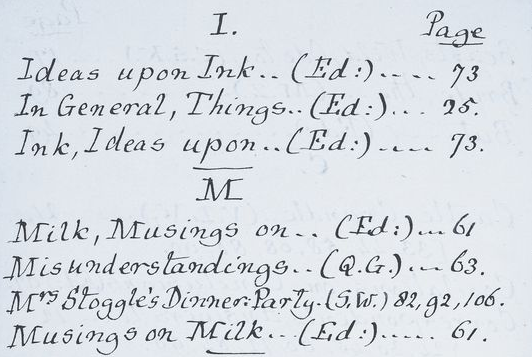
He would have been about 16.
(Thanks, Jim.)