No Dipping

Prague’s “Dancing House” is nicknamed “Fred and Ginger,” for obvious reasons.
Such a controversial design would normally be denied, but former president Václav Havel is a strong supporter of avant-garde architecture … and he owns the building next door.
(Image: Wikimedia Commons)
Showcase Dropcloth

Artist Jackson Pollock put his canvas on the floor and poured paint on it from a height.
Critics called him “Jack the Dripper.”
Fallen Astronaut

There’s only one piece of art on the moon: Fallen Astronaut, an 8.5-cm aluminum sculpture of an astronaut in a spacesuit. It’s meant to honor astronauts and cosmonauts who died furthering space exploration … but it’s also a testament to the almost limitless patience of its creator.
Belgian artist Paul Van Hoeydonck agreed to the project after meeting astronaut David Scott at a dinner party. Making art for the moon is pretty demanding in itself — it has to be lightweight, sturdy, and tolerant of temperature extremes. But NASA also said the figure couldn’t be identifiably male or female, nor of any identifiable ethnic group. On top of that, because Scott wanted to avoid the commercialization of space, they didn’t want to make Van Hoeydonck’s name public.
The artist agreed to all this, and in 1971 Apollo 15 put Fallen Astronaut on the moon, along with a plaque listing 14 fallen space explorers. Van Hoeydonck even agreed to create a replica for the National Air and Space Museum “with good taste and without publicity.”
But he finally balked when Scott tried to talk him out of selling 950 signed replicas for $750 apiece at New York’s Waddell Gallery in 1972. A guy’s got to make a living.
Honk If You Love Megaliths

Carhenge is a replica of Stonehenge constructed of vintage American automobiles spray-painted gray. The heel stone is a 1962 Cadillac.
Who says Americans have no taste?
(Image: Wikimedia Commons)
Hare Raising

This is Hase, a 200-foot bunny erected in September on an Italian mountainside by the Viennese art group Gelatin.
You’re welcome to climb around on it. No rush — it’ll be there until 2025.
A Tennessee Parthenon

Nashville’s Centennial Park contains a full-scale replica of the Parthenon.
Like the original in Athens, it’s “more perfect than perfect”: To counter optical effects, the columns swell slightly as they rise, and the platform on which they stand curves slightly upward. So the temple looks even more symmetrical than it actually is.
(Image: Wikimedia Commons)
Stendhal Syndrome

“Stendhal syndrome” refers to rapid heartbeat, dizziness, confusion, and even hallucinations in the presence of great art.
It’s named for Stendhal himself, the 19th century French author, who reported experiencing it on an 1817 visit to Florence (and described it in his book Naples and Florence: A Journey from Milan to Reggio).
It wasn’t formally described until 1979, when Italian psychiatrist Graziella Magherini documented more than 100 cases among visitors to Florence. The syndrome was first diagnosed in 1982.
Ars Longa
In the 1840s, John Banvard painted a panorama of the Mississippi River valley — possibly the largest painting ever attempted. It was 12 feet high and 1,300 feet long.
He traveled with it through Europe, Asia, and Africa, and Queen Victoria even got a private viewing.
Improbably, it’s been lost. How do you misplace a painting that’s a quarter mile long?
Anamorphosis

This is The Ambassadors (1533), the celebrated painting by Hans Holbein the Younger. It’s full of noteworthy symbols of exploration, but what’s that odd skewed element at the bottom?
If you view the canvas from a narrow angle, the image resolves into a skull:

This is an early example of anamorphic perspective, an invention of the early Renaissance. It’s thought that Holbein intended that the painting would be hung in a stairwell, when people ascending the stairs would view the image from the proper angle and get a gruesome surprise.
Why? That’s an unanswered question.
Borromean Rings

These circles are linked … but no two of them are linked.
They’re called Borromean rings.
An All-Purpose Anthem
Americans think of the song “My Country, ‘Tis of Thee” as a patriotic anthem — which is ironic, because everyone else does, too. We stole the tune from the British, who know it as “God Save the Queen,” and the same melody has served as the national anthem of Denmark, Russia, Sweden, Switzerland, Norway, and Liechtenstein.
When England met Liechtenstein in a Euro 2004 qualifying football match, they had to play the same music twice.
Fayum Mummy Portraits

This is Eutyches, a young boy who died in Egypt during the Roman Empire. How do we know this? Because this portrait was stuffed inside his mummy.
This was actually a common practice in the Fayum region of ancient Egypt, and it’s given us some of the best-preserved paintings from ancient times.
Artists would paint the portraits on wooden panels, using hot, pigmented wax, and they’ve survived remarkably well in the region’s dry heat.
CAT scans show that the portraits match their mummies in age and sex, and they’re strikingly naturalistic, though reportedly a little formulaic.
Many, like Eutyches, were children, a sad mark of the era’s low life expectancy.
Jesus Carved in Salt

“Intellectual passion dries out sensuality,” wrote Leonardo da Vinci. Someone took him literally — and carved this likeness of the Last Supper into the wall of a Polish salt mine.
(Image: Wikimedia Commons)
Dorabella Cipher

In 1897 the English composer Edward Elgar sent this enciphered message to his friend Dora Penny. Dora couldn’t decipher it, and neither can anyone else. Can you?
Matisse Inverted
In 1961, Henri Matisse’s painting Le Bateau was accidentally hung upside down in New York’s Museum of Modern Art for 47 days. 116,000 visitors had passed through the gallery before the mistake was discovered.
“Gruesomely Bad Taste”
Critics pan great art:
- Moby Dick: “Raving and rhapsodizing in chapter after chapter … sheer moonstruck lunacy.” (London Morning Chronicle)
- Rigoletto: “The weakest work of Verdi. It lacks melody. This opera has hardly any chance of being kept in the repertoire.” (La Gazette Musicale de Paris)
- Cezanne’s paintings: “He chooses to daub paint on a canvas and spread it around with a comb or a toothbrush. This process produces landscapes, marines, still lifes, portraits … if he is lucky. The procedure somewhat recalls the designs that schoolchildren make by squeezing the heads of flies between the folds of a sheet of paper.” (Le Petit Parisien)
- Prokofiev’s Piano Concerto No. 1: “The concerto will never be played by anyone on earth. … Prokofiev wouldn’t grant an encore. The Russian heart may be a dark place, but its capacity for mercy is infinite.” (The New York Times)
- Buster Keaton’s The General: “A mixture of cast iron and jelly.” (The New York Times)
- Alfred Hitchcock’s Vertigo: “Pursues its theme of false identity with such plodding persistence that by the time the climactic cat is let out of the bag, the audience has long since had kittens.” (Saturday Review)
Henry Fielding wrote, “Now, in reality, the world have paid too great a compliment to critics, and have imagined them to be men of much greater profundity then they really are.”
Bitterroot Blaze

Firefighter John McColgan “just happened to be in the right place at the right time” to take this photo on Aug. 6, 2000, while fighting a 100,000-acre blaze in Montana’s Bitterroot National Forest.
He was standing on a bridge over the East Fork of the Bitterroot River, and shot the photo with a Kodak DC280 digital camera.
The elk were gathering at the river, he says. “They know where to go, where their safe zones are. A lot of wildlife did get driven down there to the river. There were some bighorn sheep there. A small deer was standing right underneath me, under the bridge.”
Nonsense Botany
From Edward Lear’s “Nonsense Botany” (1871):

Bottlephorkia Spoonifolia.

Manypeeplia Upsidownia.

Phattfacia Stupenda.

Piggiwiggia Pyramidalis.
Nude, Descending

Goya’s La Maja Desnuda and La Maja Vestida. In 19th-century Europe, it was common to have two paintings of the same subject, swapping them out depending on who’d be visiting. Still, the Inquisition confiscated both of these as obscene.
Said the Duchess of Alba to Goya,
“Do some pictures to hang in my foyer”;
So he painted her twice –
In the nude to look nice,
And then in her clothes to annoy ‘er.
– Cyril Bibby
Musaeum Clausum
Imaginary pictures “cataloged” in Thomas Browne’s Musaeum Clausum of 1684:
- “A Moon Piece, describing that notable Battel between Axalla, General of Tamerlane, and Camares the Persian, fought by the light of the Moon.”
- “A Snow Piece, of Land and Trees covered with Snow and Ice, and Mountains of Ice floating in the Sea, with Bears, Seals, Foxes, and variety of rare Fowls upon them.”
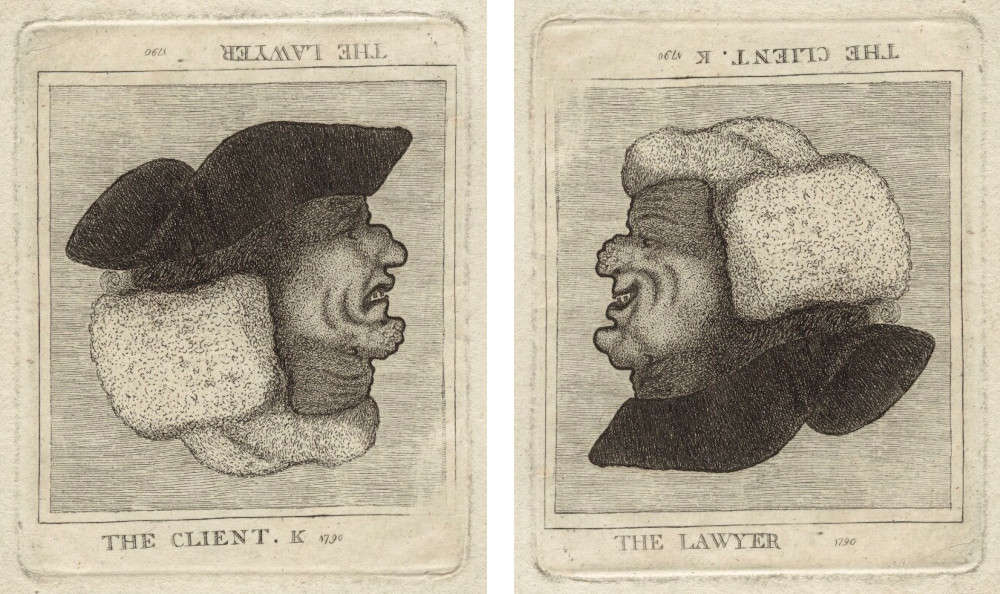
- “Pieces and Draughts in Caricatura, of Princes, Cardinals and famous men; wherein, among others, the Painter hath singularly hit the signatures of a Lion and a Fox in the face of Pope Leo the Tenth.”
- “Some Pieces A la ventura, or Rare Chance Pieces, either drawn at random, and happening to be like some person, or drawn for some and happening to be more like another; while the Face, mistaken by the Painter, proves a tolerable Picture of one he never saw.”
Borges wrote, “To write vast books is a laborious nonsense, much better is to offer a summary as if those books actually existed.”
“A Chicken Is a Noble Beast”
William Topaz McGonagall is renowned as the worst poet in the English language. Sample:
Beautiful Railway Bridge of the Silv’ry Tay!
Alas! I am very sorry to say
That ninety lives have been taken away
On the last Sabbath day of 1879,
Which will be remember’d for a very long time.
He didn’t even get the facts right here — 75 died.
In the opening to his Poetic Gems, McGonagall wrote, “The most startling incident in my life was the time I discovered myself to be a poet.” Millions agreed. Stephen Pile, in The Book of Heroic Failures, calls him “so giftedly bad he backed unwittingly into genius”; his temperance speeches were wildly popular with “poet-baiters” in Dundee, who pelted him with eggs and vegetables, and he was allowed to play Macbeth only if he paid in advance.
When Tennyson died, McGonagall visited Balmoral to ask if he might become poet laureate. He was told the queen was not at home.
DIY
Steven Wright used to say, “I’ve been doing a lot of abstract painting lately, extremely abstract. No brush, no paint, no canvas. I just think about it.”
With Mr. Picassohead you can make a Cubist portrait in about 60 seconds. I spent a little longer on this one, pretending to get the composition right, but it’s hard to go wrong with drag-and-drop noses.
Even simpler is the Mondrian Machine — even a dead guy could produce a neoplasticist masterwork if you clicked the mouse for him.
I suppose the masters wouldn’t approve of these pushbutton knockoffs; Picasso seemed to take a dim view of technology in general. “Computers are useless,” he once said. “They can only give you answers.”
Of course, if you have real talent, machines can be a useful tool, too. Art.com’s artPad is a lot easier to use than real brushes and paints, and the gallery has some decent abstracts.