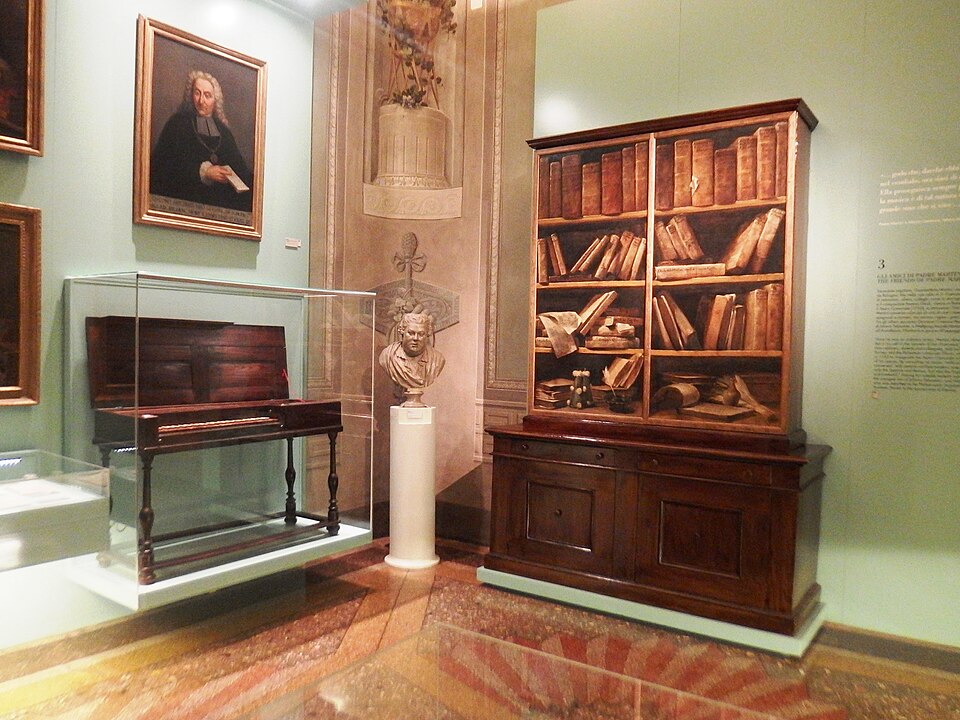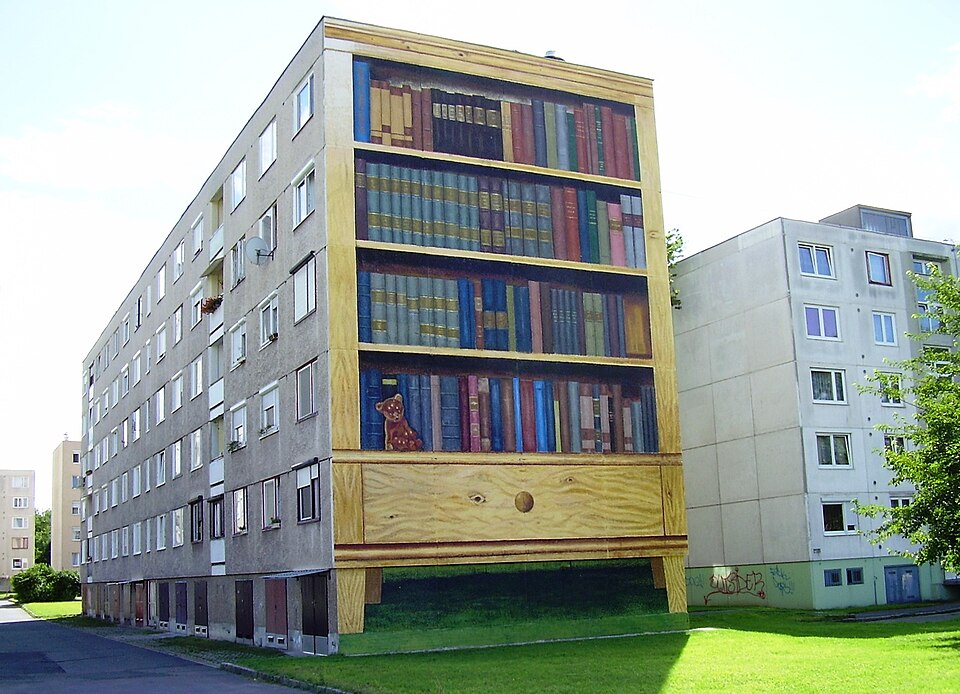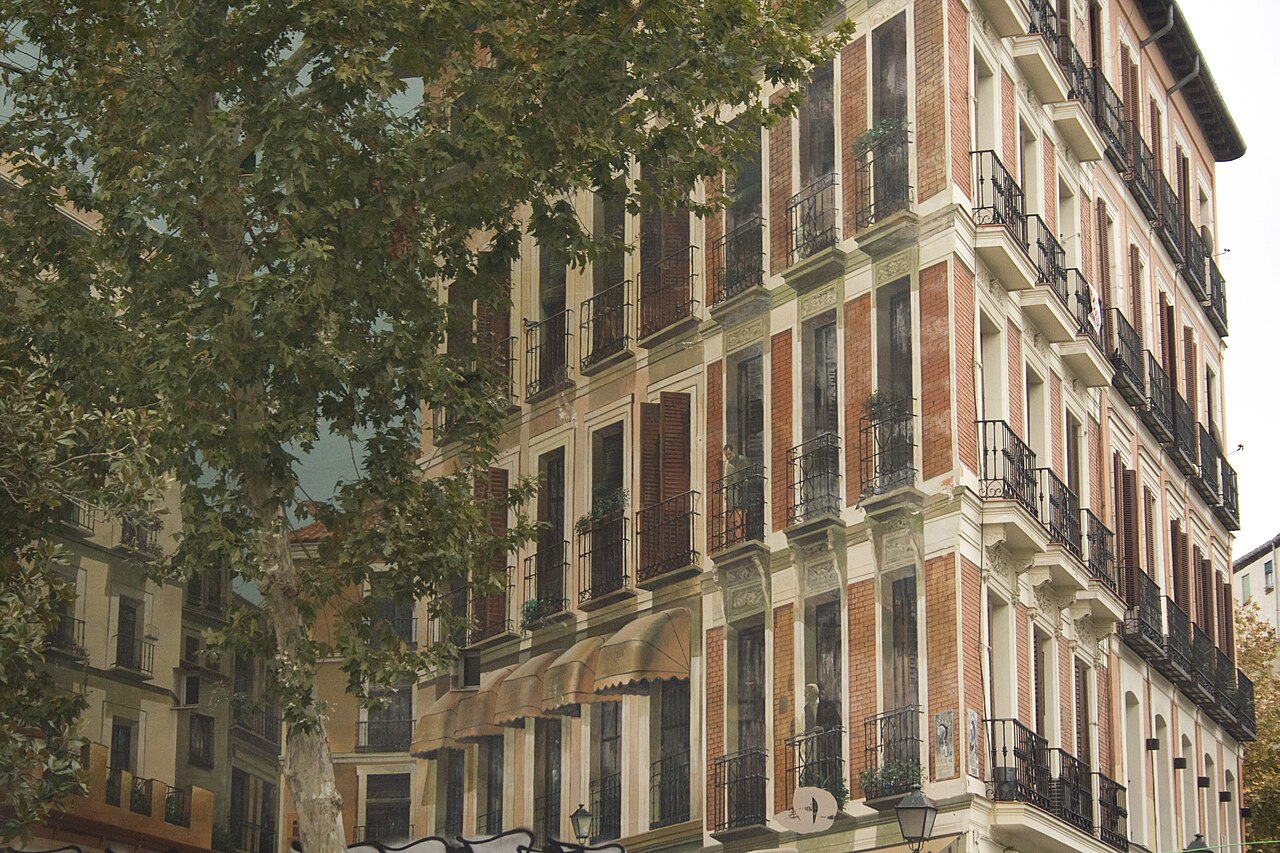
This building, at 1643 Plaza de los Carros in Madrid, is half illusion — the façade on the left, including the windows, ironwork, awnings, even the residents, is all a trompe-l’œil mural by artist Alberto Pirrongelli.

This building, at 1643 Plaza de los Carros in Madrid, is half illusion — the façade on the left, including the windows, ironwork, awnings, even the residents, is all a trompe-l’œil mural by artist Alberto Pirrongelli.
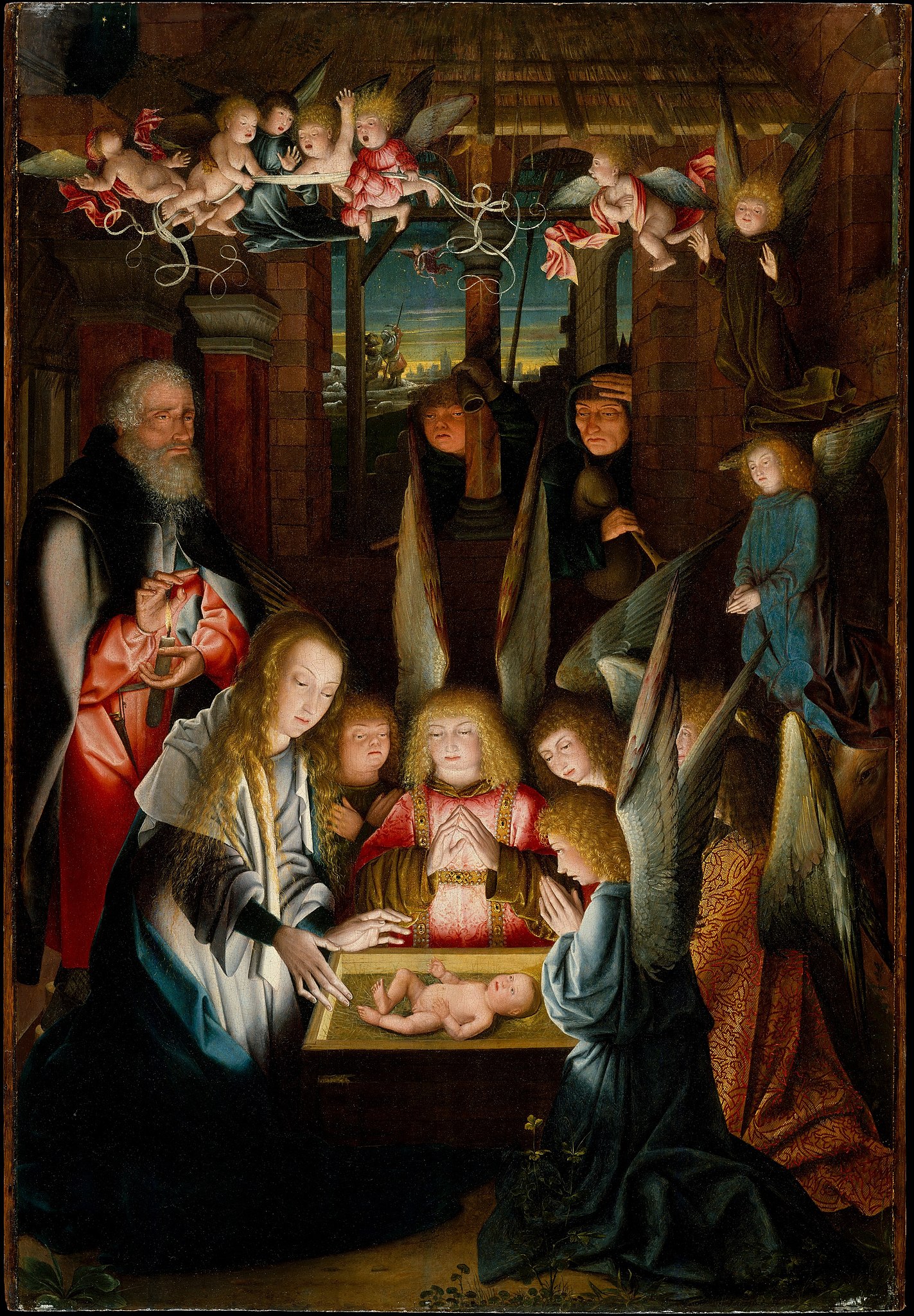
In this 1515 painting, The Adoration of the Christ Child, the angel immediately to Mary’s left appears to bear the characteristic facial features of Down syndrome (click to enlarge). This would make the painting one of the earliest representations of the syndrome in Western art.
Unfortunately, little is known about it. The Metropolitan Museum of Art, which owns it, has identified the painter only as a “follower of Jan Joest of Kalkar.” Researchers Andrew Levitas and Cheryl Reid have suggested that the painting may indicate that individuals with Down syndrome were not regarded as disabled in medieval society. But so little is known about the work or its creator that it’s hard to establish a reliable conclusion.
“After all the speculations, we are left with a haunting late-medieval image of a person with apparent Down syndrome with all the accouterments of divinity. It is impossible to know whether any disability had been recognized or whether it simply was not relevant in that time and place.”
(Andrew S. Levitas and Cheryl S. Reid, “An Angel With Down Syndrome in a Sixteenth Century Flemish Nativity Painting,” American Journal of Medical Genetics Part A 116:4 [2003], 399-405.) (Thanks, Serge.)

Where did the familiar syllables of solfège (do, re, mi) come from? Eleventh-century music theorist Guido of Arezzo collected the first syllable of each line in the Latin hymn “Ut queant laxis,” the “Hymn to St. John the Baptist.” Because the hymn’s lines begin on successive scale degrees, each of these initial syllables is sung with its namesake note:
Ut queant laxīs
resonāre fibrīs
Mīra gestōrum
famulī tuōrum,
Solve pollūti
labiī reātum,
Sancte Iohannēs.
Ut was changed to do in the 17th century, and the seventh note, ti, was added later to complete the scale.

By Robert William Petrick, a perfectly requited sentiment.
From the Strand, December 1901, “one of Sir John Stainer’s musical jokes, two hymns in one — in B flat or G major, according to the manner in which it is read, upside up or upside down. It was written as an autograph for a friend of his son’s.”

In discussing the paintings, [Jackson Pollock] would ask, ‘Does it work?’ Or in looking at mine, he would comment, ‘It works’ or ‘It doesn’t work.’ He may have been the first artist to have used the word ‘work’ in that sense.
— Lee Krasner, quoted in B.H. Friedman, Jackson Pollock: Energy Made Visible, 1972
Titles of paintings by Salvador Dalí:
He wrote, “It is not necessary for the public to know whether I am joking or whether I am serious, just as it is not necessary for me to know it myself.”

There are several simple little drawing tricks which the nurse may use to arouse the interest of her patient as she uses puzzles and catches. The oldest of these is by Hogarth and represents a soldier and his dog going through a doorway. As is seen by the diagram, it consists of three straight lines and one curved one.
— William Rush Dunton, Occupation Therapy, 1915
In the 1950s, humorist Roger Price invented “Droodles,” simple enigmatic drawings explained by their captions. Frank Zappa used one on the cover of a 1982 album:

It’s called Ship Arriving Too Late to Save a Drowning Witch.

Wikimedia user Tarquin points out that the natural rhythm of spoken language can be used to teach polyrhythms.
Above: The phrase “cold cup of tea,” spoken naturally, approximates a rhythm of 2 against 3.
Below: The phrase “what atrocious weather” approximates 4 against 3.


Two rhapsodies on the name of French philosopher Michel Onfray, by Basile Morin.
In the chain ambigram above, the first name is transfigured (at some point) into the last.
In the tessellation ambigram below, the two names appear simultaneously as figure and ground.