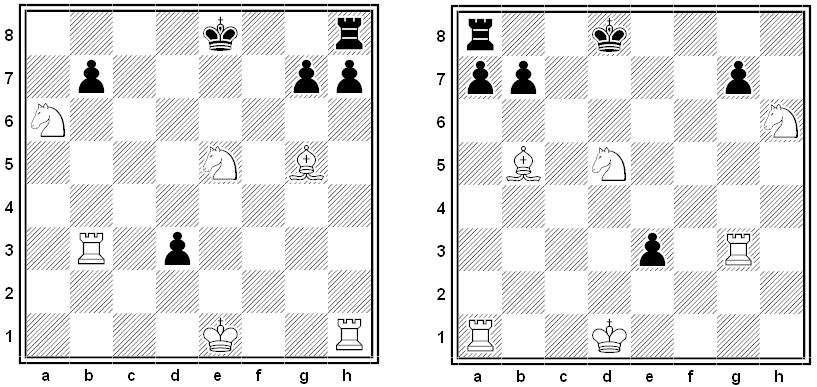
C.S. Kipping published this unusual problem in Chess Amateur in 1923. In each position, White is to mate in two moves.

C.S. Kipping published this unusual problem in Chess Amateur in 1923. In each position, White is to mate in two moves.
Suppose you have a collection of gears pinned to a wall (disks in the plane). When is it possible to wrap a conveyor belt around them so that the belt touches every gear, is taut, and does not touch itself? This problem was first posed by Manuel Abellanas in 2001. When all the gears are the same size, it appears that it’s always possible to find a suitable path for the belt, but the question remains open.
Erik Demaine, Martin Demaine, and Belén Palop have designed a font to illustrate the problem — each letter is a collection of equal-sized gears around which exactly one conveyor-belt wrapping outlines an English letter:
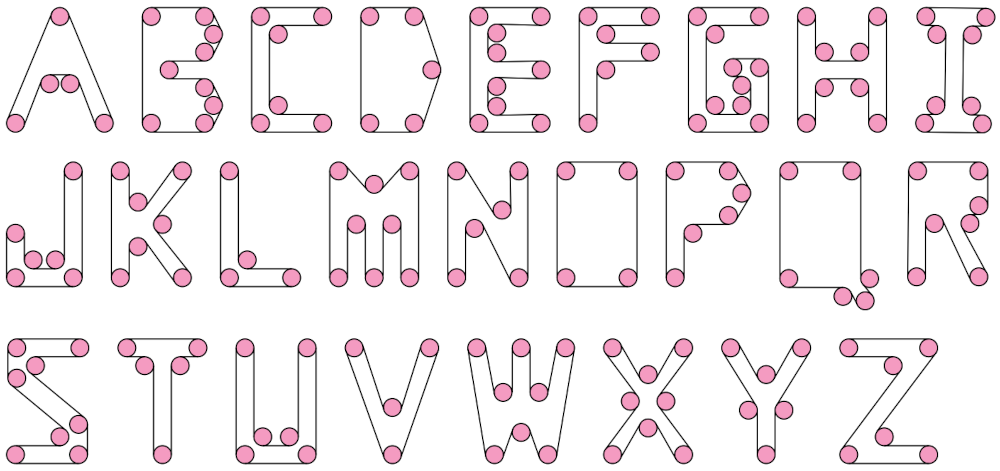
Apart from its mathematical interest, the font makes for intriguing puzzles — when the belts are removed, the letters are surprisingly hard to discern. What does this say?

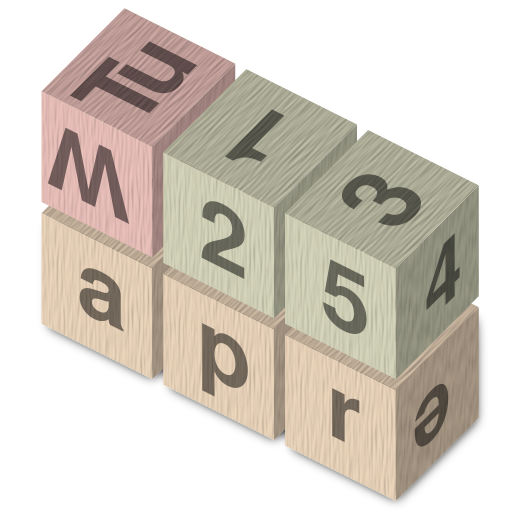
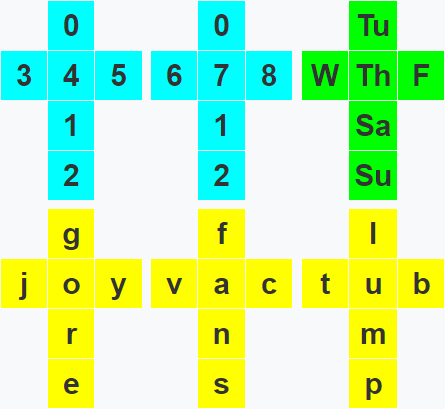
This is a variation on an old puzzle by Martin Gardner. This desk calendar currently displays the date Monday, April 25. If the six cubes are capable of displaying any day of the week and any date from January 01 to December 31, what characters appear on the unseen faces in the picture? Gardner wrote, “It is a bit trickier than one might expect.”
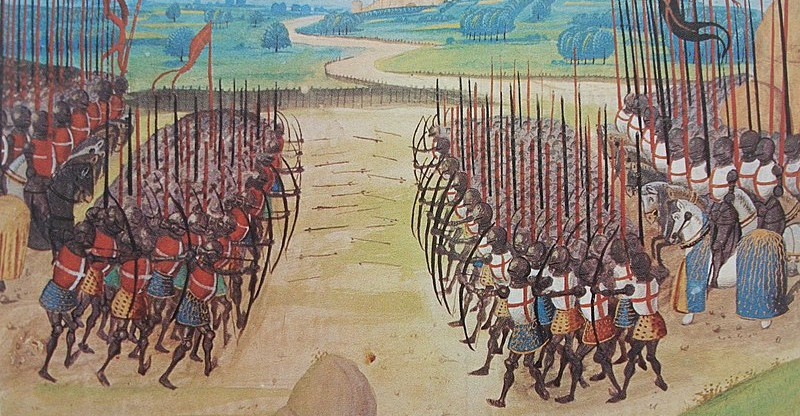
English poet Winthrop Mackworth Praed was renowned for his charades — this one, published in the 1830s, has never been solved:
Sir Hilary charged at Agincourt,–
Sooth, ’twas an awful day!
And though in that old age of sport
The rufflers of the camp and court
Had little time to pray,
’Tis said Sir Hilary mutter’d there
Two syllables by way of prayer.
My first to all the brave and proud
Who see to-morrow’s sun:
My next, with her cold and quiet cloud,
To those who find their dewy shroud
Before to-day’s be done:
And both together to all blue eyes,
That weep when a warrior nobly dies.
“The best answer I have been able to find is GOOD NIGHT,” wrote Henry Dudeney in 1919. “The two syllables are by way of wish or prayer. We wish nothing but good to the victorious, we leave those have fallen to their ‘dewy shroud’ at night, while to the sorrowful bereaved we cannot do less than wish them a good night.”
But Praed himself left no solution.
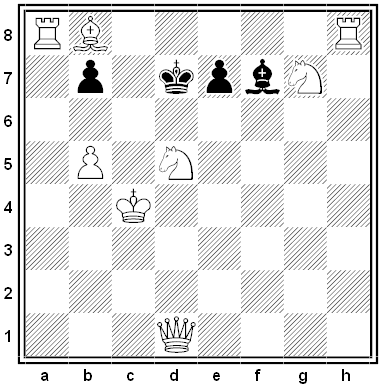
“This seems to be my most ingenious two-mover,” wrote Vladimir Nabokov in 1970. He had composed it a year earlier in Montreux. White to mate in two moves.
Al writes the numbers 1, 2, …, 2n on a blackboard, where n is an odd positive integer. He then picks any two numbers a and b, erases them, and writes instead |a – b|. He keeps doing this until one number remains. Prove that this number is odd.
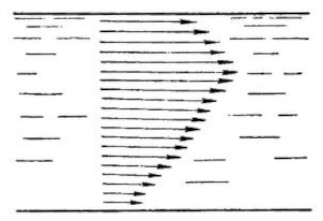
A problem by Soviet physicist Viktor Lange:
It’s not uncommon to see two ships traveling down a river at different velocities — this is due to differences in design and engine power.
“But why can rafts which have no engines float down the river with different velocities, too? It has been even noticed that the heavier the raft the higher its velocity. Why is this?”
A problem from the 17th Irish Mathematical Olympiad, in 2004:
In a tennis tournament, each player played one match against each of the others. If each player won at least one match, show that there’s a group of three players A, B, C in which A beat B, B beat C, and C beat A.
A puzzle by National Security Agency mathematician Katrina J., from the agency’s September 2017 Puzzle Periodical:
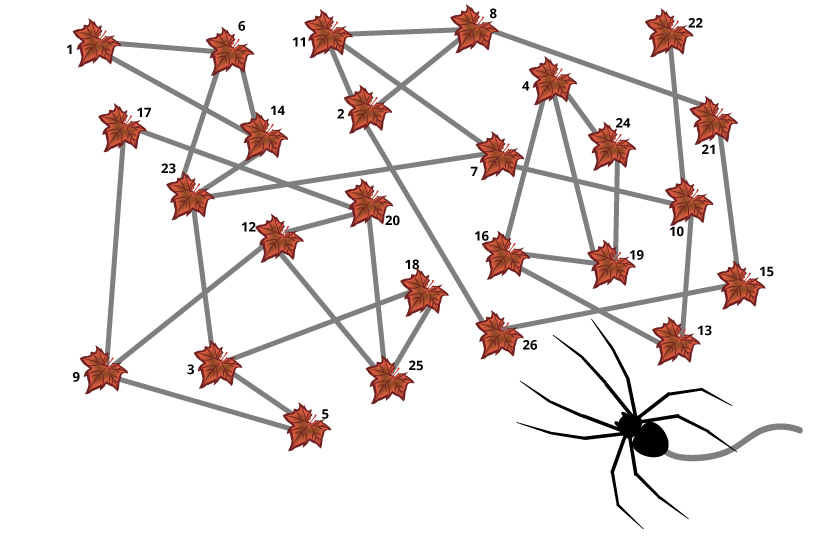
Problem:
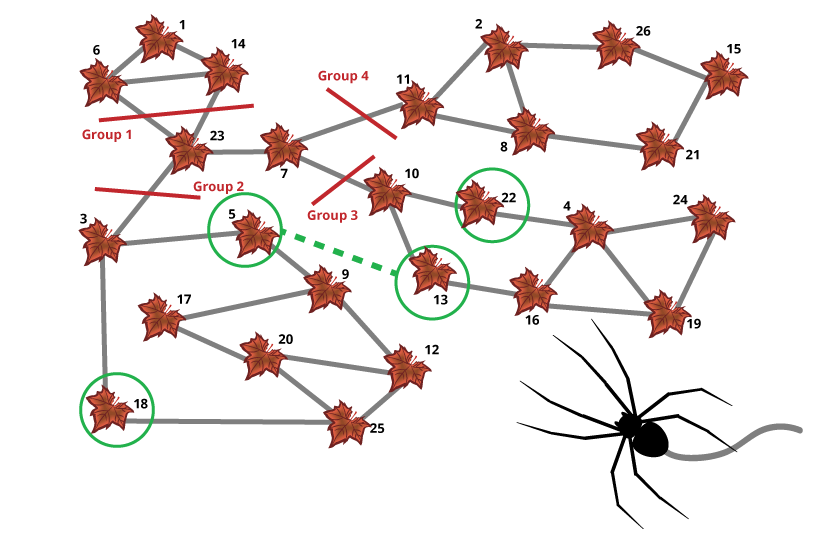
Arabella the Spider is saving food for the long winter. Arabella wants to store the bugs she caught on 26 fallen leaves, so she can find them later. But, Arabella doesn’t want to waste time by going through any leaves more than once.
In Arabella’s original web, Arabella can’t get to all of the leaves without crossing some of them more than once. But, if Arabella adds just one web between two of the leaves, she can get to every leaf without repeating. [NOTE: The NSA image shown here contains an error — there should be an additional strand between leaves 4 and 22.] There are four different pairs of leaves that Arabella could connect to solve her problem. Can you find all four possible solutions?
Note: Arabella may take any path she chooses as long as she begins on leaf 1 and ends on leaf 26.
Bonus Puzzle:
Can you show why Arabella cannot get to every leaf without repeats on her web as it is now?
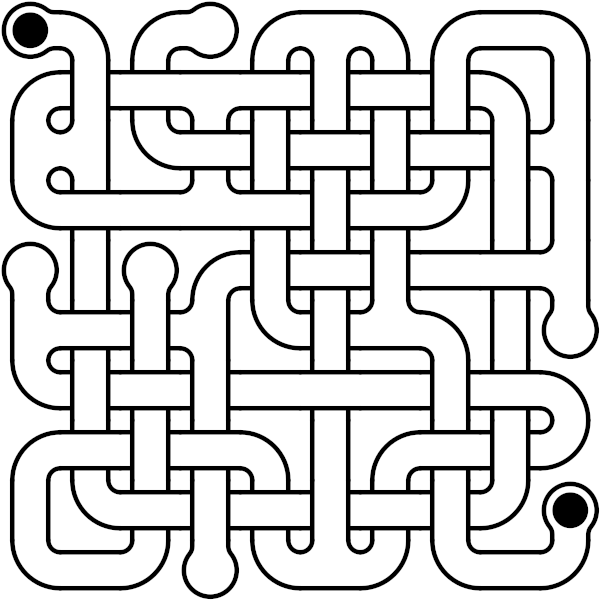
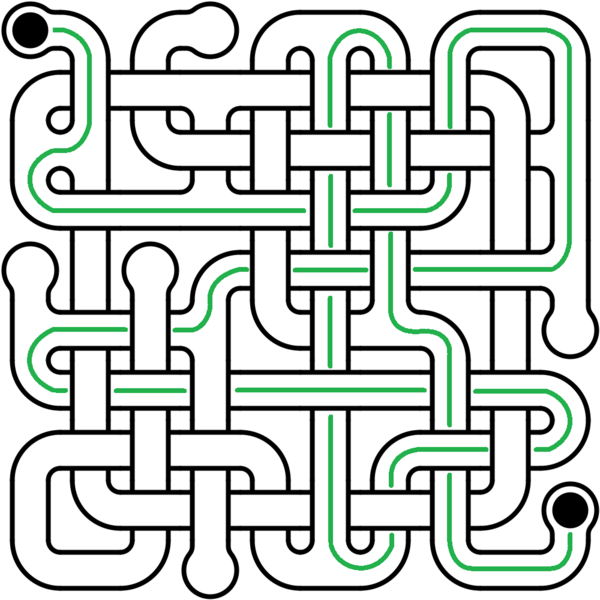
A maze by Wikimedia user Marianov. Make your way from one black circle to the other.