Will a prime number ever appear in this series?
9
98
987
9876
98765
987654
9876543
98765432
987654321
9876543210
98765432109
987654321098
9876543210987
…
Will a prime number ever appear in this series?
9
98
987
9876
98765
987654
9876543
98765432
987654321
9876543210
98765432109
987654321098
9876543210987
…

A problem by Hungarian mathematician Laszlo Lovász:
A track has n arbitrarily spaced fuel depots. Each depot contains a quantity of gasoline; the total amount of gas is exactly enough to take us around the track once. Prove that, no matter how the gas is distributed, there will be a depot at which an empty car can fill up, proceed around the track picking up gas at each depot, and complete a full round trip back to its starting depot.
This problem originated in Russia, according to various sources, but no one’s sure precisely where:
Before you is a square table that can rotate freely. In each corner is a deep well, at the bottom of which is a tumbler that’s either upright or inverted. You can’t see the tumblers, but you can reach into the wells to feel their positions.
Periodically the table rotates and stops at random. After each stop, you can feel two of the tumblers and turn over either, both, or neither. If all four of the tumblers are in the same state — all upright or all inverted — then a bell sounds. Otherwise the table rotates again and you make another “move.”
Can you guarantee to ring the bell in a finite number of moves? If so, how?
A logic puzzle by Lewis Carroll, July 2, 1893. What conclusion can be drawn from these premises?

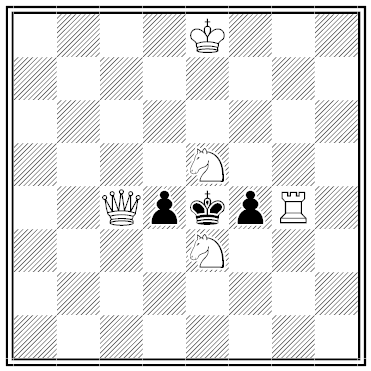
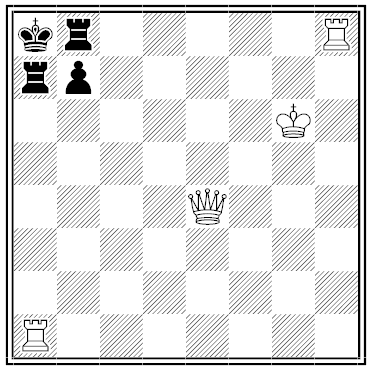
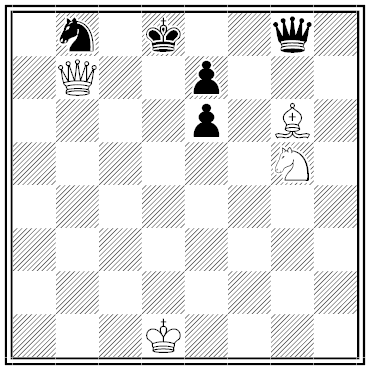
Otto Wurzburg, first prize, eighth tourney, Pittsburgh Gazette-Times, June 10, 1917. White to mate in two.

Stephen Barr observes that a pitched roof receives less rain per unit area than level ground does. This seems to mean that rain that falls at a slant will be less wetting than rain that falls vertically. Why isn’t this so?

From the U.K. Schools Mathematical Challenge, a multiple-choice competition for students ages 11-14:
Humphrey the horse at full stretch is hard to match. But that is just what you have to do: move one match to make another horse just like (i.e. congruent to) Humphrey. Which match must you move?

A ladder is leaning against a tree. On the center rung is a pussycat. She must be a very determined pussycat, because she remains on that rung as we draw the foot of the ladder away from the tree until the ladder is lying flat on the ground. What path does the pussycat describe as she undergoes this indignity?