
“CAPILLARY, a Little Caterpillar”

There have always been bad students. Here’s what kids were writing on English exams 150 years ago:

  • ABORIGINES, a system of mountains.
  • ALIAS, a good man in the Bible.
  • AMENABLE, anything that is mean.
  • AMMONIA, the food of the gods.
  • ASSIDUITY, state of being an acid.
  • AURIFEROUS, pertaining to an orifice.
  • CORNIFEROUS, rocks in which fossil corn is found.
  • EMOLUMENT, a headstone to a grave.
  • EQUESTRIAN, one who asks questions.
  • EUCHARIST, one who plays euchre.
  • FRANCHISE, anything belonging to the French.
  • IDOLATER, a very idle person.
  • IPECAC, a man who likes a good dinner.
  • IRRIGATE, to make fun of.
  • MENDACIOUS, what can be mended.
  • MERCENARY, one who feels for another.
  • PARASITE, a kind of umbrella.
  • PARASITE, the murder of an infant.
  • PUBLICAN, a man who does his prayers in public.
  • TENACIOUS, ten acres of land.
  • REPUBLICAN, a sinner mentioned in the Bible.
  • PLAGIARIST, a writer of plays.

— From Mark Twain, “English as She Is Taught: Being Genuine Answers to Examination Questions in Our Public Schools,” 1887
A Good Word

Words dropped since the 1901 edition of the Chambers Dictionary:

  • decacuminated adj. having the top cut off
  • effodient adj. habitually digging (zoology)
  • essorant adj. about to soar
  • flipe v. to fold back, as a sleeve
  • lectual adj. confining to the bed
  • neogamist n. a person recently married
  • nuciform adj. nut-shaped
  • numerotage n. the numbering of yarns so as to denote their fineness
  • pantogogue n. a medicine once believed capable of purging away all morbid humours
  • parageusia n. a perverted sense of taste
  • presultor n. the leader of a dance
  • ramollescence n. softening, mollifying
  • roytish adj. wild, irregular
  • sagesse n. wisdom
  • salebrous adj. rough, rugged
  • sammy v. to moisten skins with water
  • sarn n. a pavement
  • scavilones n. men’s drawers worn in the sixteenth century under the hose
  • tarabooka n. a drumlike instrument
  • tortulous adj. having swellings at regular intervals
  • wappet n. a yelping cur

Inventory

“Only the fool would take trouble to verify that his sentence was composed of ten a’s, three b’s, four c’s, four d’s, forty-six e’s, sixteen f’s, four g’s, thirteen h’s, fifteen i’s, two k’s, nine l’s, four m’s, twenty-five n’s, twenty-four o’s, five p’s, sixteen r’s, forty-one s’s, thirty-seven t’s, ten u’s, eight v’s, eight w’s, four x’s, eleven y’s, twenty-seven commas, twenty-three apostrophes, seven hyphens and, last but not least, a single !” — Lee Sallows

Oops

http://en.wikipedia.org/wiki/Image:Dord.jpg

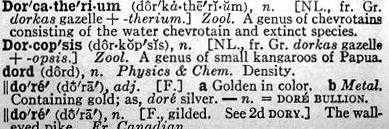
Here’s a famous goof from the 1935 edition of Webster’s New International Dictionary.

There’s no such word as dord — the chemistry editor had intended it to say “D or d”, but somehow his slip got misinterpreted and the mistake stayed on the books until 1939.

Editor Philip Babcock Gove later wrote that it was “probably too bad, for why shouldn’t dord mean ‘density’?”

Anonymous Identities

“John Doe” in other countries:

  • Australia: Fred Nurk
  • Austria: Hans Meier
  • Belgium: Jan Janssen
  • Colombia: Fulano de Tal
  • Croatia: Ivan Horvat
  • Czech Republic: Josef Novák
  • Estonia: Jaan Tamm
  • France: Jean Dupont
  • Guatemala: Juan Perez
  • Italy: Mario Rossi
  • Lithuania: Vardenis Pavardenis
  • Malta: Joe Borg
  • New Zealand: Joe Bloggs
  • Philippines: Juan dela Cruz
  • Poland: Jan Kowalski
  • Romania: Ion Popescu
  • Slovenia: Janez Novak
  • South Africa: Koos van der Merwe

In the United States, John Doe is always the defendant. An anonymous plaintiff is Richard Roe.

Active Voice

In 2004, French writer Michel Dansel published The Train from Nowhere, a 233-page novel written entirely without verbs.

He even organized a funeral for the verb at Sorbonne in Paris, calling it the “invader, dictator, usurper of our literature.” No word where it’s interred.