
A dust storm approaches Stratford, Texas, April 18, 1935. On Earth these storms are actually relatively minor; on Mars they can last for hundreds of days and cover the entire planet.

A dust storm approaches Stratford, Texas, April 18, 1935. On Earth these storms are actually relatively minor; on Mars they can last for hundreds of days and cover the entire planet.
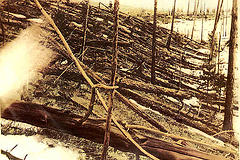
Somebody up there hates Siberia.
On June 30, 1908, something huge exploded over the Tunguska River near modern Evenkia. The blast felled 60 million trees over 2,150 square kilometers; it’s been estimated at between 10 and 15 megatons. Witnesses described a huge fireball moving across the sky, a flash, and a shockwave that knocked people off their feet and broke windows up to 400 miles away. Afterward, the night sky glowed for weeks.
But, strangely, there was no crater. In fact, a few trees near ground zero were still standing, their branches and bark stripped off. Stranger still, some reports said the skyglow had begun the night before the explosion, and that there had been strange weather and increased seismic activity for days beforehand. And carbon-14 dating of the soil gave a date in the future — meaning the soil had somehow become enriched with radioactive carbon-14.
What caused the explosion? A meteor? A comet? An asteroid? There’s been no conclusive explanation. But, disturbingly, a similar thing happened just three years ago. An explosion in Siberia in September 2002 that measured up to 5 kilotons was accompanied by northern lights, increased radioactivity, and an outbreak of unknown diseases nearby. An expedition the following year concluded that it was a comet, but no one knows for sure.
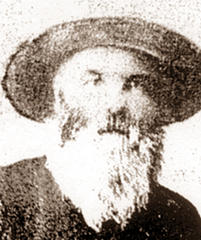
“Liver-Eating Johnson” had the coolest nickname in the Old West — cooler, perhaps, than the truth warranted.
The “mountain man” was actually born in New Jersey around 1824. He deserted the Navy after the Mexican-American War and lit out for Wyoming, where he trapped, hunted and supplied cordwood to steamboats.
The legend starts in 1847, when the Crow tribe killed his Indian wife and he launched a personal war that lasted 20 years, in which, supposedly, he would cut out and eat the liver of each man he killed.
Did he really? Who knows? But it made a good story, and Johnson’s stature began to grow — literally and figuratively. His Civil War records put him at less than 6 feet tall, but local yarns soon said he was 6 foot 6.
After serving the Union Army as a sharpshooter, he spent the 1880s as a deputy sheriff in Leadville, Colo., and a town marshal in Red Lodge, Mont. He died in 1900.
But a century later the nickname was still working. The 1972 Robert Redford film Jeremiah Johnson was based in part on his life — and Redford even served as one of the pallbearers when Johnson’s body was reburied in Cody, Wyo., in 1974.
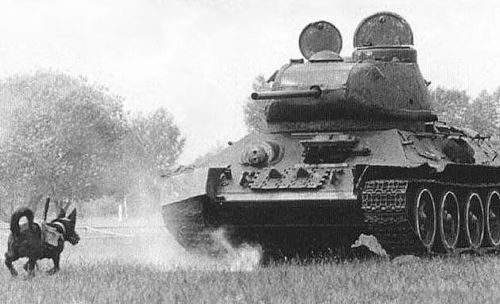
Yes, that’s a real dog, and no, the photo isn’t doctored. During World War II the Soviets experimented with “anti-tank dogs,” dogs that were trained to run under enemy tanks with explosives strapped to their backs.
Unfortunately, the Soviets trained the dogs by putting food under their own tanks, which led to some Three-Stooges-style hijinks on the battlefield. In 1942, an entire Soviet tank division was chased into retreat by its own dogs. Serves ’em right.
Eric II of Denmark styled himself Eric the Memorable.
No one remembers why.
Relationships among U.S. presidents:

Drake’s Plate of Brass is a museum curator’s nightmare: A priceless artifact revealed as historians’ in-joke gone terribly awry.
The story surrounds a golden plate that Francis Drake reportedly left as a monument when he visited Northern California in 1579. Hoping to fool one of their number, a group of local historians hammered out a fake version in 1936 and planted it near Drake’s landing point.
Sure enough, it made its way to the victim, historian George Bolton of Berkeley. Before they could reveal the joke, though, Bolton vouched for the plate’s authenticity, engaging the University of California and paying $2,500 for it.
Now that the hoax was so painfully public the conspirators had to move carefully. They tried discreetly to reveal their joke, but then to their horror Columbia University confirmed the plate as genuine. It was added to textbooks; likenesses were sold as souvenirs; copies were presented to Queen Elizabeth II herself on several occasions.
Only 40 years later, after exhaustive testing at Oxford, Lawrence Berkeley Laboratory and MIT, was the plate confirmed as a fake, and it was several years before the whole story was pieced together. The plate is still on display at the Bancroft Library at Berkeley, an embarrassing testament to the gullibility of an excited historian.
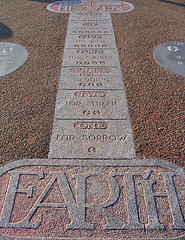
It’s ironic that hopscotch has come to be known as a little girl’s game, because it couldn’t have a more masculine pedigree. The first hopscotch courts were used in military training exercises in ancient Britain during the early Roman Empire. Footsoldiers wearing field packs and full body armor ran through courts 100 feet long, much as football players run through truck tires today.
Imitating the soldiers, Roman children drew their own smaller courts and added a scoring system, which has been preserved remarkably well for more than a thousand years as the game has spread to France (where it’s called “Marelles”), Germany (“Templehupfen”), the Netherlands (“Hinkelbaan”), India (“Ekaria Dukaria”), and even Vietnam (“Pico”) and Argentina (“Rayuela”).
Today’s children still draw their hopscotch courts with the word “London” at the top, without knowing that they’re representing the Great North Road, a 400-mile Roman road from Glasgow to London that was frequently used by the Roman military.
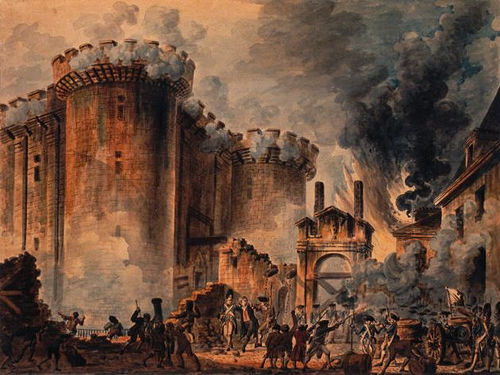
“Nothing.” — Louis XVI
(Diary entry for July 14, 1789, the day of the storming of the Bastille.)
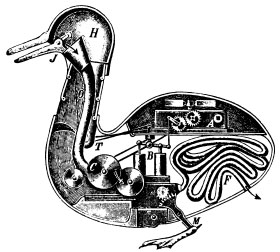
Vaucanson’s Shitting Duck was one of the more unsavory products of the French Enlightenment.
When it was unveiled by Jacques de Vaucanson in 1739, thousands watched the “canard digérateur” stretch its neck to eat grain from a hand. The food then dissolved, “the matter digested in the stomach being conducted by tubes, as in an animal by its bowels, into the anus, where there is a sphincter which permits it to be released.” These inner workings were all proudly displayed, “though some ladies preferred to see them decently covered.”
Why make fake duck shit when the world is so well supplied with the real thing? It was part of the Enlightenment’s transition from a naturalistic to a mechanical worldview. Suddenly a duck was not a God-given miracle but a machine made of meat, and complex automatons carried the promise of mechanized labor, stirring a cultural revolution.
Goethe mentioned Vaucanson’s automata in his diary, and Sir David Brewster called the duck “perhaps the most wonderful piece of mechanism ever made.” Sadly, the whole thing was a fake: The droppings were prefabricated and hidden in a separate compartment. Back to the drawing board.
