Technology

Traffic Forecast

http://www.sxc.hu/photo/326255

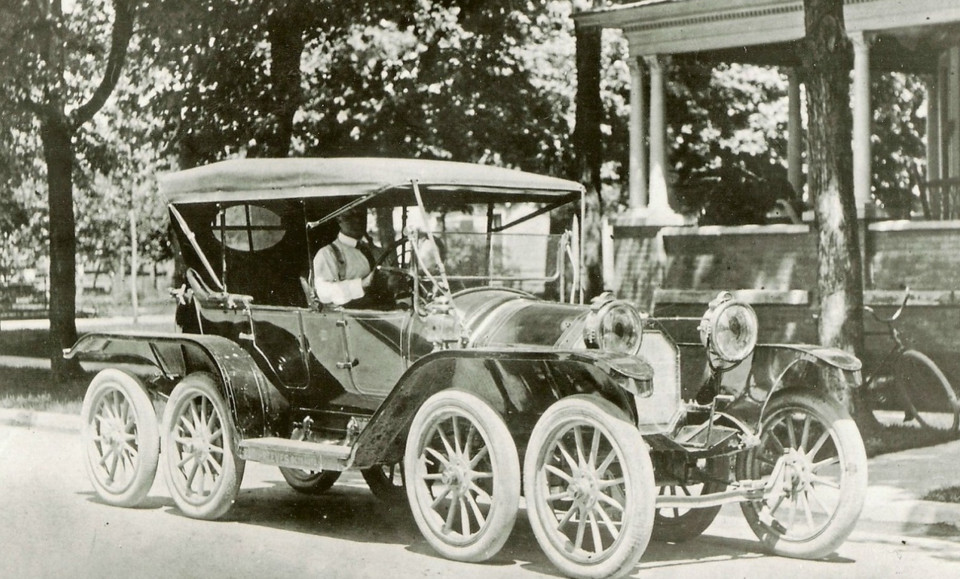
John Macnie’s 1883 utopian novel The Diothas describes paved roads on which cars achieve speeds of 20 miles per hour:

When we had fairly emerged into the country, the curricle, gradually increasing its speed, moved over the smooth track like a shadow, obedient to the slightest touch of its guide. Steering was effected much as in the tricycle of the present: the brakes were controlled by the feet. The forefinger, by means of a lever resembling the brake of a bicycle, regulated the amount of force allowed to issue from the reservoir.

That’s not the remarkable part, though. “‘You see the white line running along the centre of the road,’ resumed Utis. ‘The rule of the road requires that line to be kept on the left except when passing a vehicle in front. Then the line may be crossed, provided the way on that side is clear.’”

Lending a Hand

http://books.google.com/books?id=aswXAQAAMAAJ

The tricks by which a shop-lifter succeeds in plying her profession without being caught are many and ingenious. The most successful of all tricks is the false arm and hand, shown in one of the illustrations. While the shop-lifter’s hands are apparently in sight of the store clerks, one is at work stowing away articles. The false hand is, of course, gloved and thrust through one of the sleeves. The real hand works under cover of the bodice and coat. The second illustration shows one of the pockets in which stolen articles are secreted.

Popular Mechanics, September 1908

No Hands

https://www.google.com/patents/US755209

Illinois inventor James E. Bennett offered this contraption in 1904 to enable baseball catchers to intercept the ball without using their hands. The ball passes through the wire frame and hits a cushion at the rear of the box, then drops into a pocket from which the player can retrieve it.

It was not well received. The Cincinnati Enquirer said the box resembled “a cage built for a homesick bear or a dyspeptic hyena.”

Further, as Dan Gutman points out in his 1995 collection of baseball inventions, Banana Bats & Ding-Dong Balls, a catcher does more than catch pitches. “On a high pop, presumably, the catcher would have to run to the spot where he judged the ball was going to land, then lie on the ground face up and wait for it to hit him in the stomach.” At least his hands will be free.

Round Trip

http://www.google.com/patents/US3933115

Looking for a nimble way to transport large amounts of cargo across bodies of water, Alessandro Dandini invented this “spherical rolling hull marine vessel” in 1974. The sphere contains a motor that trundles along a continuous track, which sets the hull rolling across the water. Cargo can be stored inside the sphere, in the two cabins mounted on the sides, or suspended beneath them. (The detachable cabins can also serve as life craft.) Because the sphere has a relatively low draft, it can move through the water with less drag than a conventional vessel. “It provides for a fast turnaround when loading and unloading cargo, which results in a highly efficient water transportation vessel.”

Easy Rider

http://www.google.com/patents/US6270132

I thought I was kidding on Sunday when I suggested a motorized corn cob holder. But in 2001 Nicholas Kretschmer patented exactly that — and his simulates the sound of a motorcycle engine.

http://www.futilitycloset.com/2013/05/26/cold-whirled/

A more direct approach:

(Thanks, Bianca, Ethan, and Jesse.)

Cold Whirled

http://www.google.com/patents/about?id=WlYWAAAAEBAJ

Richard Hartman’s “motorized ice cream cone,” patented in 1999, saves both time and trouble:

Because the act of eating an ice cream cone has traditionally been performed by holding a scoop of ice cream largely stationary in one’s hand relative to the continuous licking movements of one’s tongue, the appeal of a device that basically reverses this procedure — that is, continuously moves the ice cream portion while one’s tongue is held in a relatively stationary position — has been largely overlooked. However, it can be seen that such a device is enormously entertaining, extends the natural enjoyment and creative play possibilities of eating ice cream and similarly malleable foods, and enhances the overall experience of eating such foods for young children and adults alike.

Perhaps we can apply the same principle to corn on the cob.

Unbound

http://commons.wikimedia.org/wiki/File:Wright_flyer_III_loc_gov.jpg

Samuel Johnson’s 1759 novel Rasselas contains a remarkable passage — he anticipates the airplane by nearly 150 years:

He that can swim needs not despair to fly; to swim is to fly in a grosser fluid, and to fly is to swim in a subtler: We are only to proportion our power of resistance to the different density of the matter through which we are to pass: You will be necessarily upborne by the air, if you can renew any impulse upon it, faster than the air can recede from the pressure.

“As a basic claim for a modern patent, the statement could not be broader nor more comprehensive,” wrote a correspondent to U.S. Air Service in 1920. “It only required the modern high-powered internal combustion engine to render his claim effective.”

The Loneliest Number

http://www.google.com/patents/about?id=2DASAAAAEBAJ

Patented by Zoya Hajianpour in 2004: a “roller for applying sunscreen to one’s own back.”

That’s not as sad as this.

Low Tech

http://www.google.com/patents/US5263209

Brooke Pattee’s “night light for a toilet,” patented in 1993, mounts a tube filled with electrical lamps under the upper rim of a toilet bowl so that users can use the bathroom without fumbling in the dark or being blinded by the overhead light.

Blake Warrington’s “toilet seat cover position alarm,” patented in 1989, sounds an alarm if the seat cover is not lowered after the toilet is flushed. “The alarm has the practical effect of conditioning persons who use the toilet to routinely close the toilet seat cover.”

Lost Weapons

Swords in the ancient Middle East were made of a substance called Damascus steel, which was noted for its distinctive wavy pattern and famed for producing light, strong, and flexible blades. No one knows how it was made.

In defending Constantinople against the Muslims, the Byzantine Empire used something called “Greek fire,” an incendiary substance that was flung at the enemy’s ships and that burned all the more fiercely when wet. But precisely what it was, and how it was made, have been forgotten.

(Thanks, Mike.)

http://commons.wikimedia.org/wiki/File:Greekfire-madridskylitzes1.jpg

Eavesdropping

Edwardian journalist Charles Cyril Turner, the world’s first modern aviation correspondent, describes a May morning alone in a balloon over Surrey:

Very slowly I approach a big wood. It would better express the situation were I to say that very slowly a big wood comes nearer to the balloon, for there is no sense of movement, and the earth below seems to be moving slowly past a stationary balloon. … Fifteen hundred feet up and almost absolute silence, broken occasionally by the barking of a dog heard very faintly, or by a voice hailing the balloon, and by an occasional friendly creak of the basket and rigging if I move ever so slightly. Then quite suddenly I am aware of something new.

The balloon has come down a little already, and I scatter a few handfuls of sand and await the certain result. But my attention is no longer on that, it is arrested by this new sound which I hear, surely the most wonderful and the sweetest sound heard by mortal ears. It is the combined singing of thousands of birds, of half the kinds which make the English spring so lovely. I do not hear one above the others; all are blended together in a wonderful harmony without change of pitch or tone, yet never wearying the ear. By very close attention I seem to be able at times to pick out an individual song. No doubt at all there are wrens, and chaffinches, and blackbirds, and thrushes, hedge sparrows, warblers, greenfinches, and bullfinches and a score of others, by the hundred; and their singing comes up to me from that ten-acre wood in one sweet volume of heavenly music. There are people who like jazz!

That’s from Turner’s 1927 memoir The Old Flying Days. Elsewhere he describes approaching the surface of the North Sea far from land: “We could hear the incessant murmur of the commotion of waters as the countless millions of waves and ripples sang together. Surely there is not in nature any sound quite like this, and only in a balloon can it be heard, for by the shore one hears only the turbulent noise of the waters breaking on land, and in any sort of ship the noise of the ship itself makes what to our ears would seem discord.”

Stick Up

http://www.google.com/patents/US292389

John Van Zandt’s “combined cane and burglar alarm,” patented in 1884, is low-tech but effective: The head contains a percussion cap, and the ferrule contains a spring clamp.

“The operation is as follows: The occupant of the room simply takes the cane and suspends the same over the top of the door, as hereinbefore explained. On the door being slightly opened the support for the cane is released, whereupon the cane drops and, striking the floor, explodes the cap, thus frightening away the thief and arousing the occupant of the room.”

Trouble Above

http://commons.wikimedia.org/wiki/File:Patent_Drawing_for_a_Flying_Machine,_10-05-1869_-_10-05-1869.jpg

I have fully considered the project of these our modern Dædalists, and am resolved so far to discourage it, as to prevent any person from flying in my time. It would fill the world with innumerable immoralities, and give such occasions for intrigues as people cannot meet with who have nothing but legs to carry them. You should have a couple of lovers make a midnight assignation upon the top of the monument, and see the cupola of St. Paul’s covered with both sexes like the outside of a pigeon-house. Nothing would be more frequent than to see a beau flying in at a garret window, or a gallant giving chaos to his mistress, like a hawk after a lark. There would be no walking in a shady wood without springing a covey of toasts. The poor husband could not dream what was doing over his head. If he were jealous, indeed, he might clip his wife’s wings, but what would this avail when there were flocks of whore-masters perpetually hovering over his house? What concern would the father of a family be in all the time his daughter was upon the wing?

– Joseph Addison, Guardian, July 20, 1713

Mother’s Milk

http://www.google.com/patents/US3122130

How do you feed newborn pigs when the mother has died or when they are so small or numerous that they may be crushed at feeding time? In 1961 Cora Lee Brown found a unique solution:

One of the important objects of this invention is the provision of a pig feeder designed in the form and size of an actual sow so as to simulate as much as possible the nursing environment afforded by the real animal and to thereby create a natural atmosphere for cultivating the natural eating habits and conditions of the newborn pigs.

In field tests Brown’s invention reduced the mortality rate of newborn pigs. It even plays a recording of the actual sounds of a sow at feeding time, “which operates on predetermined time schedules and is synchronized with the regulated supply of feed to the feeding tank.”

Things to Come

http://commons.wikimedia.org/wiki/File:Capek_RUR.jpg

DR. GALL: You see, so many Robots are being manufactured that people are becoming superfluous; man is really a survival. But that he should begin to die out, after a paltry thirty years of competition! That’s the awful part of it. You might think that nature was offended at the manufacture of the Robots. All the universities are sending in long petitions to restrict their production. Otherwise, they say, mankind will become extinct through lack of fertility. But the R.U.R. shareholders, of course, won’t hear of it. All the governments, on the other hand, are clamoring for an increase in production, to raise the standards of their armies. And all the manufacturers in the world are ordering Robots like mad.

HELENA: And has no one demanded that the manufacture should cease altogether?

DR. GALL: No one has the courage.

HELENA: Courage!

DR. GALL: People would stone him to death. You see, after all, it’s more convenient to get your work done by the Robots.

HELENA: Oh, Doctor, what’s going to become of people?

DR. GALL: God knows, Madame Helena, it looks to us scientists like the end!

– From Karel Čapek’s 1920 play R.U.R., which introduced the word robot

Sightseeing

http://www.google.com/patents/US502168

Sumter Battey’s surprisingly modern-looking “aerial machine” was patented in 1893. Essentially it’s an aluminum shell filled with hydrogen and bearing a car full of passengers and freight. The shell is fitted with adjustable wings, and the whole thing is propelled by detonating nitroglycerine pellets in the cup-shaped holder on the right, which can be swung back and forth in order to direct the vessel. “The devices for steering, as well as for causing the explosions, are fully under the control of the operator located within the car D.” What could go wrong?

Hair Tomorrow

http://www.google.com/patents/US4932098

In 1990, as the length of manned space missions began to increase dramatically, NASA’s Richard Haines began to wonder: On an extended mission, how could crew members groom themselves without leaving bits of hair and beard floating about the cabin?

His solution was a clear plastic bubble fitted with slits for a groomer’s hands, as well as a vacuum hose. The same apparatus can be used for almost any grooming task, including haircuts, shaving, and manicures.

“The device may also be used to collect the aerosol droplets of hair spray or small powder residue and the residue of other cosmetics which otherwise would float freely throughout the cabin.”

Pedal Pusher

http://www.google.com/patents/US4441728

Inventor Warren C. Schroeder offered a novel energy saver in 1981 — a sail for bicycles:

[The] sail … can be erected, dismantled or removed in seconds and … can take advantage of the wind direction in an arc that exceeds 200 degrees. The sail can be reoriented by the operator from the bicycle seat while in operation of the cycle. This allows operator to take full advantage of the full effective wind directional range and change. The use of the sail improves visibility of the bicycle from other vehicle operators thereby improving the safety of the cyclist.

“The bicycle sail allows the cycle enthusiast an inexpensive means of free transportation energy — the wind, ‘sailing on wheels.’” Stopping may be another matter.

“The Bender”

http://books.google.com/books?id=X640AQAAMAAJ

Scientific American examined a novel idea in 1854: a jointed ship whose fore and aft sections can rise and fall independently on the waves. The ship would then flex with each swell, and a chain extended between the masts could drive a paddlewheel amidships. “The hope is cherished that this Bender, whether in the form of a small boat for harbor use, or in a vessel of larger size, will demonstrate the practicability of using the wave power in moving against a head-wind.”

I don’t know how far they pursued the idea. A shipbuilder named George Steers declared himself “ready to undertake the construction of such a vessel for any parties that may apply to him.”

Weatherproof

http://www.google.com/patents/about?id=GrIYAAAAEBAJ

In 1998 Tennessee inventor Thomas Bennington conceived a novel way to make a wind-resistant house: Mount a decommissioned airliner on a rotating pillar. “The design and configuration of the fuselage enables it to always point into the wind, thereby presenting the smallest cross-sectional area to the destructive wind forces.”

Bennington envisions the house contending successfully with thunderstorms, tornadoes, and hurricanes. “Market forces have made certain types of commercial aircraft structures similar in cost per square foot to that of conventional ground-based dwellings. Such aircraft include Boeing 727s that have been removed from active service. Of course, the quality of the materials used in the fabrication of and the engineering associated with such aircraft are far superior than those seen in most wood-framed homes.”

Shocking

http://commons.wikimedia.org/wiki/File:Corset1908_047Fig25.png

We are sick of the röntgen rays … you can see other people’s bones with the naked eye, and also see through eight inches of solid wood. On the revolting indecency of this there is no need to dwell.

Pall Mall Gazette, March 1896

Water Bed

http://www.google.com/patents/US299951

Edward Brown’s ill-considered “hammock canoe,” patented in 1884, can be suspended between trees like a conventional hammock or launched on a river like a bottomless aquatic coffin:

On the sides of the main structure or frame handles or holding means are provided, by means of which the person using the device can support the same while walking or floating with their body protruding through the opening in the netting or floor of the float. In addition to the handles I can employ a strap or band adapted to pass over the shoulders of the person using the device.

It’s not clear to me how someone can walk, float, lie, stand, and carry a boat at the same time. Perhaps I should get one and try it out.

A Leg Up

http://www.google.com/patents/US6161223

Allison Andrews had a brainstorm in 1999: If our pants could be easily divided in two, then we could mix and match their halves:

This system saves money by providing a pair of pants that is selectable from the set of all combinations of the left legs against the right legs. Since most members of the combination set do not physically exist at any given time, the user has a large selection set for a fraction of the price.

This way, your wardrobe increases geometrically with each new purchase.

Extra Credit

Boeing was demonstrating its new Dash-80 airliner for the nation’s air transport executives in Seattle in August 1955 when test pilot Alvin “Tex” Johnston decided to impress them — instead of a simple flyover he performed a barrel roll:

In 1994, just before test pilot John Cashman undertook the maiden flight of the 777, Boeing president Phil Condit told him, “No rolls.”