Religion

Quiet Study

When French-American philanthropist Stephen Girard founded Philadelphia’s Girard College in 1830, he explicitly excluded religion from the campus:

I enjoin and require that no ecclesiastic, missionary or minister of any sect whatsoever, shall ever hold or exercise any station or duty whatever in the said college; nor shall any such person ever be admitted for any purpose, or as a visitor, within the premises appropriated to the purposes of the said college.

“In making this restriction, I do not mean to cast any reflection upon any sect or person whatsoever,” he wrote, “but, as there is such a multitude of sects, and such a diversity of opinion amongst them, I desire to keep the tender minds of the orphans, who are to derive advantage from this bequest, free from the excitement which clashing doctrines and sectarian controversy are so apt to produce.”

The Golden Key

A monk was standing at a convent gate,
With sanctimonious phiz, and shaven pate,
Promising, with solemn cant,
To all that listen’d to his rant,
A full and perfect absolution,
With half-a-dozen hallowed benedictions,
If they would give some contribution,
Some large donation supererogatory,
To ransom fifty murder’d christians,
And free their precious souls from purgatory:
When (he asserted) they would gain
A passport from the realms of pain,
And find a speedy passage to the skies.
A knight was riding by, and heard these lies;
He stopp’d his horse, “Salve,” the parson cried;
And “Benedicite” the youth replied.
“Most reverend father,” quoth the knight,
Who, it appears, was sharp and witty,
“These martyr’d christians’ wretched plight
Believe me, I sincerely pity:
Nay, more–their sufferings to relieve,
I will these fifty ducats give.”
This was no sooner said than done;
The priest pronounc’d his benison.
“Now, I presume,” the soldier said,
“The spirits of these christians dead
Have reach’d their final place of rest?”
“Most true,” replied the rev’rend friar,
“(Unless Saint Francis is a liar;)
And, to reward the pious action
Of this most christian benefaction,
You will, no doubt, eternally be blest.”
“Well, then,” exclaim’d the soldier-youth,
“If what you say indeed be truth,
And these same pieces that I’ve given,
Have snatch’d their souls from purgatory’s pains,
And bought them a snug place in heaven,
No further use for them remains.”
He said thus much to prove, at least,
He was as cunning as the priest:
Then put the ducats in his poke
And rode off, laughing at the joke.

– “C.J.D.,” in The Mirror of Literature, Amusement, and Instruction, 1824

Heaven on Earth

In 1864, Peter and Hannah Armstrong deeded a tract of Pennsylvania land to God:

Containing four square miles of land of which we have redeemed about six hundred acres, and we do hereby set apart the balance of said tract at or before the redemption of the whole world, as the purchased possession of Jesus Messiah, together with all and singular rights, liberties, privileges and appurtenances whatsoever thereunto belonging to us; we do grant, deed and convey to the said Creator and God of heaven and earth and to his heirs Jesus Messiah, for their proper use and behoof for ever. In witness whereof we have hereunto set our hands and seal the day and year above written.

The Deity failed to pay his property taxes, unfortunately, and the land was auctioned back to a human.

In an 1884 will, Charles Hastings deeded a plot of Massachusetts land “unto the Lord Jesus, the Supreme Ruler of the Universe.” Perhaps learning from the Armstrongs’ experience, he gave it in trust, reserving the right as agent to “occupy and improve, make repairs, pay taxes, insurance policies, &c.” But Hastings’ heirs contested the will in 1897, and it was declared invalid.

The Greater Good

http://commons.wikimedia.org/wiki/File:Fawn_3.jpg

Suppose in some distant forest lightning strikes a dead tree, resulting in a forest fire. In the fire a fawn is trapped, horribly burned, and lies in terrible agony for several days before death relieves its suffering. So far as we can see, the fawn’s intense suffering is pointless. For there does not appear to be any greater good such that the prevention of the fawn’s suffering would require either the loss of that good or the occurrence of an evil equally bad or worse. Nor does there seem to be any equally bad or worse evil so connected to the fawn’s suffering that it would have had to occur had the fawn’s suffering been prevented. Could an omnipotent, omniscient being have prevented the fawn’s apparently pointless suffering? The answer is obvious, as even the theist will insist. An omnipotent, omniscient being could have easily prevented the fawn from being horribly burned, or, given the burning, could have spared the fawn the intense suffering by quickly ending its life, rather than allowing the fawn to lie in terrible agony for several days. Since the fawn’s intense suffering was preventable and, so far as we can see, pointless, doesn’t it appear that … there do exist instances of intense suffering which an omnipotent, omniscient being could have prevented without thereby losing some greater good or permitting some evil equally bad or worse?

– William L. Rowe, “The Problem of Evil and Some Varieties of Atheism,” American Philosophical Quarterly 16.4 (1979): 335-341.

Beaten Brass

In modern Europe, as in ancient Greece, it would seem that even inanimate objects have sometimes been punished for their misdeeds. After the revocation of the edict Nantes, in 1685, the Protestant chapel at La Rochelle was condemned to be demolished, but the bell, perhaps out regard for its value, was spared. However, to expiate the crime of having rung heretics to prayers, it was sentenced to be first whipped, and then buried and disinterred, by way symbolizing its new birth at passing into Catholic hands. Thereafter it was catechized, and obliged to recant and promise that it would never again relapse into sin. Having made this ample and honourable amends, the bell was reconciled, baptized, and given, or rather sold, to the parish of St. Bartholomew. But when the governor sent in the bill for the bell to the parish authorities, they declined to settle it, alleging that the bell, as a recent convert to Catholicism, desired to take advantage of a law lately passed by the king, which allowed all new converts a delay of three years in paying their debts.

– James George Frazer, Folk-Lore in the Old Testament, 1918

Mr. Big

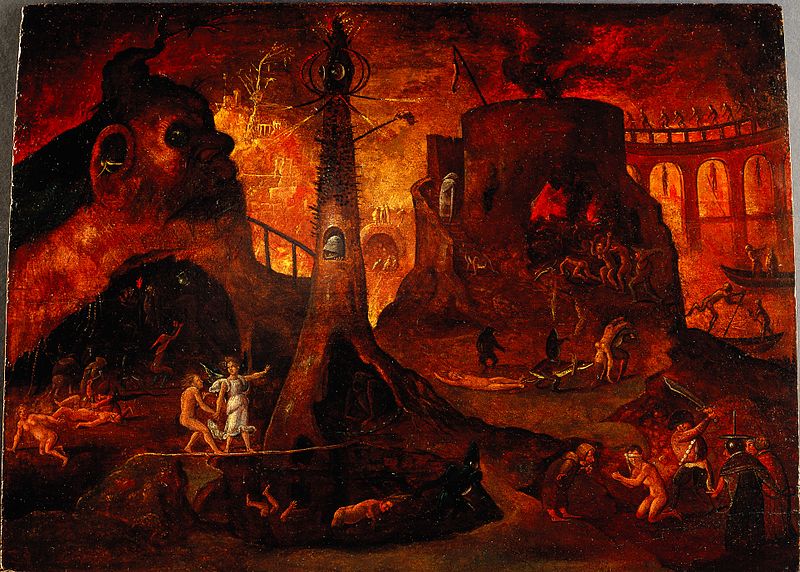
http://commons.wikimedia.org/wiki/File:Pandemonium.jpg

One Filmer, defending witches in England, is said to have made this ingenious defense. His clients were charged, as was usual, with being accessory to the devil. Under the common law there could be no accessory unless there was also a principal; and no accessory could be convicted until the principal was convicted; for if the principal be acquitted there is no guilty principal and hence can be no accessory. Consequently until the principal be convicted the accessory cannot be tried.

Taking advantage of this state of the law, Filmer argued that his clients could not be tried until their alleged principal had been tried and convicted, and how could this be done? Only according to the law of the land. In the first place how could the devil be summoned? The officer serving the precept would either be obliged to go to the devil and summons him personally, or, failing that, would be obliged to leave a copy of the precept at his usual place of abode. Although admiring friends of the officer may from time to time have advised him to do both, yet the practical application of such advice is an impossibility. Then assuming the respondent to be duly summoned, he would be entitled to a trial by a jury of his peers. But His Satanic Majesty has no peers, and even if he had, they would be certain to be in collusion with the respondent and would certainly acquit him. Under any circumstances therefore how could his accessories be tried?

– H.C. Shurtleff, “The Grotesque in Law,” American Law Review, January-February 1920

Technicality

A table of signs used during hours of silence by the sisters in the Syon Monastery in Isleworth, Middlesex, in the 15th century:

Ale — Make the sign of drink and draw thy hand displayed before thine ear downward.
Bed — Make the sign of a house and put thy right hand under thy cheek, and close thine eyes.
Book — Wag and move thy right hand in manner as thou shouldest turn the leaves of a book.
Cheese — Hold thy right hand flatways in the palm of thy left.
Cold — Make the sign of water trembling with thy hand or blow on thy forefinger.
Drink — Bow thy right forefinger and put it on thy nether lip.
Eating — Put thy right thumb with two forefingers joined to thy mouth.
Girdle — Draw the forefingers of either hand round about thy middle.
Glass — Make the sign of a cup with the sign of red wine.
Incense — Put thy two fingers into thy two nostrils.
Mustard — Hold thy nose in the upper part of thy right fist and rub it.
Salt — Fillip with the right thumb and forefinger over the left thumb.
Sleeping — Put thy right hand under thy cheek and forthwith close thine eyes.
Water — Join the fingers of thy right hand and move them downward droppingly.

Giraldus Cambrensis, describing the monks of Canterbury in 1180, wrote that they were “so profuse in their gesticulations of fingers and hands and arms, and in the whisperings whereby they avoided open speech, wherein all showed a most unedifying levity and license,” that he felt as if he were sitting “at a stage play or among a company of actors or buffoons: for it would be more appropriate to their Order and to their honourable estate to speak modestly in plain human speech than to use such a dumb garrulity of frivolous signs and hissings.”

The Final Exam

http://commons.wikimedia.org/wiki/File:Ten_Commandments_by_A.Losenko_(%3F).jpg

“The Ten Commandments should be treated like an examination. Only six need to be attempted.” So said Bertrand Russell, allegedly.

“I have a variant,” wrote J.E. Littlewood. “As a Pure mathematician I can’t be expected to do the Applied ones. Interpreting No. 1 to mean what it says in logic, I should be prepared to do the Pure ones. No. 2 is a sitter, No. 3 would take some initial caution, but worth it with the reward of full marks. It is good mental hygiene to take Sunday off, and I could throw in this Applied question. Nos. 5 to 10 are applied. Actually my parents are dead so No. 6 is a walk-over. And I should be disappointed if I didn’t get full marks on the applied 9 and 10.”

A World Away

http://en.wikipedia.org/wiki/File:Tematangi.jpg

The Tematangi atoll in French Polynesia is on the opposite side of the world from Mecca.

This makes the qibla, or Muslim direction of prayer, strangely sensitive in this region. Muslims on neighboring islands who are praying toward Mecca may find themselves facing in markedly different directions.

Changing Teams

A very old Jewish man called his wife to his bed. ‘I am going to die. Please call a priest — I wish to convert to Catholicism.’ His wife responded with shock and disbelief, reminding her husband that they had been devout Jews all their lives. ‘I know, dear,’ he said, ‘but isn’t it better that one of them should die than one of us?’

– Anonymous epigraph to John Martin Fischer, The Metaphysics of Death, 1993

Pasted Praise

This “parable against persecution” was a favorite of Benjamin Franklin, who would sometimes pretend to recite it out of a Bible as “the 51st chapter of Genesis.” He wrote that “the remarks of the Scripturians upon it … were sometimes very diverting”:

1. And it came to pass after these things, that Abraham sat in the door of his tent, about the going down of the sun.

2. And behold a man, bowed with age, came from the way of the wilderness, leaning on a staff.

3. And Abraham arose and met him, and said unto him, ‘Turn in, I pray thee, and wash thy feet, and tarry all night, and thou shalt arise early on the morrow, and go on thy way.’

4. But the man said, ‘Nay, for I will abide under this tree.’

5. And Abraham pressed him greatly; so he turned, and they went into the tent; and Abraham baked unleavened bread, and they did eat.

6. And when Abraham saw that the man blessed not God, he said unto him, ‘Wherefore dost thou not worship the most high God, creator of heaven and earth?’

7. And the man answered and said, ‘I do not worship the God thou speakest of; neither do I call upon his name; for I have made to myself a God, which abideth alway in mine house, and provideth me with all things.’

8. And Abraham’s zeal was kindled against the man; and he arose, and fell upon him, and drove him forth with blows into the wilderness.

9. And at midnight God called unto Abraham, saying, ‘Abraham, where is the stranger?’

10. And Abraham answered and said, ‘Lord, he would not worship thee, neither would he call upon thy name; therefore have I driven him out from before my face into the wilderness.’

11. And God said, ‘Have I borne with him these hundred ninety and eight years, and nourished him, and clothed him, notwithstanding his rebellion against me; and couldst not thou, that art thyself a sinner, bear with him one night?’

12. And Abraham said, ‘Let not the anger of my Lord wax hot against his servant; lo, I have sinned; forgive me, I pray thee.’

13. And Abraham arose, and went forth into the wilderness, and sought diligently for the man, and found him, and returned with him to his tent; and when he had entreated him kindly, he sent him away on the morrow with gifts.

14. And God spake again unto Abraham, saying, ‘For this thy sin shall thy seed be afflicted four hundred years in a strange land;

15. ‘But for thy repentance will I deliver them; and they shall come forth with power, and with gladness of heart, and with much substance.’

(In reality it’s thought to have originated with the Persian poet Saadi.)

Oops

That the deliverance of the saints must take place some time before 1914 is manifest, since the deliverance of fleshly Israel, as we shall see, is appointed to take place at that time, and the angry nations will then be authoritatively commanded to be still, and will be made to recognize the power of Jehovah’s Anointed. Just how long before 1914 the last living members of the body of Christ will be glorified, we are not directly informed; but it certainly will not be until their work in the flesh is done; nor can we reasonably presume that they will long remain after that work is accomplished. With these two thoughts in mind, we can approximate the time of the deliverance.

– Charles Taze Russell, Studies in the Scriptures, 1908

That the deliverance of the saints must take place very soon after 1914 is manifest, since the deliverance of fleshly Israel, as we shall see, is appointed to take place at that time, and the angry nations will then be authoritatively commanded to be still, and will be made to recognize the power of Jehovah’s Anointed. Just how long after 1914 the last living members of the body of Christ will be glorified, we are not directly informed; but it certainly will not be until their work in the flesh is done; nor can we reasonably presume that they will long remain after that work is accomplished. With these two thoughts in mind, we can approximate the time of the deliverance.

– Charles Taze Russell, Thy Kingdom Come, 1916

Fair Enough

The grave of Arthur Haine in the City Cemetery [of Portland, Oregon], between 10th and 13th Streets, is marked by a stone of his own design and the epitaph, ‘Haine Haint.’ Haine, who died in 1907, left a will saying, ‘Having lived as an atheist I want to be buried like one — without any monkey business.’

– Federal Writers’ Project, Oregon Trail: The Missouri River to the Pacific Ocean, 1939

The Unseen Gardener

http://commons.wikimedia.org/wiki/File:David_Bates_-_Summer_flowers_in_a_quiet_corner_of_the_garden.jpg

Two people return to their long neglected garden and find among the weeds a few of the old plants surprisingly vigorous. One says to the other, ‘It must be that a gardener has been coming and doing something about these plants.’ Upon inquiry they find that no neighbour has ever seen anyone at work in their garden. The first man says to the other, ‘He must have worked while people slept.’ The other says, ‘No, someone would have heard him and besides, anybody who cared about the plants would have kept down these weeds.’ The first man says, ‘Look at the way these are arranged. There is purpose and a feeling for beauty here. I believe that someone comes, someone invisible to mortal eyes. I believe that the more carefully we look the more we shall find confirmation of this.’ They examine the garden ever so carefully and sometimes they come on new things suggesting that a gardener comes and sometimes they come on new things suggesting the contrary and even that a malicious person has been at work. Besides examining the garden carefully, they also study what happens to gardens left without attention. Each learns all the other learns about this and about the garden. Consequently, when after all this, one says, ‘I still believe a gardener comes’ while the other says, ‘I don’t,’ their different words now reflect no difference as to what they have found in the garden, no difference as to what they would find in the garden if they looked further and no difference about how fast untended gardens fall into disorder. … What is the difference between them?

– John Wisdom, “Gods,” Proceedings of the Aristotelian Society, 1944

Antony Flew asks, “Just how does what you call an invisible, intangible, eternally elusive gardener differ from an imaginary gardener or even from no gardener at all?”

Next!

Modern times have come to China — religious teachers must now fill out a government application before they can be reincarnated.

The decree, passed in 2007, requires that applications be submitted to four different government bodies. “The selection of reincarnates must preserve national unity and solidarity of all ethnic groups, and the selection process cannot be influenced by any group or individual from outside the country.”

“Work out your own salvation,” said the Buddha. “Do not depend on others.”

Unquote

http://commons.wikimedia.org/wiki/File:Preaching.jpg

“There is not one command in all the Gospel for public worship. … The frequent attendance at it is never so much as mentioned in all the New Testament.” — William Law

High Anxiety

http://commons.wikimedia.org/wiki/File:Sun_and_Moon_creation.jpg

If God is infinitely just, he will punish wrongdoers.

If he’s infinitely merciful, he’ll forgive them.

Can he do both?

(Bonus palindrome: Did I do, O God, did I as I said I’d do? Good, I did!)

Private Line

In 1980, Morris Davie was accused of setting forest fires and brought to the headquarters of the Royal Canadian Mounted Police to take a lie detector test. He was left alone in a room, where a hidden camera recorded him dropping to his knees and saying, “Oh God, let me get away with it just this once.”

At trial, his lawyer objected to this evidence, arguing that it violated a Canadian law that prohibited the interception of private communications “made under circumstances in which it is reasonable for the originator thereof to expect that it will not be intercepted by any person other than the person intended by the originator thereof to receive it.”

Is God a person? The trial judge thought so — he held the videotape inadmissible and Davie was acquitted. The British Columbia Court of Appeal disagreed, however, deciding that a private communication requires an “intended human recipient.”

“In my opinion,” wrote Justice J.A. Hutcheon, “the word ‘person’ is used in the statutes of Canada to describe someone to whom rights are granted and upon whom obligations are placed. There is no earthly authority which can grant rights or impose duties upon God. I can find no reason to think that the Parliament of Canada has attempted to do so in the enactment of sections of the Criminal Code dealing with the protection of privacy.” He ordered a new trial.

Fringe Sect

In 1918, Bertrand Russell was sentenced to six months in prison for writing an antiwar essay.

I was much cheered in my arrival by the warder at the gate who had to take particulars about me. He asked my religion and I replied ‘agnostic.’ He asked how to spell it, and remarked with a sigh: ‘Well, there are many religions, but I suppose they all worship the same God.’

“This remark kept me cheerful for about a week.”

The Alexamenos Graffito

http://commons.wikimedia.org/wiki/File:Alexorig.jpg

In 1857 archaeologists unsealed an ancient house on the Palatine Hill in Rome. Inside, carved into the plaster of one of the walls, they found this inscription.

It appears to show a donkey-headed figure attached to a cross. A young man raises his hand to it, perhaps in worship. Below this is written in crude Greek, “Alexamenos worships [his] God.”

It’s believed to be one of the first representations of the crucifixion of Jesus.

Pssst

Can praying improve your reasoning? I once questioned a student about his suspicious behavior during a logic examination. He confessed that he was praying for the correct answer. I felt this was cheating. Even if God did not give him the answer, the student was soliciting the answer from Someone Else.

– Dartmouth philosopher Roy Sorensen, in A Brief History of the Paradox, 2003

Mixed Blessing

I read about an Eskimo hunter who asked the local missionary priest, ‘If I did not know about God and sin, would I go to hell?’ ‘No,’ said the priest, ‘not if you did not know.’ ‘Then why,’ asked the Eskimo earnestly, ‘did you tell me?’

– Annie Dillard, Pilgrim at Tinker Creek, 1974

Devil’s Advocate

Calling Halloween “the devil’s holiday,” in 1986 Ralph P. Forbes of London, Ark., filed suit to prevent the public schools from letting kids wear costumes to school.

He filed the suit on behalf of himself, all Christian children, and Jesus Christ. The defendants included the Arkansas Department of Education, “high priests of secular humanism,” and Satan.

U.S. District Judge George Howard Jr. continued the case, whereupon attorney John Wesley Hall Jr. offered to represent Satan pro bono. He pointed out that the Dark One doesn’t transact business, own property, or commit torts in Arkansas, and asked the judge to drop him as a defendant.

The Chicago Tribune reported drily that “efforts to reach Satan for comment were unsuccessful.”

For What It’s Worth

A paper received from Natal Africa contains an article by Rev. Josiah Tyler on the similarity of Jewish and Zulu customs. Among them we mention several: The feast of first fruits, rejection of swine’s flesh, right of circumcision, the slayer of the king not allowed to live, Zulu girls go upon the mountains and mourn days and nights, saying ‘Hoi! Hoi!’ like Jepthah’s daughter, traditions of the universal deluge, and of the passage of Red Sea; great men have servants to pour water on their hands; the throwing stones into a pile; blood sprinkled on houses. The authors’ belief is that the Zulus were cradled in the land of the Bible. Certain customs are mentioned which may be ascribed to the primitive tribal organism. These are as follows: Marriages commonly among their own tribe; uncle called father, nephew a son, niece a daughter; inheritance descends from father to eldest son. If there are no sons it goes to the paternal uncle. A surmise has been advanced by some that the relics of the Queen of Sheba’s palace may be found in certain ancient ruins described by Peterman, Baines and others, and the Ophir of scripture has been located at Sofala, an African port.

The American Antiquarian, January 1885