Futility Closet

"To Take a Man's Waistcoat Off Without Removing His Coat"

Posted in Puzzles, Science & Math by Greg Ross on April 14th, 2008

The waistcoat should first be unbuttoned in the front, and then the buckle at the back must be unloosed. The operator, standing in front of the person operated upon, should then place his hands underneath the coat at the back, taking hold of the bottom of the waistcoat, at the same time requesting the wearer to extend his arms at full length over his head. Now raise the bottom part of the waistcoat over the head of the wearer (if the waistcoat be tight it will be necessary to force it a little, but this must not be minded so long as the waistcoat is not torn); the waistcoat then will have been brought to the front of the wearer, across his chest. Take the right side bottom-end of the waistcoat, and put it into the arm-hole of the coat at the shoulder, at the same time putting the hand up the sleeve, seizing the end, and drawing it down the sleeve; this action will release one arm-hole of the garment to be removed. The next thing to be done is to pull the waistcoat back again out of the sleeve of the coat, and put the same end of the waistcoat into the left arm-hole of the coat, again putting the hand up the sleeve of the coat as before, and seizing the end of the garment. It may then be drawn quite through the sleeve, and the puzzle is accomplished.

Cassell's Complete Book of Sports and Pastimes, 1896


"The Locked Gift": Solution

Posted in Puzzles by Greg Ross on April 8th, 2008

Solution to The Locked Gift, from Monday:

I put the necklace in a box, add a padlock, and send it to my wife.

She adds a second padlock and mails it back.

I remove my padlock and send her the box, and she opens it.

Dartmouth mathematician Peter Winkler writes, "This solution is not just play; the idea is fundamental in Diffie-Hellman key exchange, a historic breakthrough in cryptography."


The Locked Gift

Posted in Puzzles by Greg Ross on April 7th, 2008

http://www.sxc.hu/photo/90999

I want to mail a necklace to my wife, but anything sent through the mail will be stolen unless it's sent in a padlocked box. A box can bear any number of padlocks, but neither of us has the key to a lock owned by the other. How can I mail the necklace safely to my wife?

I'll give the answer tomorrow.


"Monkey and Pulley": Solution

Posted in Puzzles by Greg Ross on April 4th, 2008

Solution to Monkey and Pulley, from Thursday:

We find the age of the monkey works out at 1.5 years, and the age of the mother 2.5 years, and the monkey therefore weighing 2.5 lbs., and the weight the same. Then we soon discover that the rope weighed 1.25 lbs., or 20 oz.; and, as a foot weighed 4 oz., the length of the rope was 5 feet.

(From Henry Dudeney.)


"Monkey and Pulley"

Posted in Puzzles by Greg Ross on April 3rd, 2008

A rope is passed over a pulley. It has a weight at one end and a monkey at the other. There is the same length of rope on either side and equilibrium is maintained. The rope weighs four ounces per foot. The age of the monkey and the age of the monkey's mother together total four years. The weight of the monkey is as many pounds as the monkey's mother is years old. The monkey's mother is twice as old as the monkey was when the monkey's mother was half as old as the monkey will be when the monkey is three times as old as the monkey's mother was when the monkey's mother was three times as old as the monkey. The weight of the rope and the weight at the end is half as much again as the difference in weight between the weight of the weight and the weight and the weight of the monkey. Now, what is the length of the rope?

I'll give the answer tomorrow.


"King, Queen, Knave": Solution

Posted in Literature, Puzzles by Greg Ross on March 30th, 2008

nabokov chess problem solution

Solution to King, Queen, Knave, from last Sunday:

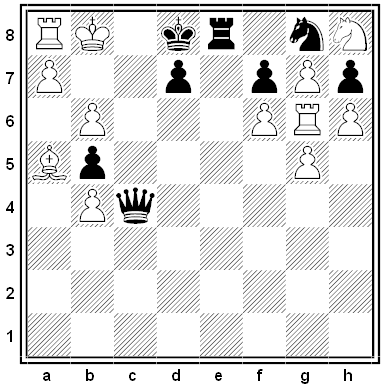
White's last move must have been an underpromotion, with a pawn on d7 capturing a knight on c8. If we retract that move we get the position above, and if the pawn instead now captures the rook on e8 and promotes to a knight, it gives mate. This is the only legal possibility that meets the requirements of the problem.

Nabokov writes, "There is some mild magic in the retrospective transformation of White R into Black Kt, and Black R into White Kt, with the symmetry of the pieces (and White's defense of c7) retained."


"Cupid's Arithmetic": Solution

Posted in Puzzles by Greg Ross on March 27th, 2008

Solution to Cupid's Arithmetic, from Wednesday:

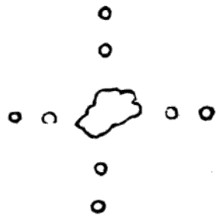
All the young mathematician had to do was to reverse the paper and hold it up to the light, or hold it in front of a mirror, when he would immediately see that his betrothed's curious jumble of figures will read:

cupid's arithmetic solution


"Cupid's Arithmetic"

Posted in Puzzles by Greg Ross on March 26th, 2008

A conundrum from Henry Ernest Dudeney, Modern Puzzles, 1926:

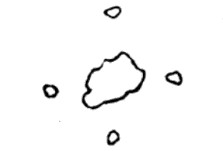
Dora Crackham one morning produced a slip of paper bearing the jumble of figures shown in our illustration. She said that a young mathematician had this poser presented to him by his betrothed when she was in a playful mood.

cupid's arithmetic

"What am I to do with it?" asked George.

"Just interpret its meaning," she replied. "If it is properly regarded it should not be difficult to decipher."

What did she mean? I'll give the answer tomorrow.


Kavka's Toxin Puzzle

Posted in Puzzles by Greg Ross on March 25th, 2008

I'll give you a million dollars if you intend to drink this poison.

You don't actually have to drink it. I'll pay you immediately, and then you're perfectly free to change your mind.

Can you do this?

(Posed by University of California political philosopher Gregory Kavka.)


King, Queen, Knave

Posted in Literature, Puzzles by Greg Ross on March 23rd, 2008

nabokov chess problem

Vladimir Nabokov composed chess problems. Here's a clever one from 1932: "White retracts its last move and mates in one."

This is an instance of retrograde analysis: Of the many legal moves that White might just have made, only one can be revised to yield an immediate mate. Can you find it?

I'll save the answer for next Sunday.