Meow
F.D.C. Willard isn’t the only overachieving housecat.
In 2004, a cat named Colby Nolan received an MBA from Trinity Southern University in a fraud investigation by the Pennsylvania attorney general.
To be fair, Colby had a pretty good resume. The cat’s application listed community college courses, work at a fast-food restaurant, babysitting, and a paper route. Once accepted he earned a 3.5 grade point average in the MBA program, according to his transcript.
In 1967, Oliver Greenhalgh, another cat, was accepted as a Fellow of the English Association of Estate Agents and Valuers during an investigation of bogus associations. Oliver paid 11 guineas; it’s not clear what would have happened if they’d called his references.
The New York Zoo Hoax
On Nov. 9, 1874, readers of the New York Herald were startled to learn that wild animals were roaming the city after a mass escape from the Central Park Zoo as city dwellers shot at them from tenement windows:
There is no instance reported of any animals being hit, while it is believed many citizens were struck by the missiles. One policeman, Officer Lannigan of the Seventh Precinct, was wounded in the foot near Grand Street by a shot from a window during a chase after the striped hyena, which was mistaken by the crowd for a panther. This cowardly brute was finally killed by a bartender armed with a club.
The story reported casualties of 27 dead and 200 injured. It sparked a panic, as most readers overlooked the last paragraph, which stated that “the entire story given above is a pure fabrication.” It had been intended to draw attention to inadequate safety precautions at the zoo.
The hoax’s mastermind, Thomas B. Connery, had two consolations: His paper’s circulation “did not drop by so much as one subscriber,” he reported — and he’d got to watch the editor of the rival New York Times leave his home “with a brace of pistols, prepared to shoot the first animals that would cross his path.”
The Berners Street Hoax
In 1810, Theodore Hook, a writer of comic operas, bet his friend Samuel Beazley that he could turn any house in London into the most talked-about address in the city within one week. Beazley accepted, and Hook began writing letters.
A few weeks later, on Nov. 10, a Mrs. Tottenham of 54 Berners Street turned away a coal merchant delivering a load of coal that she hadn’t ordered.
She was in for a long day. The Morning Post reported: “Wagons laden with coals from the Paddington wharfs, upholsterers’ goods in cart loads, organs, pioanofortes, linens, jewelry, and every other description of furniture sufficient to have stocked the whole street, were lodged as near as possible to the door of 54, with anxious trades-people and a laughing mob.”
It went on. “There were accoucheurs, tooth-drawers, miniature painters, artists of every description, auctioneers, … grocers, mercers, post-chaises, mourning-coaches, poultry, rabbits, pigeons, etc. In fact, the whole street was literally filled with the motley group.”
The merchants were followed by dignitaries: the governor of the Bank of England, the archbishop of Canterbury, cabinet ministers, dukes, and finally the lord mayor of London.
Hook won his bet, collecting one guinea. He eventually confessed to the prank, but apparently never received any punishment.
Mary Tofts

In 1726, 25-year-old English maidservant Mary Tofts began giving birth to rabbits. Despite a miscarriage earlier that year, she apparently went into labor, and local doctor John Howard delivered several stillborn rabbits.
More were coming. Howard summoned other doctors by letter, and Mary’s next litter was witnessed by Nathaniel St. Andre, surgeon-anatomist to King George I, and Sir Richard Manningham, the most famous obstetrician in London.
Amazed, St. Andre published a tract titled A Short Narrative of an Extraordinary Delivery of Rabbits. But Mary’s deliveries stopped when she was put under close supervision, and soon a boy came forward reporting that she had bribed him to supply her with more rabbits. In the end she confessed, saying she had done it “to get so good a living that I should never want as long as I lived.” Ah.
Ern Malley
I had often, cowled in the slumbrous heavy air,
Closed my inanimate lids to find it real,
As I knew it would be, the colourful spires
And painted roofs, the high snows glimpsed at the back,
All reversed in the quiet reflecting waters -
Not knowing then that Durer perceived it too.
Now I find that once more I have shrunk
To an interloper, robber of dead men’s dream,
I had read in books that art is not easy
But no one warned that the mind repeats
In its ignorance the vision of others. I am still
The black swan of trespass on alien waters.
That’s from “Durer: Innsbruck, 1495,” a poem by Ern Malley. When it was celebrated in the Australian modernist magazine Angry Penguins, its real authors, James McAuley and Harold Stewart, stepped forward. Not only had they written the poem, they said, but they had “deliberately perpetrated bad verse”: “We opened books at random, choosing a word or phrase haphazardly. We made lists of these and wove them in nonsensical sentences. We misquoted and made false allusions.”
The point, they said, was to show that modern critics had become “insensible of absurdity and incapable of ordinary discrimination.”
The critics insisted that they had accidentally created a masterpiece.
Fortune Favors the Bold
On Oct. 16, 1906, small-time criminal Wilhelm Voigt became a big-time criminal … for one day.
Wearing a secondhand captain’s uniform, he appeared at the local army barracks, where he dismissed the commander. Then, with 10 grenadiers and a sergeant in tow, he took a train to Köpenick, east of Berlin, and took over city hall.
There he confiscated 4,000 marks and 37 pfennigs and ordered the town secretary and the mayor sent to Berlin on charges of crooked bookkeeping. He told the remaining soldiers to guard the building for half an hour and then left for the train station, where he changed back to civilian clothes and slipped away.
Why? Why not?
Who?
Identities assumed by virtuoso impostor Stanley Clifford Weyman (1890-1960):
- U.S. consul representative to Morocco. Arrested for fraud.
- Military attaché from Serbia and U.S. Navy lieutenant (so the two could use each other as references).
- “Lt. Cmdr. Ethan Allen Weinberg, consul general for Romania.” He inspected the U.S.S. Wyoming and invited its officers to a dinner at the Astor Hotel. On being arrested, he was heard to complain that they should have waited until dessert.
- “Royal St. Cyr,” a lieutenant in the U.S. Army Air Corps. Arrested on an inspection tour of the Brooklyn armory.
- Company doctor in Lima, Peru. Threw parties until arrested.
- State Department naval liaison officer. Introduced himself to Princess Fatima of Afghanistan and promised to arrange a meeting with the president. She gave him $10,000 for “presents” to State Department officials. Weyman got appointments with Secretary of State Evans Hughes and with Warren G. Harding. Indicted for impersonating a naval officer.
- U.S. secretary of state. Interviewed Queen Marie of Romania for the Evening Graphic newspaper.
- Personal physician to Pola Negri, Rudolph Valentino’s grieving lover. Established a faith-healing clinic and issued regular press releases.
- Arrested during World War II for telling draft dodgers how to feign various medical conditions.
- Journalist for the United Nations. Caught when he asked the State Department whether he could remain a U.S. citizen if he became the Thai delegation’s press officer.
Ironically, Weyman’s most honest act may have been his last: He was shot trying to stop a robbery in a New York hotel. “One man’s life is a boring thing,” he once said. “I lived many lives. I’m never bored.”
Victoria Punk’d
From The Private Life of the Queen, by “One of Her Majesty’s Servants,” 1897:
Her Majesty [Queen Victoria] takes delight in a clever riddle or rebus, but on one occasion she was very angry at having been hoaxed over a riddle which was sent to her with a letter to the effect that it had been made by the Bishop of Salisbury.
For four days the Queen and Prince Albert sought for the reply, when Charles Murray (Controller of the Household) was directed to write to the bishop and ask for the solution.
The answer received was that the bishop had not made the riddle nor could he solve it.
Unicorn Hoax?

Gottfried von Leibniz was convinced of the existence of unicorns by this skeleton, found in Germany’s Harz Mountains in 1663.
Why does it have only two legs? Well, supporters said, that’s because souvenir hunters plundered it.
Then why did they take the legs but leave the horn? Um …
A Professional Student
According to his transcript, George P. Burdell has been a student at Georgia Tech since 1927. How? He was invented out of thin air when student Ed Smith received two enrollment forms. With Smith’s help, “Burdell” attended all his friend’s classes and took all the same exams.
For a nonexistent person, Burdell turned out to be pretty ambitious. Smith graduated in 1930, but his invisible friend stuck around, adopted by other students. He eventually earned a master’s degree and became an official alumnus, then flew 12 bombing missions over Europe in World War II. In 1969 he signed up for a whopping 3,000 credit hours at Georgia Tech — and began a 12-year term on MAD magazine’s board of directors. In 2001 he was briefly the leading contender among voters for TIME magazine’s person of the year.
Strangely, after 79 years of school Burdell is still only a sophomore. He’s majoring in civil engineering, according to a recent report card.
An Unacknowledged Genius
Onne Ruddeborne bank twa pynynge Maydens fate,
Theire teares faste dryppeynge to the waterre cleere;
Echone bementynge for her absente mate,
Who atte Seyncte Albonns shouke the morthynge speare.
The nottebrowne Elinoure to Juga fayre
Dydde speke acroole, wythe languishment of eyne,
Lyche droppes of pearlie dew, lemed the quyvryng brine.
That’s from “Elenoure and Juga,” a pastoral poem by Thomas Rowley, a 15th-century monk.
Actually, no, it’s not. Its real author was Thomas Chatterton, a 17-year-old boy who faked medieval manuscripts and “aged” them by holding them over candles or smearing them with glue or varnish.
He fooled everyone — this poem was published in Town and Country Magazine in May 1769, and Chatterton published several others in the following months. Starving and unable to reveal his secret, he was driven to suicide shortly afterward, but his work was discovered and praised posthumously by Shelley, Wordsworth, Coleridge and Keats.
“A Magic-Ridden People”
Excerpts from “Body Ritual Among the Nacirema,” a paper published by Horace Miner in the June 1956 edition of American Anthropologist:
- “They are a North American group living in the territory between the Canadian Cree, the Yaqui and Tarahumare of Mexico, and the Carib and Arawak of the Antilles. Little is known of their origin, although tradition states that they came from the east.”
- “The fundamental belief underlying the whole system appears to be that the human body is ugly and that its natural tendency is to debility and disease. Incarcerated in such a body, man’s only hope is to avert these characteristics through the use of ritual and ceremony. Every household has one or more shrines devoted to this purpose.”
- “In addition to the private mouth-rite, the people seek out a holy-mouth-man once or twice a year. These practitioners have an impressive set of paraphernalia, consisting of a variety of augers, awls, probes, and prods. The use of these items in the exorcism of the evils of the mouth involves almost unbelievable ritual torture of the client.”
- “There are ritual fasts to make fat people thin and ceremonial feasts to make thin people fat. Still other rites are used to make women’s breasts larger if they are small, and smaller if they are large. A few women afflicted with almost inhuman hyper-mammary development are so idolized that they make a handsome living by simply going from village to village and permitting the natives to stare at them for a fee.”
It’s a satire. What’s Nacirema spelled backward?
The Beale Ciphers
A secret hoard of $20 million in gold and silver lies buried somewhere near Roanoke, Va. That’s according to a coded message left by adventurer Thomas Jefferson Beale in the 1820s:
I have deposited in the county of Bedford, about four miles from Buford’s, in an excavation or vault, six feet below the surface of the ground, the following articles, belonging jointly to the parties whose names are given in number “3,” herewith:
The first deposit consisted of one thousand and fourteen pounds of gold, and three thousand eight hundred and twelve pounds of silver, deposited November, 1819. The second was made December, 1821, and consisted of nineteen hundred and seven pounds of gold, and twelve hundred and eighty-eight pounds of silver; also jewels, obtained in St. Louis in exchange for silver to save transportation, and valued at US$13,000.
The above is securely packed in iron pots, with iron covers. The vault is roughly lined with stone, and the vessels rest on solid stone, and are covered with others. Paper number “1″ describes the exact locality of the vault, so that no difficulty will be had in finding it.
Unfortunately, no one has been able to decipher paper “1″ or “3″, and a hundred years’ digging has turned up nothing. Is it a hoax? Who knows?
Hey, Wait a Minute …
Identities assumed by Ferdinand Waldo Demara (1921-1982), “The Great Impostor”:
- sailor
- civil engineer
- sheriff’s deputy
- assistant prison warden
- doctor of applied psychology
- hospital orderly
- lawyer
- child-care expert
- monk (Benedictine and Trappist)
- editor
- cancer researcher
- teacher
- surgeon
- hospital priest
When asked for his motivation, he said, “Rascality, pure rascality.”
Drake’s Plate of Brass

Drake’s Plate of Brass is a museum curator’s nightmare: A priceless artifact revealed as historians’ in-joke gone terribly awry.
The story surrounds a golden plate that Francis Drake reportedly left as a monument when he visited Northern California in 1579. Hoping to fool one of their number, a group of local historians hammered out a fake version in 1936 and planted it near Drake’s landing point.
Sure enough, it made its way to the victim, historian George Bolton of Berkeley. Before they could reveal the joke, though, Bolton vouched for the plate’s authenticity, engaging the University of California and paying $2,500 for it.
Now that the hoax was so painfully public the conspirators had to move carefully. They tried discreetly to reveal their joke, but then to their horror Columbia University confirmed the plate as genuine. It was added to textbooks; likenesses were sold as souvenirs; copies were presented to Queen Elizabeth II herself on several occasions.
Only 40 years later, after exhaustive testing at Oxford, Lawrence Berkeley Laboratory and MIT, was the plate confirmed as a fake, and it was several years before the whole story was pieced together. The plate is still on display at the Bancroft Library at Berkeley, an embarrassing testament to the gullibility of an excited historian.
Snake Oil
Contents of Stanley’s Snake Oil, produced by “Rattlesnake King” Clark Stanley in 1917, as determined by the federal government:
- mineral oil
- 1% fatty oil (presumed to be beef fat)
- red pepper
- turpentine
- camphor
I.e., no actual snake oil. But it’s pretty close to modern-day capsaicin-based liniments, so it may still have worked pretty well as intended.
Spaghetti Trees
In 1957, as a joke, the BBC TV program Panorama reported a bumper harvest from the “spaghetti trees” of Ticino, Switzerland, thanks to a mild winter and the “virtual disappearance of the spaghetti weevil.”
Britons at the time knew pasta mainly as canned spaghetti with tomato sauce; hundreds of viewers called to ask for advice about growing their own trees.
The BBC reportedly told them to “place a sprig of spaghetti in a tin of tomato sauce and hope for the best.”
San Serriffe
In April 1977, as a joke, the British newspaper The Guardian published a seven-page supplement about a fictional island nation called San Serriffe. It fooled quite a few readers, which is surprising, since it’s essentially a series of bad puns about typography:
- There are two main islands, the Upper Caisse and the Lower Caisse. The capital, Bodoni, is linked by highways to the major ports, including Port Clarendon, but Arial in the Lower Caisse has grown in importance during the personal computer era.
- Natives are called Flong, and the descendants of colonists and known as colons. Those of mixed race are called semi-colons.
- At independence in 1967, the country was led by General Pica, a military strongman.
- Cultural highlights include the Ampersand String Quartet and “Times Nude Romances.”
- The islands hold an annual endurance challenge race, known as the Two Em Dash, that now attracts international participants.
The island’s alternate name, if it needed any, is Hoaxe.
The Dreadnought Hoax

That’s Virginia Woolf on the left, dressed up as an Abyssinian prince. In 1910 she participated in an elaborate practical joke to trick the Royal Navy into showing their flagship, H.M.S. Dreadnought, to a supposed delegation of Abyssinian royals.
Arriving by VIP coach, the impostors spoke in Latin, shouted “bunga bunga” at the impressive warship, asked for prayer mats and bestowed “military honors” on the officers. At one point Anthony Buxton sneezed his whiskers off, but he stuck them back on before anyone noticed. When it was over they revealed the hoax by sending a letter and a group photo to the Daily Mirror.
This was, amazingly, a typical day for Horace de Vere Cole (far right), an Edwardian dynamo of practical jokes. As an undergraduate at Cambridge University, Cole had visited his own college posing as a sultan of Zanzibar. He once impersonated prime minister Ramsay MacDonald at a Labour Party meeting, telling members to work harder for less money. And he later slipped his watch into an MP’s pocket and dared him to run to the nearest corner — then had him arrested for pickpocketing.
He could improvise, too. He once told a group of workmen to dig a hole in the middle of Piccadilly Circus; it took a week for public officials to refill it. And he once shared a taxi with a naked female mannequin; he had the cabbie stop in front of a policeman, opened the door, and banged the dummy’s head on the pavement, shouting, “Ungrateful hussy!”
It’s not recorded whether anyone ever played a joke on him. “Everything is funny,” wrote Will Rogers, “as long as it is happening to Somebody Else.”
The Great Moon Hoax

Jayson Blair may not have been reaching high enough. The New York Times reporter was disgraced for faking quotes and interviews, but that’s kid stuff compared to the Great Moon Hoax of 1835, a series of articles (1, 2, 3, 4, 5, 6) in which the New York Sun announced that life had been discovered on the moon.
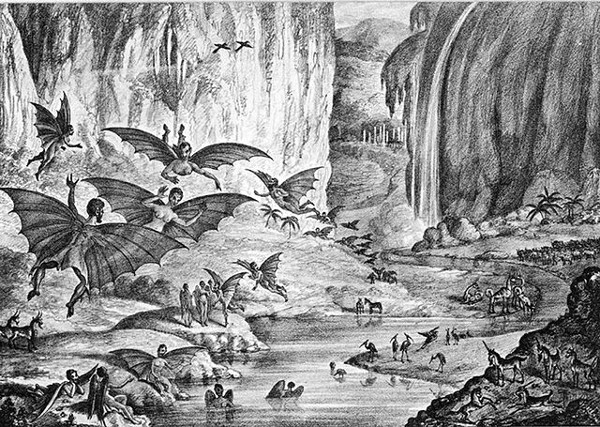
“Reprinted” from the defunct Edinburgh Journal of Science, the six articles told of “an immense telescope of an entirely new principle” with which astronomer John Herschel supposedly discovered lunar bison, goats, pelicans, trees, beaches, and even bat-men who built temples of sapphire.
That last detail sent the Sun‘s circulation to 19,360, the world’s highest … and it stayed high even after Sun reporter Richard Adams Locke admitted that he’d invented the whole thing.
Strangely, most accounts report that the Sun‘s readers were amused at the joke. The real outrage came from rival newspapers that had reprinted the articles, claiming to be getting them from the original source. Now that’s embarrassing.
Brooklyn Bridge East

The Eiffel Tower has been getting some alarming press lately: Its nighttime image has been copyrighted, and Islamists admitted they’d planned an attack on the Paris landmark in 2002. But these still can’t compete with the most outrageous episode in the tower’s history, when a Bohemian con man sold the whole thing for scrap — twice.
The tower was built for the Paris Exhibition of 1889, and by 1925 its upkeep was becoming a burden. So Victor Lustig posed as a government official and summoned six scrap dealers to a secret meeting, where he told them the city wanted to dismantle it. He led a convincing tour of the site, and even induced one eager dealer to “bribe” him for the job.
Lustig fled to Vienna with the cash, and the embarrassed scrap dealer never called the cops. So the con man came back six months later and ran the same scam again, with six new dealers. This time the suspicious mark went to the police, but Lustig still escaped.
An even more successful salesman was at work elsewhere in the early 1920s: Arthur Ferguson sold Nelson’s Column, Big Ben, and Buckingham Palace, then sailed to America and marketed the White House and the Statue of Liberty. Sometimes the best salesmen are the most audacious ones.
(Image: Wikimedia Commons)