In a Word

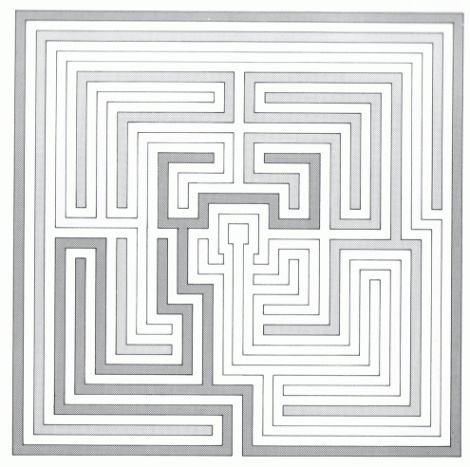
https://www.pinterest.com/pin/the-chevening-maze-in-kent-is-the-first-multiplyconnected-puzzle-maze-this-means-it-cannot-be-solved-by-the-put-your-left-hand--48624870947902374/

anfractuous
adj. having many windings and turnings

loof
n. the palm of the hand

penetralia
n. the innermost recesses of a building

swither
n. a state of perplexity

It’s commonly said that you can defeat a hedge maze by placing one hand on a wall and carefully maintaining that contact as you advance. If the hedges are all connected, this method will reliably lead you to the center of the maze (and, indeed, to every other part of it before you return to the entrance).

The Chevening maze, in Kent, was designed deliberately to thwart this technique. Its center is concealed in an “island” of hedges distinct from the outer wall, so following either a left- or a right-hand rule will return you to the entrance without ever passing the goal.

In a Word

chartaceous
adj. made of paper

admarginate
v. to add or note in the margin

subdititious
adj. fraudulently substituted for a person or thing

prepense
n. malice aforethought

Alexander Pope made use of every scrap of paper that offered a clean surface — nearly the entire first draft of his translation of the Iliad was written on the backs of envelopes, bills, miscellaneous letters, and stray bits of paper. Jonathan Swift suggested that other writers might turn this to their advantage: They could print their own works in editions with wide margins, lend these to “paper-sparing Pope,” wait for him to fill in the spaces with poetry — and then sell this as their own.

In a Word

tesserarian
adj. pertaining to play

aspernate
v. to scorn

absit
n. a student’s temporary leave of absence

denegate
v. to deny or refuse

In 1873, when the University of Michigan challenged Cornell to the new game of football, Cornell president Andrew D. White declined. He said, “I will not permit thirty men to travel four hundred miles to agitate a bag of wind.”

In a Word

ampullosity
n. pretentious use of language

Though much hath been written and said in order to render the Lexiphantic style ridiculous, yet it is surprising to see how it keeps its ground among circles of a certain kind, where even good sense is by no means a stranger: — let the following card witness, which was really sent by a gentleman to a lady, who had asked his company to tea and supper: — ‘Mr. F—-‘s compliments to Miss S—-, at your post meridian computation, be not fascinated with the ardescence of my bibulating in co, since anterior motives stimulate me to itinerate in a transverse direction. But after the diurnal operosity hath increased the delectability of Vesper, perhaps I may saturate a wonted appetite, by the contuding that petacious root, so nice an esculent, if humidated by butter, joined to mellifluous conviviality.’ — It was read twice before the lady found out that the writer excused himself from coming to tea, but would probably eat a roasted potatoe with her at night.

— Geoffry Gambado, New Oddest of All Oddities, for 1813

In a Word

https://commons.wikimedia.org/wiki/File:Gum_wall,_Seattle,_Washington,_Estados_Unidos,_2017-09-02,_DD_19-21_HDR.jpg
Image: Diego Delso

manducate
v. chew

congustable
adj. having a similar flavor

deturpation
n. a making foul

gazingstock
n. a thing gazed at with wonder

Beneath Seattle’s Pike Place Market is a 50-foot brick wall covered with used chewing gum. Begun in the 1990s, the wall now bears an estimated 180 pieces of gum per brick. In 2009 it was ranked second only to the Blarney Stone as the world’s germiest tourist attraction.

Washington state governor Jay Inslee called the “gum wall” his “favorite thing about Seattle you can’t find anywhere else,” but in fact Bubblegum Alley, in San Luis Obispo, Calif., is even bigger, at 70 feet long (below). Opponents call it offensive, but the Chamber of Commerce lists it as a “special attraction.”

https://commons.wikimedia.org/wiki/File:Bubblegum_alley.jpg
Image: Wikimedia Commons

In a Word

zetetic
adj. proceeding by inquiry

astucious
adj. subtle; cunning; astute

consectary
adj. following logically

‘Who did you pass on the road?’ the King went on, holding out his hand to the Messenger for some more hay.

‘Nobody,’ said the Messenger.

‘Quite right,’ said the King: ‘this young lady saw him too. So of course Nobody walks slower than you.’

‘I do my best,’ the Messenger said in a sulky tone. ‘I’m sure nobody walks much faster than I do!’

‘He can’t do that,’ said the King, ‘or else he’d have been here first.’

— Lewis Carroll, Through the Looking-Glass, 1871

In a Word

verbarian
adj. relating to words

gasconade
n. boastful or bombastic language

philautia
n. self-conceit; undue regard for oneself

procacious
adj. cheeky, provocative

An odd little detail from Boswell’s Life of Johnson:

“His next instructor in English was a master, whom, when he spoke of him to me, he familiarly called Tom Brown, who, said he, ‘published a spelling-book, and dedicated it to the UNIVERSE; but, I fear, no copy of it can now be had.'”

In a Word

https://commons.wikimedia.org/wiki/File:Hardwick_Hall_3_(7027835143).jpg
Image: Wikimedia Commons

scattergood
n. a person who spends money wastefully

Built in the 16th century to flaunt its owner’s wealth, Hardwick Hall, in Derbyshire, boasted large windows when glass was a luxury. Children called it “Hardwick Hall, more glass than wall.”

Unfortunately, writes Stephen Eskilson in The Age of Glass (2018), “a cold day saw the chimneys of Hardwick Hall drawing cold air through the drafty windows and circulating it again to the outside,” “a sui generis example of thermal inefficiency.”