Company

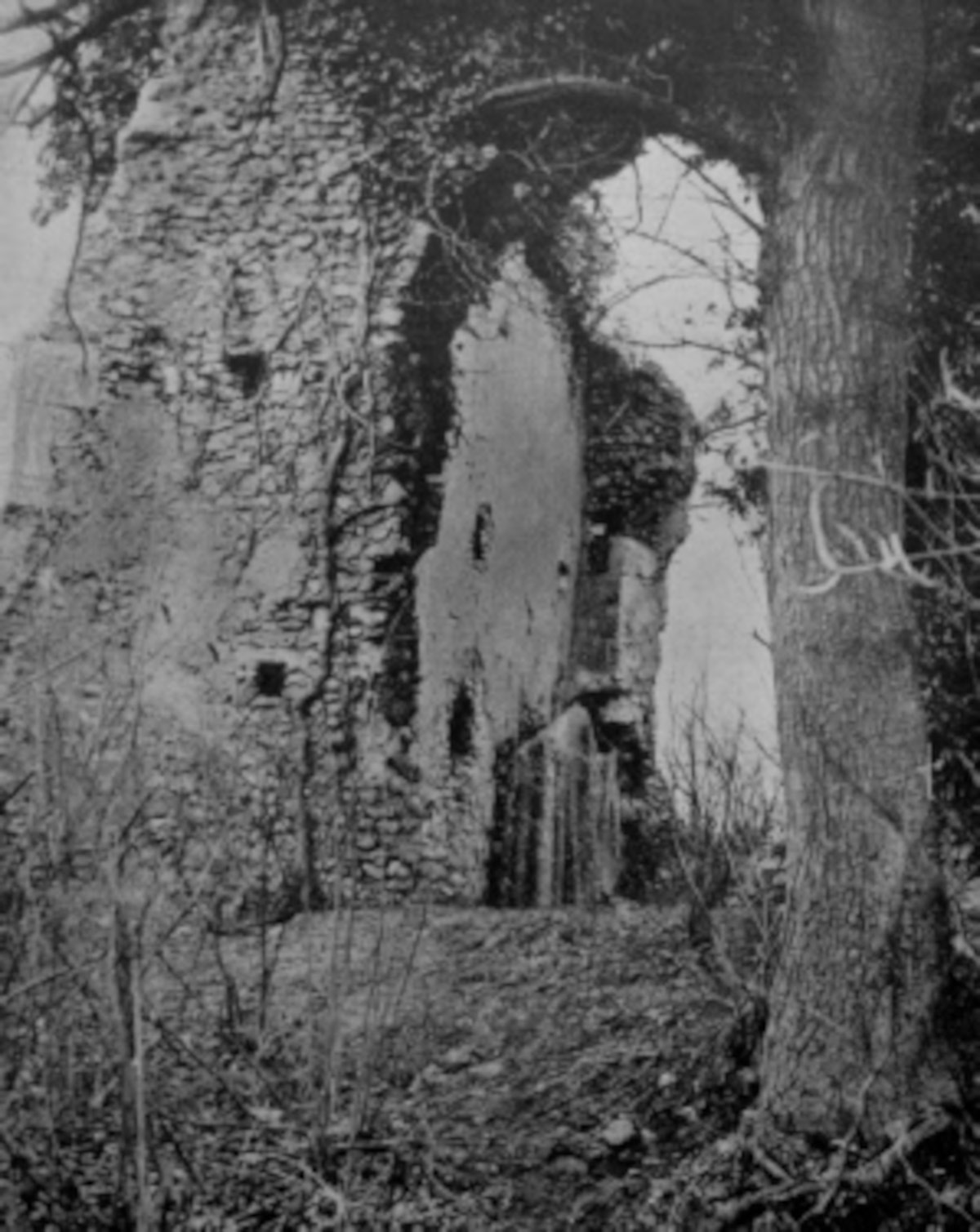
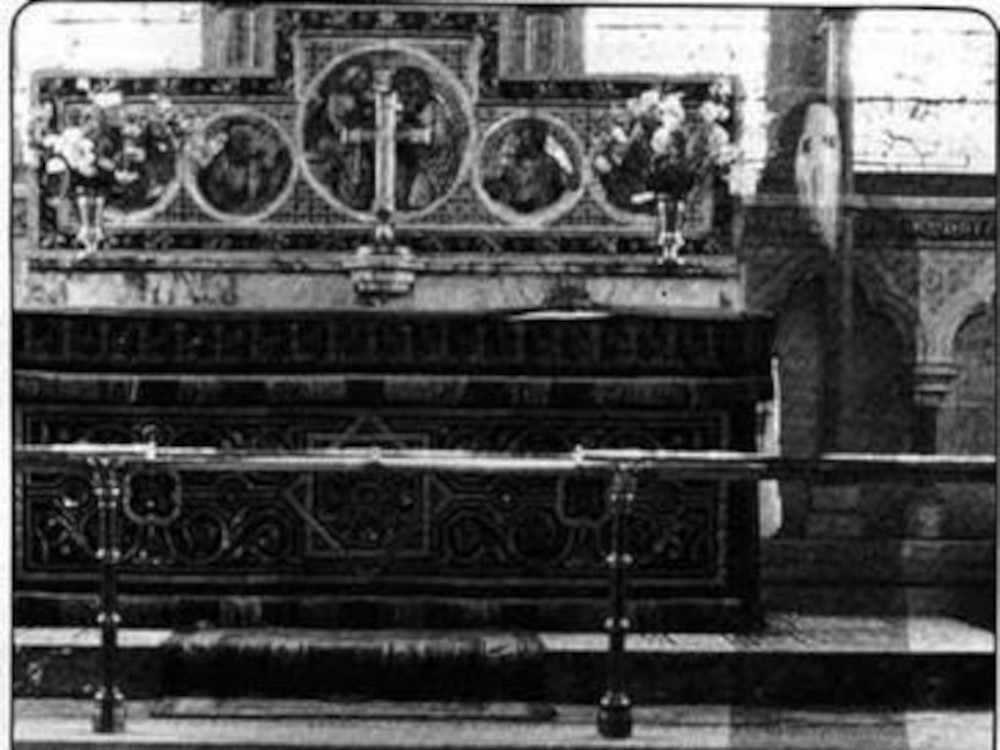
In 1907, historian Reginald Hine, photographer Thomas Latchmore, and artist F.L. Griggs took a camera to Hertfordshire’s Minsden Chapel hoping to photograph the ghost of a murdered monk whose spirit was said to haunt the place. Hine published this photo in his 1929 History of Hitchin, pointing out “the cowled apparition whose form can faintly be discerned” in the image:

https://archive.org/details/in.ernet.dli.2015.77270/page/n45/mode/2up

In 1930 Latchmore admitted that the image had been a hoax, created with a double exposure; the ghostly figure may be Hine himself.

While we’re at it: In 1963 by the Rev. Kenneth Lord took this photo in the Church of Christ the Consoler on the grounds of Newby Hall in North Yorkshire:

https://en.wikipedia.org/wiki/File:The_Specter_of_Newby_Church.jpg

Ostensibly the figure is another ghostly monk, this one wearing a shroud over its face. If it’s not a double exposure then the figure stands as much as 9 feet tall; make your own judgment.

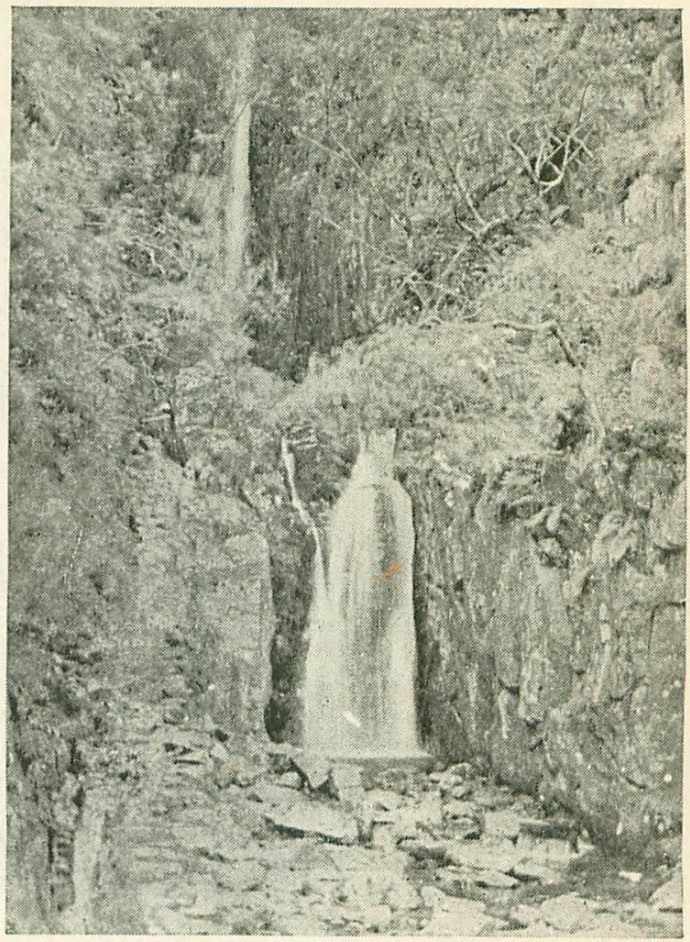
And a reader sent this image in to the Strand in July 1897:

https://archive.org/details/strand-1897-v-14/page/117/mode/2up

Taken at Scale Force, the Lake District’s highest waterfall, “It is a perfect representation of a stately, long-bearded old man, clothed in a flowing robe, with a crown and sceptre. … The form is perfect natural. I did not notice it until after the photo was developed.”

Interestingly, as recently as 2006 the old man was still there:

https://commons.wikimedia.org/wiki/File:Scale_Force_-_geograph.org.uk_-_1557757.jpg
Image: Wikimedia Commons

Whatever he’s looking for, he hasn’t found it yet.

Never Mind

In 1812, inventor Charles Redheffer caused a sensation in Philadelphia when he announced a perpetual motion machine. Residents could view the device for a fee, he said, but none could approach it lest they damage the apparatus. When city commissioner Nathan Sellers arrived to observe the device, he happened to bring his son Coleman, who noticed something that all the adults had missed: The machine’s cogs were worn on the wrong side. The device that the machine was ostensibly driving was itself impelling the whole apparatus.

Redheffer decamped to New York City and tried again with an altered machine, but Robert Fulton noticed that this one ran unsteadily. He traced a catgut cord to an upper room, where an old man was turning a hand crank. Spectators destroyed the machine, and Redheffer fled the city.

“The Adventure of the Tall Man”

After Arthur Conan Doyle’s death, his biographer Hesketh Pearson claimed to have discovered among his papers the scenario of an uncompleted tale.

A girl appeals to Sherlock Holmes for help — her uncle has been found shot in his bedroom, and her lover has been arrested as a suspect. The lover has recently had a quarrel with the old man; a revolver is found in his house that could have fired the fatal shot; and he owns a ladder whose feet match marks below the dead man’s window and which bears incriminating soil on its feet. The girl suspects another man who has been paying court to her.

Holmes and Watson go to the village, where they discover a pair of stilts in a disused well. When the accused man is found guilty of murder, Holmes is driven to a desperate stratagem: He dresses an actor as the murdered man, mounts him on the stilts, and has him approach the villain’s bedroom window, crying, “As you came for me, I have come for you!” Terrified, the man makes a full confession: He had planted the revolver and smeared the ladder’s feet with soil, hoping to win the girl and her money.

Pearson adds, apparently without intending the pun, “Presumably Doyle scrapped this because he felt on reflection that the episode of the stilts was rather tall.”

Of the story, Richard Lancelyn Green wrote, “there is no evidence to show that it is by [Doyle] and strong internal evidence to suggest that it’s not.” For what it’s worth, Robert A. Cutter completed the adventure in 1947.

Around the World

Paris newspapers once carried an ad offering a cheap and pleasant way of travelling for the price of 25 centimes. Several simpletons mailed this sum. Each received a letter of the following content:

‘Sir, rest at peace in bed and remember that the earth turns. At the 49th parallel — that of Paris — you travel more than 25,000 km a day. Should you want a nice view, draw your curtain aside and admire the starry sky.’

The man who sent these letters was found and tried for fraud. The story goes that after quietly listening to the verdict and paying the fine demanded, the culprit struck a theatrical pose and solemnly declared, repeating Galileo’s famous words: ‘It turns.’

— Yakov Perelman, Physics for Entertainment, 1913

Brute Force

NBC’s Today Show had a surprising guest in 1959: G. Clifford Prout Jr., president of the Society for Indecency to Naked Animals, an activist group that hoped to clothe “any dog, cat, horse or cow that stands higher than 4 inches or longer than 6 inches.” Prout’s bizarre cause earned him regular media attention, and the society’s newsletter published this anthem:

High on the wings of SINA / we fight for the future now;
Let’s clothe every pet and animal / whether dog, cat, horse or cow!
G. Clifford Prout, our President / he works for you and me,
So clothe all your pets and join the march / for worldwide Decency!
S.I.N.A., that’s our call / all for one and one for all.
Hoist our flag for all to see / waving for Morality.
Onward we strive together / stronger in every way,
All mankind and his animal friends / for SINA, S-I-N-A!

Of course it didn’t last. When Walter Cronkite interviewed Prout in 1962, one of his staff realized he was really actor and screenwriter Buck Henry. The hoax had been masterminded by serial prankster Alan Abel. “When Cronkite eventually found out that he’d been conned, and I was the guy behind it, he called me up,” Abel recalled. “I’d never heard him that angry on TV — not about Hitler, Saddam Hussein, or Fidel Castro. He was furious with me.”

Bootstraps

The 45-letter pneumonoultramicroscopicsilicovolcanoconiosis is often cited as one of the longest words in English — it’s been recognized both by Merriam-Webster and by the Oxford English Dictionary. The OED Supplement traced it to a 1936 puzzle book by Frank Scully called Bedside Manna, defining it as “a disease caused by ultra-microscopic particles of sandy volcanic dust.” But in fact it had appeared first in a Feb. 23, 1935, story in the New York Herald Tribune:

Puzzlers Open 103rd Session Here by Recognizing 45-Letter Word

Pneumonoultramicroscopicsilicovolcanoconiosis succeeded electrophotomicrographically as the longest word in the English language recognized by the National Puzzlers’ League at the opening session of the organization’s 103d semi-annual meeting held yesterday at the Hotel New Yorker.

The puzzlers explained that the forty-five-letter word is the name of a special form of silicosis caused by ultra-microscopic particles of silica volcanic dust …

At the meeting NPL president Everett M. Smith had claimed the word was legitimate, but in fact he’d coined it himself. Distinguished by the newspaper, it found its way into Scully’s book and thence into the dictionaries, “surely one of the greatest ironies in the history of logology,” according to author Chris Cole. Today it’s recognized as long but phony — Oxford changed its definition to “an artificial long word said to mean a lung disease caused by inhaling very fine ash and sand dust.”

(Chris Cole, “The Biggest Hoax,” Word Ways 22:4 [November 1989], 205-206.)

Bad News

https://pixabay.com/illustrations/dragon-myth-mythology-legend-pagan-8803854/

In 2015 Nature published an alarming article suggesting that dragons are real and had only gone to sleep during the Little Ice Age. A medieval document discovered “under a pile of rusty candlesticks” in the Bodleian Library showed that the creatures were once common but had entered a state of brumation when temperatures dropped and their traditional diet of knights began to thin. Rising temperatures in the modern age have correlated with increasing mentions in fictional literature, which “suggests that these fire-breathing lizards are being sighted more frequently.”

It gets worse: “Sluggish action on global warming is set to compound the problem, and policies such as the restoration of knighthoods in Australia are likely to exacerbate the predicament yet further by providing a sustained and delicious food supply.” The date of the article was April 2.

(Andrew J. Hamilton, Robert M. May, and Edward K. Waters, “Here Be Dragons,” Nature 520:7545 [April 2, 2015], 42-43.)

“Jumpin’ Yuccy”

https://archive.org/details/sim_scientific-monthly_1952-10_75_4/page/250/mode/2up

The Scientific Monthly reported a startling discovery in October 1952: the Schuss-yucca, a rare desert plant whose stalk could grow 10 feet in 2 minutes.

Readers’ letters generally joined in the spirit of the hoax — including one that mentioned a boxer who “stopped hiking long enough to inspect a yucca at just the wrong time.”

The plant shot up 16 feet at that moment, dealing him an uppercut that ended his career. “All he would say of the unfortunate incident was ‘Any time a goddam bush can lay me out cold, I know prizefighting ain’t for me.'”

Botulism

For a man who left no official writings, French philosopher Jean-Baptiste Botul cut an impressive swath through the early 20th century. Born in 1896, he befriended Marcel Proust, betrothed Marthe Richard, and associated with Simone de Beauvoir, Marie Bonaparte, Jean Cocteau, Jean Giraudoux, Stefan Zweig, and Andre Malraux. At age 50 he resettled in Paraguay, where he founded a town that observed the principles of Kantian philosophy.

Actually, none of that is true. Botul was invented out of whole cloth in 1995 by journalist Frédéric Pagès and promoted by an “Association of the Friends of Jean-Baptiste Botul,” which published works that supposedly advanced his ideas, including The Sexual Life of Immanuel Kant, Nietzsche and the Noonday Demon, and Soft Metaphysics.

The joke has been so successful that an annual prize has been awarded for a work that mentions Botul. The most famous recipient is Bernard-Henri Lévy, who quoted the imaginary philosopher extensively in his 2010 book On War in Philosophy. He acknowledged afterward that he’d fallen for a “well-rigged” hoax.

Hazard

From an April Fools’ feature in LIFE, April 4, 1938:

https://books.google.com/books?id=40oEAAAAMBAJ&pg=PA6

The photo appeared in a German paper, which claimed the story was American. “To Germans, actual American goings-on are fantastic enough to be April Fools’ tricks.”