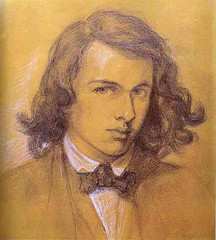
Dante Gabriel Rossetti revered his wife, and when she died in 1862 he laid his journal in her coffin.
Seven years later he decided he needed the poems, so he had her exhumed.

Dante Gabriel Rossetti revered his wife, and when she died in 1862 he laid his journal in her coffin.
Seven years later he decided he needed the poems, so he had her exhumed.
Marcus Garvey suffered a stroke in January 1940, woke up to read his obituary in the Chicago Defender, learned that he had been “broke, alone and unpopular,” suffered a second stroke, and died.
History’s 10 deadliest natural disasters:
Six of the 10 occurred in China. See also Death Tolls.
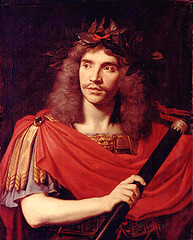
Molière collapsed on stage in 1673 and died hours later.
The play was called The Hypochondriac.
Lawrence Sterne, after a lifetime of peculiarities, and becoming notorious as an eccentric, curious and able writer, at his death was buried in a graveyard near Tyburn, belonging to the Parish of Mary-le-bone, and the ‘resurrection man’ disinterred his corpse and conveyed it to the professor of anatomy at Cambridge where being laid upon the dissecting table, was at once recognized by one of those present who knew him well while living.
— Bizarre Notes & Queries, February 1886
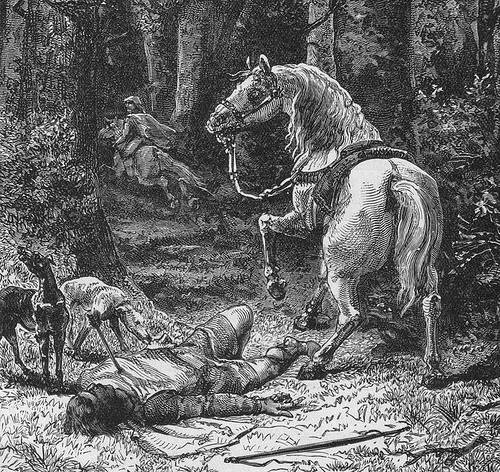
A son of William the Conqueror, William II of England is remembered mostly for the curious manner of his death. In August 1100, William organized a hunting expedition in the New Forest. In sharing arrows with the Anglo-Norman nobleman Walter Tirel, he said, “It is only right that the sharpest be given to the man who knows how to shoot the deadliest shots.” That was tempting fate, apparently: The king did not return after the hunt, and his body was discovered the next day with an arrow piercing his lungs.
Walter fled to France, but chroniclers generally don’t consider him a murderer. He was a skilled bowman, unlikely to fire impetuously, and the abbot who sheltered him in France heard him swear repeatedly that he had not been in the part of the forest where the king was hunting. On the other hand, William’s brother Henry was also in the hunting party, and he stood to gain (and did) from William’s death.
So what really happened? We’ll never know.
Abraham de Moivre correctly predicted the date of his own death.
He noted that he was sleeping 15 minutes longer each day and surmised that he would die on the day he slept for 24 hours. That date, he calculated, would be Nov. 27, 1754.
He was right.
Epitaph of John Laird McCaffrey (1940-1995), who lies in Montreal’s Mount Royal Cemetery:
John:
Free your body and soul
Unfold your powerful wings
Climb up the highest mountains
Kick your feet up in the air
You may now live forever
Or return to this earth
Unless you feel good where you are!
It was composed jointly by his ex-wife and mistress.
Read the first letter of each line.
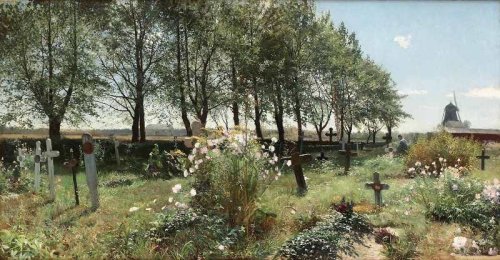
Unfortunate grave inscriptions, collected by Susan Darling Safford in Quaint Epitaphs (1895):
The little hero that lies here
Was conquered by the diarrhoea.
(Portland, Maine)
JOHN PHILLIPS
Accidentally shot as a mark of affection by his brother.
(Maine)
Our little Jacob has been taken away to bloom in a superior flower pot above.
(Vermont)
Beneath this stone our baby lays,
He neither crys nor hollers.
He lived just one and twenty days,
And cost us forty dollars.
(Vermont)
Grim death took little Jerry,
The son of Joseph and Sereno Howells,
Seven days he wrestled with the dysentery
And then he perished in his little bowels.
(Vermont)
Here lies the body of Dr. Hayward,
A man who never voted.
Of such is the kingdom of Heaven.
(Wayland, Massachusetts)
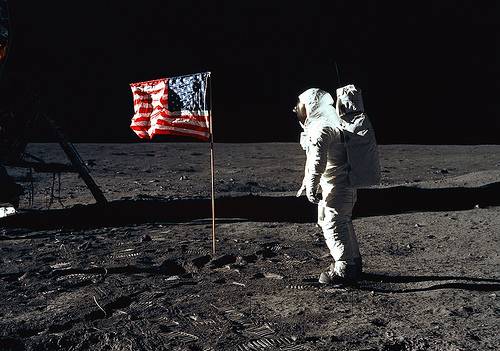
On July 18, 1969, two days before the first lunar landing, presidential speechwriter William Safire composed the following text to be read by President Nixon if astronauts Neil Armstrong and Edwin Aldrin were stranded on the moon:
Fate has ordained that the men who went to the moon to explore in peace will stay on the moon to rest in peace.
These brave men, Neil Armstrong and Edwin Aldrin, know that there is no hope for their recovery. But they also know that there is hope for mankind in their sacrifice.
These two men are laying down their lives in mankind’s most noble goal: the search for truth and understanding.
They will be mourned by their families and friends; they will be mourned by the nation; they will be mourned by the people of the world; they will be mourned by a Mother Earth that dared send two of her sons into the unknown.
In their exploration, they stirred the people of the world to feel as one; in their sacrifice, they bind more tightly the brotherhood of man.
In ancient days, men looked at the stars and saw their heroes in the constellations. In modern times, we do much the same, but our heroes are epic men of flesh and blood.
Others will follow, and surely find their way home. Man’s search will not be denied. But these men were the first, and they will remain the foremost in our hearts.
For every human being who looks up at the moon in the nights to come will know that there is some corner of another world that is forever mankind.
Safire also suggested that Nixon call the “widows-to-be” before the speech, and that a clergyman should commend the astronauts’ souls to the “deepest of the deep” when communications ended.