Getting There

Designed by architects in Amsterdam and Beijing, the Lucky Knot Bridge in Changsha, China, combines three bridges in one. Inspired by both the Möbius strip and the Chinese knotting art, the 185-meter pedestrian bridge spans Dragon King Harbor River, connecting multiple levels at varying heights (the river banks, the road, and a park at a higher level) while permitting pedestrians to pass from one route to another using “moon gates.”

“Bridges … have a highly metaphorical quality,” Michel Schreinemachers, a partner at Next Architects, told Wired. “They connect not only in a physical sense, but also people, places, needs, and experiences.”

Disappearing Act

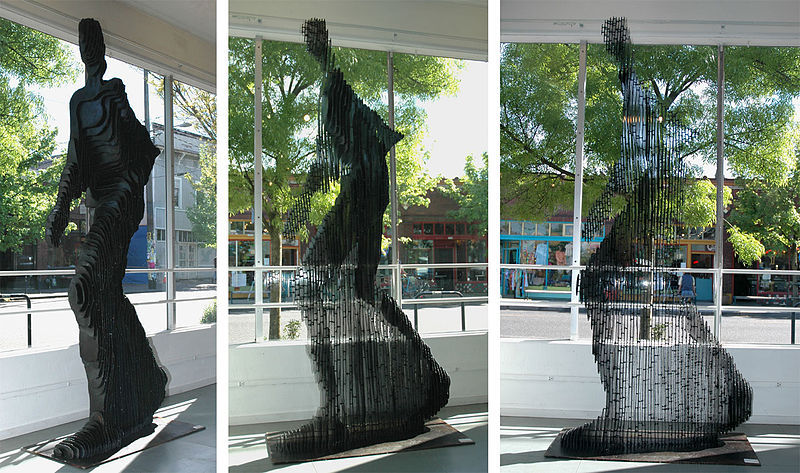
https://commons.wikimedia.org/wiki/File:Quantum_Man.jpg
Image: Wikimedia Commons

Julian Voss-Andreae studied physics at the University of Vienna before pursuing an art degree in the United States. His sculpture Quantum Man consists of 115 vertical steel sheets spaced by 1,000 short steel rods. The resulting figure looks solid when viewed from the front but almost disappears when viewed from the side, as light passes between the sheets.

“My interest is really nature,” he says. “One way to explore it is through science. Another is through intuitive sense and a search for metaphors.”

(Thanks, Ron.)

Inspiration

Berndnaut Smilde makes clouds. The Dutch artist has devised a way to combine water vapor with smoke to create miniature clouds that hover in enclosed spaces. He’s been deploying it in locations ranging from cathedrals to coal mines.

“I see them as temporary sculptures, made of almost nothing, balancing on the edge of materiality, an image of prospect in an empty space,” he told Rajesh Punj. “For me the work is about the idea of a cloud inside a space and what people project onto it. You can see them as a sign of misfortune or an element from a classical painting. There is something ungraspable about clouds: it might explain why people have been projecting so many meanings and myths upon clouds for centuries.”

Time named the technique one of the 50 best inventions of 2012.

Elbow Room

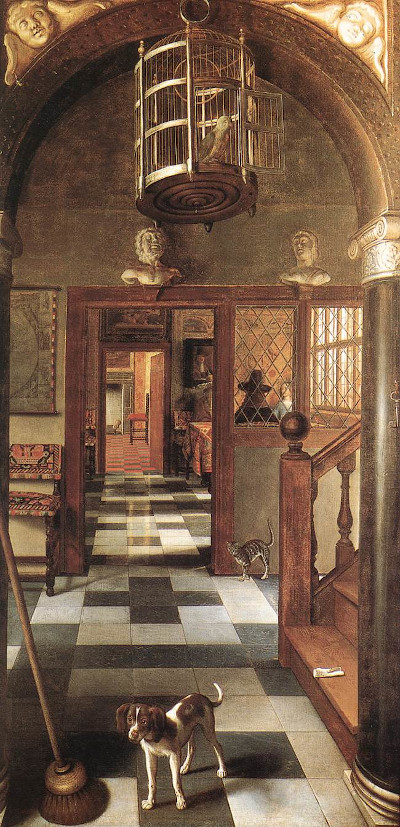
https://commons.wikimedia.org/wiki/File:View_of_a_Corridor_1662_Samuel_van_Hoogstraten.jpg

Visiting Thomas Povey in 1663, Samuel Pepys was surprised when his host opened a door to reveal an unsuspected region of the house.

At a second glance he saw that Povey had only opened a closet in which a large deceiving painting had been hung.

The painting, Samuel Dirksz van Hoogstraten’s View of a Corridor, still hangs at Dyrham Park today.

A Different View

https://commons.wikimedia.org/wiki/File:Un_bar_aux_Folies-Berg%C3%A8re_d%27E._Manet_(Fondation_Vuitton,_Paris)_(33539037428).jpg

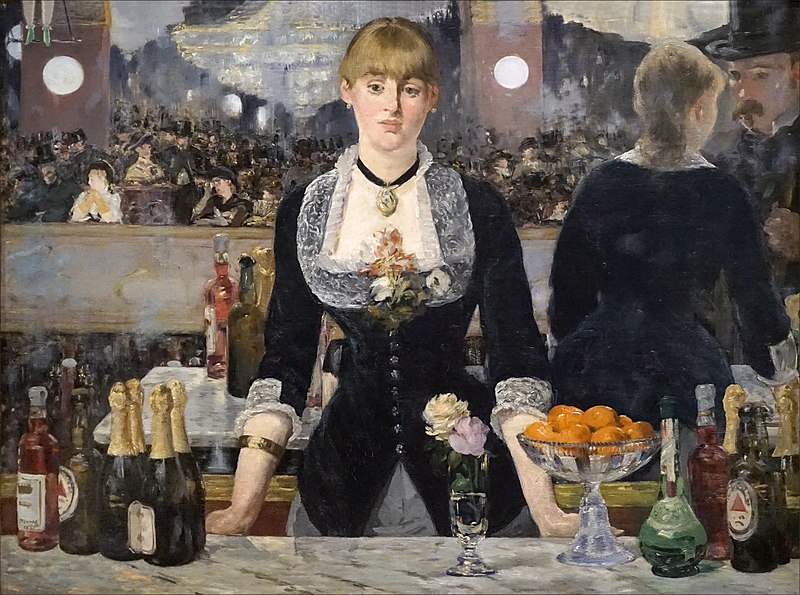
Manet’s painting A Bar at the Folies-Bergère is sometimes criticized for its confused composition. The bottles to the barmaid’s right stand near the back of the bar, but in the reflection behind her they stand near the front. Her own image ought to stand behind her, not off to the right. And reflection of the man she’s addressing (in the position of the painter, or the viewer) ought also to be behind her — indeed, she herself should be blocking our view of it.

But in a dissertation at the University of New South Wales, art historian Malcolm Park found that the arrangement makes sense if certain assumptions are reconsidered. The barmaid is facing the viewer across the bar, with a mirror behind her. But she’s looking diagonally along the bar, not directly across it. (See the diagram here.)

The bottles in the background and the man she appears to be addressing are both in fact to the viewer’s left, beyond the edge of the frame and so visible only as reflections. And the barmaid’s own reflection appears to our right because, from our perspective, the mirror is not directly behind her — it’s “turned” somewhat, carrying her image over to one side.

(Malcolm Park, Ambiguity and the Engagement of Spatial Illusion Within the Surface of Manet’s Paintings, dissertation, College of Fine Arts, University of New South Wales, 2001.)

In a Word

https://commons.wikimedia.org/wiki/File:Fishpond_Mosaic.jpg
Image: Wikimedia Commons

hortulan
adj. of or belonging to a garden

micacious
adj. sparkling, shining

bumfuzzle
v. to astound or bewilder

asomatous
adj. having no material body

Artist Gary Drostle designed this trompe l’oeil mosaic for a public garden in Croydon in 1996.

He calls it “the ideal low maintenance fishpond.”

A New Outlook

Sculptor Anna Coleman Ladd found an unusual application for her artistry during World War I, creating prostheses for the dramatic injuries produced by machine guns and heavy artillery. After reading about artist Francis Derwent Wood’s “Tin Noses Shop” in London, she moved to London and opened a “Studio for Portrait-Masks.”

Her copper and silver masks, 1/32″ thick and weighing 4-9 ounces, were founded on facial casts and painted to match the precise skin tone of each patient. Held in place by eyeglasses, many included realistic mustaches, eyebrows, and eyelashes. By the end of 1919 Ladd had created 185 of them, charging $18 for each and donating her own services. The Red Cross called them “miracles,” and in 1932 France made her a Chevalier of the Legion of Honour.

https://commons.wikimedia.org/wiki/File:Anna_Coleman_Ladd_and_soldier.jpg