At the time of its completion under Hadrian, the Pantheon in Rome had the world’s largest unreinforced concrete dome.
It still does. It’s held that record for nearly 2,000 years.

At the time of its completion under Hadrian, the Pantheon in Rome had the world’s largest unreinforced concrete dome.
It still does. It’s held that record for nearly 2,000 years.

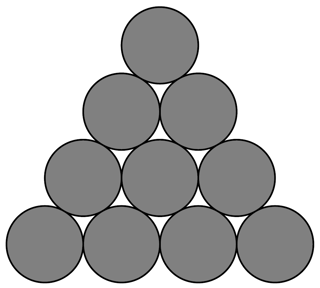
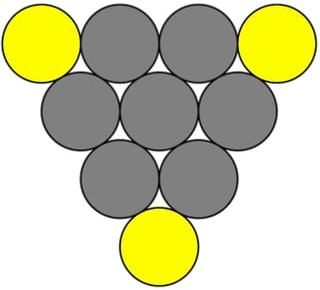
This figure contains four “cliques” of four points each, with each of the four points in each clique connected to each of the others, and each pair of cliques intersecting at a single point. Four colors suffice to color all the points so that no two linked points share a color.
Is this always possible? If k cliques, each containing k points, are arranged in similar fashion, can the result always be colored properly with k colors? In 2021, half a century after Paul Erdős first posed the question, Dong Yeap Kang and his colleagues proved that, for sufficiently large k, the conjecture is true.
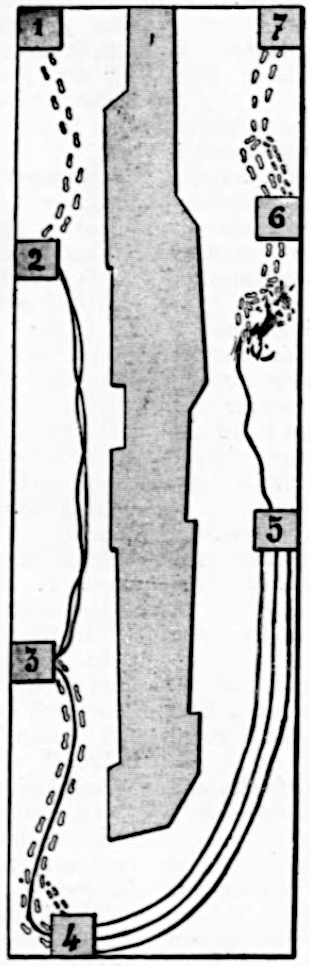
“A few precepts to repeat whenever you are in need of comfort,” by Gabriel Hanotaux, French minister of foreign affairs from 1894 to 1895:
“Above all things, never be afraid. The enemy who forces you to retreat is himself afraid of you at that very moment.”
(Via André Maurois’ The Art of Living, 1939.)
Lord Dudley was one of the most absent men I think I ever met in society. One day he met me in the street, and invited me to meet myself. ‘Dine with me to-day; dine with me, and I will get Sydney Smith to meet you.’ I admitted the temptation he held out to me, but said I was engaged to meet him elsewhere.
— Wit and Wisdom of Sydney Smith, 1856
In May 1884, a group of schoolboys on a beach in Zanzibar came upon a large mass of pumice stone that had washed up at the tidemark. Evidently it had been floating in the sea for some time, as its bottom was crusted with barnacles and weed. Welded to its upper surface, they discovered, were dozens of skeletons, including humans, monkeys, and two big cats, probably Sumatran tigers.
It was a relic of the eruption of Krakatoa, which had taken place nine months earlier in the Dutch East Indies. The rock had floated 4,000 miles across the Indian Ocean to the east coast of Africa.
(From Simon Winchester’s Krakatoa, 2013.)

Plato’s Republic itself does not begin, as some of the modern writers would have it, with some such sentence as, ‘Human civilization, as seen through its successive stages of development, is a dynamic movement from heterogeneity to homogeneity,’ or some other equally incomprehensible rot. It begins rather with the genial sentence: ‘I went down yesterday to the Piraeus, with Glauco, the son of Aristo, to pay my devotion to the goddess; and desirous, at the same time, to observe in what manner they would celebrate the festival, as they were now to do it for the first time.’
— Lin Yutang, The Importance of Living, 1937
Jonathan Franzen’s “10 rules for novelists”:
(From The End of the End of the Earth: Essays, 2018.)
The Wallace–Bolyai–Gerwien theorem, first proven in 1807, states that any two polygons of equal area must have a common dissection. That is, there’s always a way to cut up the first one and assemble the pieces to form the second.
But what if the pieces must be connected by hinges? In his “haberdasher” puzzle of 1907, Henry Dudeney showed that it’s possible to convert a triangle into a square by cutting it in pieces and turning it “inside out”:

Is it always possible to arrange such a “hinged dissection” between two polygons of equal area? The question remained open until 2007, when Erik Demaine showed that the answer is yes — and provided an algorithm to find it.
02/25/2026 UPDATE: Reader Simon Schneider directed me to this interactive visualization of the Wallace–Bolyai–Gerwien theorem, which lets you draw two polygons and then converts one to the other before your eyes. It’s hypnotizing. Here’s a paper on the dissection algorithm used. (Thanks, Simon.)
The day returns and brings us the petty round of irritating concerns and duties. Help us to play the man, help us to perform them with laughter and kind faces, let cheerfulness abound with industry. Give us to go blithely on our business all this day, bring us to our resting beds weary and content and undishonoured, and grant us in the end the gift of sleep.
— Morning prayer recited by Robert Louis Stevenson to his household at Villa Vailima, his last residence in Samoa
This is a familiar variation on the Müller-Lyer optical illusion. The horizontal segments on the left appear longer than those on the right, but in fact they’re all the same length.
Italian researcher Gianni A. Sarcone devised the dynamic demonstration below — the blue and black segments are all the same length and do not change; only the “fins” are moving: