A problem from the October 1964 issue of Eureka, the journal of the Cambridge University Mathematical Society:
“At noon precisely, a train leaves A for B, and another leaves B for A. They pass after 51 minutes. Each train stays 27 minutes at its destination and then returns by the same route. The trains from A and B travel throughout with constant speeds of 23 m.p.h. and 39 m.p.h., respectively. At what time do they pass for the second time?”
|
SelectClick for Answer |
3 p.m. (3 × 51 + 27 minutes past noon).
05/02/2026 UPDATE: Reader Catalin Voinescu sent a diagram:
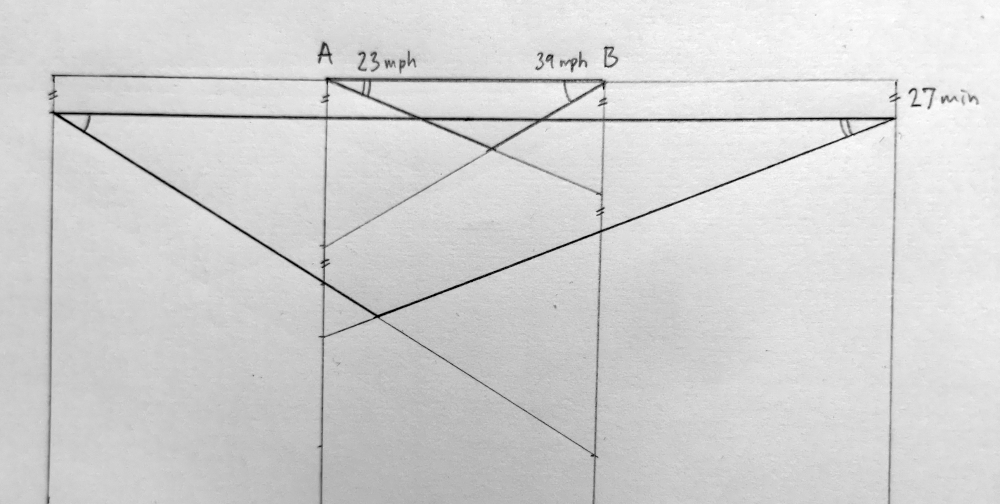
(Thanks, Catalin.)
05/08/2026 UPDATE: Reader Robert Filman sent a verbal explanation:
Let d be the distance between A and B. Trains a and b meet after 51 minutes; at that point, they together have traveled d. The second meeting happens after a has traveled d to get from A to B, and b has traveled d to get from B to A, and they’ve together traveled d to meet again. So the two trains have traveled 3d at the second meeting, and together they take 51 minutes to do a d, so their traveling time is 153 minutes. Add the 27 minutes spent before return journeys, and we get 180 minutes total, or 3pm.
Amusingly, their actual speeds don’t matter, as long as the faster train doesn’t overtake the other (that is, as long as the slower train reaches its other station), which is precluded by the problem statement.
(Thanks, Robert.)
|