Evicted

A trap for gullible tapeworms, patented in 1854 by Alpheus Myers.
The capsule is baited and swallowed by the patient, after a fast “to make the worm hungry.” The worm seizes the bait, the trap closes on its head, and the doctor withdraws the whole length of the parasite from the patient’s stomach, presumably with a magician’s flourish.
“In constructing the trap, care should be taken that the spring g, is only strong enough to hold the worm, and not strong enough to cause his head to be cut off.”
Polar Express

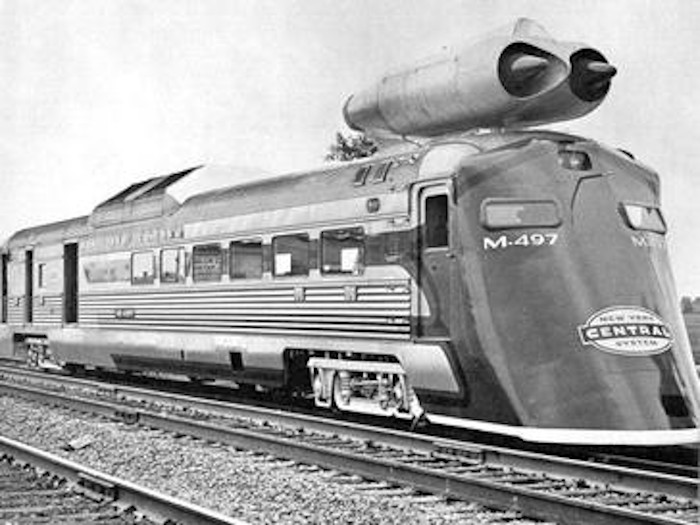
This ought to work — in 1966, D.R. Petrik proposed replacing the wheels of trains with blocks of ice.
More precisely, the wheels (101) would be bracketed by ice blocks (102), which are pressed downward against the heated track and assume the weight of the train. As the blocks melt they can be replaced with fresh ones from refrigerated compartments in the car (103) “without stopping the train or engaging the wheels.”
If it’s not pulled by a locomotive, the whole business can be propelled by jet or rocket thrust, or perhaps propellers. “Of course the wheels could be eliminated altogether in suitable cases, although their retention may be persuaded by the desire to provide an emergency or reserve means of support.” Happy landings.
King Bomb

On Oct. 30, 1961, the Soviet Union detonated the most powerful weapon in human history. At 50 megatons, “Tsar Bomba” was 5,000 times more powerful than the bomb that had destroyed Hiroshima. Its flash was visible 1,000 kilometers away, its mushroom cloud rose 40 miles, and the atmospheric disturbance it created circled the earth three times.
One cameraman wrote: “The clouds beneath the aircraft and in the distance were lit up by the powerful flash. The sea of light spread under the hatch and even clouds began to glow and became transparent. At that moment, our aircraft emerged from between two cloud layers and down below in the gap a huge bright orange ball was emerging. The ball was powerful and arrogant like Jupiter. Slowly and silently it crept upwards. … Having broken through the thick layer of clouds it kept growing. It seemed to suck the whole earth into it. The spectacle was fantastic, unreal, supernatural.”
A more distant observer heard only an indistinct blow, “as if the earth had been killed.”
The bomb had little value as a practical weapon, but it gave Khrushchev crowing rights and advanced us all along a dangerous road. Four hundred years earlier, Leonardo had prophesied, “Men will seem to see new destructions in the sky. … There shall come forth from beneath the ground that which by its terrific report shall stun all who are near it and cause men to drop dead at its breath, and it shall devastate cities and castles.”
(Thanks, Matt.)
A Shakespearean Sub

The first navigable submarine appeared in 1620. Dutch inventor Cornelius Drebbel covered a wooden frame with greased leather to make a watertight, steerable craft for the Royal Navy; within four years he’d produced an “invisible eel” large enough to accommodate 12 oarsmen and remain 15 feet underwater for three hours. It’s said he even took James I on a test dive in the Thames, making him the first monarch to travel underwater.
It’s not clear how Drebbel avoided carbon dioxide buildup. An acquaintance of Robert Boyle who had sailed on the sub said the inventor produced a “chemical liquor” that would “cherish the vital flame residing in the heart.” Possibly he had found a way to produce oxygen gas by heating nitre.
Drebbel’s sub never saw action, but it was centuries ahead of its time. As late as 1901 H.G. Wells wrote, “I must confess that my imagination, in spite even of spurring, refuses to see any sort of submarine doing anything but suffocate its crew and founder at sea.”
Cordless Jump Rope

In 2002 Lester Clancy patented an exercise apparatus that “simulates the effects of jumping rope, but does not utilize an actual rope.”
“To use the invention, a user holds a handle in each hand, and begins to simulate jumping rope while moving the handles in a circle with their hands and arms. The weighted ball or gear simulates the centrifugal action of a jump rope, thus delivering all the health benefits of jumping rope without any of the disadvantages of stumbling on the rope, having the rope hit the ceiling or the like.”
Another workout: Mail one handle to a partner in Japan and you can have an 8,000-mile tug of war.
Nothing Doing

In July 1979, Horace A. Knowles applied for a patent for a “novelty toy which assists the user in twiddling his thumbs”:
Heretofore no equipment has been available to the thumb twiddler to assist him in the twiddling procedure. To those twiddlers who lack sufficient coordination, not only is the repose and peace of mind which thumb twiddling normally brings not available, but the inability to carry out the twiddling successfully, including the inadvertent bumping of the thumbs against one another during the twiddling motion, causes additional frustration.
Is this satire? I can’t tell, and neither could the Patent Office — they approved Knowles’ application the following year.
Not So Fast!

Stanley Valinski patented this “man-catching tank” in 1921, “for use in banks for catching and holding burglars or the like.”
The steerable armored enclosure sits in the lobby with a watchman inside. If the bank is robbed, the watchman pushes a button to summon the police, then drives the tank to block the door, where he can cover the bandits with a gun or grab them using the angle frames.
It’s remarkably well thought out: There’s even a separate hatch by which bank officials can enter the tank if the watchman is shot. Probably best not to mention that in the interview.
Crime and Punishment

Apparently vexed by bicycle thieves, Adolph Neubauer had a bright idea in 1899: Crank needles up through the seat when the bike wasn’t in use “and thus prevent any one from mounting the bicycle without serious injury.”
He got the patent in 1900. Whether it worked is unknown.
Work and Play

Here’s one solution to the energy crisis: enlist the children. Julius Restein’s “device for operating churns,” patented in 1888, will exercise your kid and produce loads of delicious butter at the same time.
It also works with washing machines.
Face Lift

Why use creams to reduce wrinkles? Instead you can stretch your face, using Adolph Brown’s “method of minimizing facial senescence,” patented in 1952:
Anchor is hooked into the skin just beyond the hairline. … The partner hook is moved in the direction away from the face until sufficient tension forces are developed to withdraw desired amounts of skin from the face, and while this tension is maintained, the partner hook is anchored by pressing to grip the scalp.
The “rubber-like connector” between the hooks keeps the whole arrangement fairly flexible — if you don’t sneeze.
An Expansive Idea

While serving in Congress in 1848, Abe Lincoln conceived a way to help boats that became stranded on sandbars. If bellows were attached to a craft below the waterline, these could be inflated when it got stuck, buoying the craft and allowing it to float over the shoal.
Lincoln whittled a 20-inch model from a cigar box and a shingle. His law partner, W.H. Herndon, didn’t think much of it, but Lincoln presented it to lawyer Z.C. Robbins, who arranged a patent in 1849. This makes Lincoln the only president to hold a patent.
Apparently it never went to market, though. “Railroads soon diverted traffic from the rivers,” Robbins recalled, “and Lincoln got deep in law and politics, and I don’t think he ever received a dollar from it.”
Small Press
The first eyewitness account of the Wright brothers’ flying machine appeared in the journal Gleanings in Bee Culture.
The editor, beekeeper Amos I. Root, had visited the Wrights in 1904 at Huffman Prairie, Ohio, where they were working to perfect the machine after its historic first flight the preceding December.
Root sent copies of his article to Scientific American — but they were dismissed.
Shhh!
Americans require a restful quiet in the moving picture theater, and for them talking from the lips of the figures on the screen destroys the illusion. Devices for projecting the film actor’s speech can be perfected, but the idea is not practical. The stage is the place for the spoken word. The reactions of the American public up to now indicate the movies will not supersede it.
– Thomas Edison, quoted in the New York Times, May 21, 1926
Music in the Millennium
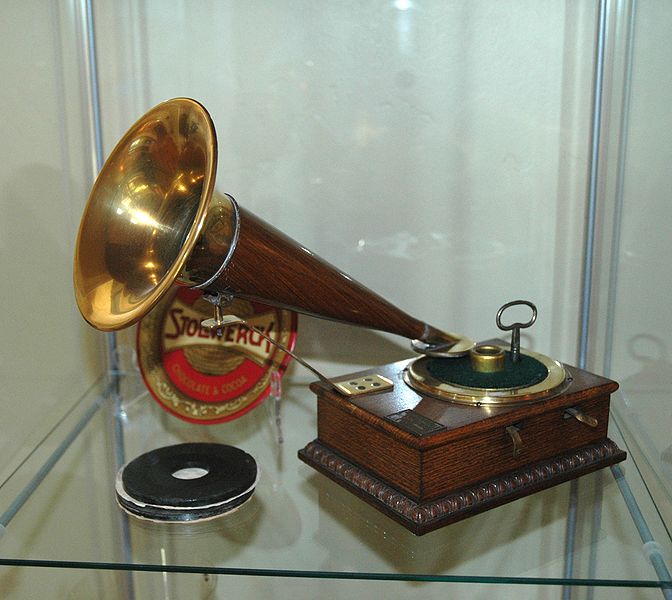
[T]he professional [musician] himself will cease, like the actor, to rank as a sort of superior harlequin or performing animal, exhibiting his powers for the diversion of an assembled public. What he has once played can, if he choose, be constantly repeated. … Instead of the executant or singer being judged by his performance on an occasion when fatigue, illness or unfavourable circumstances may militate against his perfect success, when the nerve-shattering conditions of the platform probably in any case offend his susceptibilities and detract from the perfection of his performance, he will be able to found his reputation upon the very best performance he is capable of. He will be able to try and try again in the privacy of his study. When he has satisfied himself, and then alone, will he publish his artistic effort to the world. He can destroy as many unsatisfactory records as he pleases, just as the sculptor can break up his clay when he has not succeeded, just as the painter can paint out his picture when it has not pleased him, and be judged only by his best.
– T. Baron Russell, A Hundred Years Hence, 1906
Light Headed

With Benjamin Oppenheimer’s “improvement in fire-escapes,” patented in 1879, you can jump safely from the window of a burning building and land “without injury and without the least damage” thanks to a 5-foot parachute and shock-absorbing shoes.
Samuel Mott patented a similar idea in 1920: an aviators’ helmet that contains a folded parachute that can be “readily released in case of emergency.”
But what if you bail out of an airplane that’s over a burning building?
Blithe Spirit

Above: a combination car bumper and bottle opener, patented by Rafael Bonnelly in 1964.
Below: a combination clothes brush and flask, patented by Thomas Helm in 1893.
Maybe you do have a drinking problem.

Sea Legs

Henry Rowlands’ “apparatus for walking on the water” is exactly that, a “new and useful Contrivance for Traveling on Water” essentially by wearing boats as shoes.
Rowlands’ patent was issued in December 1858. Curiously, on Nov. 27 of that year, Chambers’s Journal reported that a Heer Ochsner of Rotterdam (“and who so likely to accomplish such a feat as a Dutchman?”) had made essentially the same invention, which he called a podoscaph.
But there’s more: As if to outdo Rowlands, Ochsner had “recently astonished his countrymen by appearing on the Maas, wearing a podoscaph fifteen feet long on each foot, and holding a pole, flattened at one end as a paddle, in his hand. Thus equipped, he walked up the Maas to the Rhine, and on to Cologne in seven days.”
I can’t find any record that the two met in the mid-Atlantic and fought it out during a lightning storm, but I think we should assume that this definitely happened.
Out, Damned Tot!

George Blonsky’s “Apparatus for Facilitating the Birth of a Child by Centrifugal Force,” patented in 1965, is pretty well self-explanatory. The modern woman lacks the muscle tone to deliver a baby easily, so we put her on a giant turntable and let G forces do the work. A glimpse through the patent abstract gives the general idea: “stretcher … handgrip … girdle … ballast … speed … forces … net … bell … handbrake … stretcher.”
A note for expectant mothers — William Potts Dewees’ 1858 Treatise on the Physical and Medical Treatment of Children includes this advice on “the treatment of the nipples”:
[T]he patient should begin to prepare these parts previously to labor, by the application of a young, but sufficiently strong puppy to the breast; this should be immediately after the seventh month of pregnancy. By this plan the nipples become familiar to the drawing of the breasts; the skin of them becomes hardened and confirmed; the milk is more easily and regularly formed; and a destructive accumulation and inflammation is prevented.
I don’t know whether Dewees actually tried this … but it seems likely he did, doesn’t it?
Imagine!
Imagine the theatre of the future. … [T]he masses will no doubt go to the theatre much as they do now. Only instead of seeing a company of actors and actresses, more or less mediocre, engaged in the degrading task of repeating time after time the same words, the same gestures, the same actions, they will see the performance of a complete ‘star’ company, as once enacted at its very best, reproduced as often as it may be wanted, the perfected kinetoscope exhibiting the spectacle of the stage, the talking machine and the phonograph (doubtless differentiated) rendering perfectly the voices of the actors and the music of the orchestra. There will be no need for the employment of inferior actors in the small parts. As the production of any play will only demand that it be worked up to the point of perfection and then performed once, there will be no difficulty in securing the most perfect rendering that it is capable of.
– T. Baron Russell, A Hundred Years Hence, 1906
A Valuable Oversight

Patent examiners are busy people, and when this application arrived at the U.S. Patent Office in 1881 it seemed innocuous enough — the inventor, John Sutliff, had called it simply “motor.” So they issued the patent.
It is, in fact, a perpetual motion machine. When ball L rolls to the left, it depresses the bellows, which fills the submerged bulb, raising the lever and turning cogwheel F. This pivots the box, which sends the ball back to the right, drawing air into the bellows and submerging the bulb again, “and so on alternately.”
Thus the cogwheel turns forever, driving shaft H, which you can hook up to anything you like. A convenient source of endless free energy, and it’s been under our noses all this time.
Diaper With Holsters

Patented by Harriet Clough in 1958.
Ogden Nash wrote, “Progress might have been all right once, but it’s gone on too long.”
Hair Raising

Patented in 1951, John J. Boax’s “hair singeing apparatus” would do away with conventional haircuts: Vacuums extend the user’s hair and the hood burns it to a chosen length.
Even the guy in the drawing seems uncertain about this, but all progress requires sacrifice.
A Capture En Passant

He does look evil, doesn’t he?
Hawley Harvey Crippen had fled for America by the time Scotland Yard discovered his wife’s torso under the brick floor of his London house.
But they sent out a warning, and the captain of the SS Montrose thought he recognized the fugitive aboard his ship. He asked his wireless telegraphist to send a message to the British authorities: “Have strong suspicions that Crippen London cellar murderer and accomplice are among saloon passengers. Mustache taken off growing beard. Accomplice dressed as boy. Manner and build undoubtedly a girl.”
Chief Inspector Walter Dew overtook the Montrose in a faster liner and boarded her in the St. Lawrence River disguised as a pilot. When introduced to Crippen, he said (resoundingly, one hopes), “Good morning, Dr. Crippen. Do you know me? I’m Chief Inspector Dew from Scotland Yard.”
Crippen hesitated, then said, “Thank God it’s over. The suspense has been too great. I couldn’t stand it any longer.”
Crippen’s mistress was acquitted, but he was hanged in 1910, the first criminal in history captured by the aid of wireless.
See STOP.
“Apparatus for Obtaining Criminal Confessions”

This one leaves me speechless. Helene Adelaide Shelby was unhappy with the low rate of criminal confessions, so in 1927 she invented a solution. The police put their suspect into the darkened chamber on the left, and he finds himself facing a floodlit human skeleton with glowing red eyes. The skeleton asks questions (via a megaphone in the mouth), and the suspect’s reactions are recorded by a camera and a microphone in the skull.
The effect produces “a state of mind calculated to cause him, if guilty, to make confession.” I’ll bet. What if he’s innocent?