In 1904, adventure novelist H. Rider Haggard awoke from a dream with the conviction that his daughter’s dog was dying. He dismissed the impression as a nightmare, but the events that followed seemed to give it a grim significance. In this week’s episode of the Futility Closet podcast we’ll describe Haggard’s strange experience, which briefly made headlines around the world.
We’ll also consider Alexa’s expectations and puzzle over a college’s name change.
Though once a puppy, and though Fop by name,
Here moulders one, whose bones some honour claim;
No sycophant, although of spaniel race,
And though no hound, a martyr to the chase.
Ye squirrels, rabbits, leverets, rejoice!
Your haunts no longer echo to his voice;
This record of his fate exulting view,
He died, worn out with vain pursuit of you.
“Yes” — the indignant shade of Fop replies —
“And worn with vain pursuit man also dies.”
On the morning of May 8, 1965, physicist Carl R. Disch departed the radio noise building of Antarctica’s Byrd Station to return to the main complex 7,000 feet away. He would be walking through a snowstorm with winds of 35 mph, but a hand-line had been installed connecting the two installations so that scientists wouldn’t lose their way.
When Disch didn’t arrive at the main station in a reasonable time, a search party was organized. This spotted his trail but had to return to the station to refuel, and by the time they returned the trail had been covered by drifting snow. The area was searched extensively and the station lighted to increase its visibility, but Disch was never found.
During the search, temperatures dropped to -79 degrees Fahrenheit. The search was called off on May 14. Disch is presumed dead, but his body has never been found.
After numerous accidents where the Illinois Central Railroad crossed Highway 7 near Grenada, Mississippi, in the 1930s, inventor Alonzo Billups came up with a one-of-a-kind solution. When a train approached the crossing, motorists were confronted with a lighted skull and crossbones, the glowing words “Stop-DEATH-Stop,” flashing neon arrows indicating the train’s direction, and an air raid siren.
The video here is a simulation; the actual gantry was removed due to a scarcity of neon in the war years. But two photographssurvive.
Self-defense is widely accepted as a valid reason to use deadly force. But why is it valid? Most other kinds of killing arouse strong moral and political controversy: capital punishment, abortion, euthanasia, suicide, war, even the killing of animals. But debates about self-defense tend to accept its basic legitimacy. Even those who oppose national self-defense as a justification for war may accept the same principle in a conflict between individuals.
“Not only is self-defense uniquely uncontroversial as a form of killing, but the lack of controversy persists despite the absence of any plausible account as to why it is justified,” writes philosopher Whitley R.P. Kaufman in Justified Killing (2009). “The strength and unanimity with which the assumption that killing in self-defense is morally and legally permissible is held suggest that there must be some powerful and persuasive rationale justifying such killing. But if there is such a rationale, moral philosophy has yet to find it.”
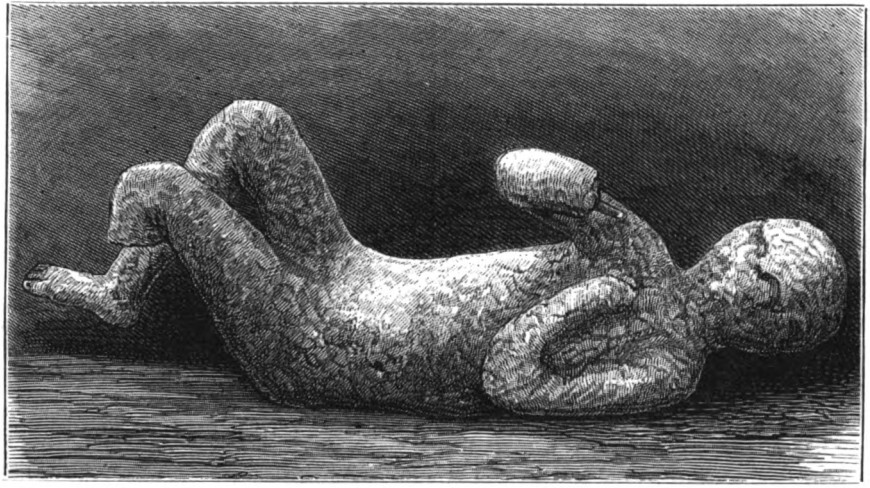
We now and then hear of some interesting discovery, but seldom of one more affecting to the sense of humanity than that which was made three weeks ago. In one of the narrow streets [of Pompeii] were found signs of human remains in the dried mud lying on the top of the strata of lapilli reaching to the second floor of the houses; and when the usual process of pouring plaster of Paris into the hollow left by the impression of a body had been accomplished, there came to light the form of a little boy, seemingly about twelve years old. Within the house, opposite to the second floor window of which this infantile form lay, were found a gold bracelet and the skeleton of a woman, the arms stretched towards the child. The plaster form of this woman could not be obtained, the impression being too much destroyed. It is evident that the mother, when the fiery mass descended, had put her little boy out of the window in the hope of saving him, and he must, no doubt have been overwhelmed. The position of the left leg, indeed, seems to show that the child had lost one foot, or that it had been hurt of lamed, which may have been done by the burning substance that quickly overspread the floors of the house and the pavement on the street. Some think the boy was actually being raised and carried in his mother’s arms, at the moment when both finally perished. His left arm is close to the chest, as though wrapped in his toga or mantle, while the right arm (which has been broken off above the wrist, in digging out the figure) was somewhat uplifted. There is a protuberance on the face, which seems to have been caused by his putting a finger to his mouth, to clear off the suffocating matter that pressed upon him in his last moments of life.
— Illustrated London News, March 11, 1882, via Eugene J. Dwyer, Pompeii’s Living Statues, 2010
When you are flying, everything is all right or it is not all right. If it is all right there is no need to worry. If it is not all right one of two things will happen. Either you will crash or you will not crash. If you do not crash there is no need to worry. If you do crash one of two things is certain. Either you will be injured or you will not be injured. If you are not injured there is no need to worry. If you are injured one of two things is certain. Either you will recover or you will not recover. If you recover there is no need to worry. If you don’t recover you can’t worry.
When CNN was launched in 1980, founder Ted Turner said, “Barring satellite problems, we won’t be signing off until the world ends. We’ll be on, and we will cover it live, and that will be our last, last event. We’ll play the National Anthem only one time, on the first of June [1980], and when the end of the world comes, we’ll play ‘Nearer My God to Thee’ before we sign off.”
He wasn’t joking — Turner had ordered the creation of a video of the Christian hymn performed by members of the U.S. Army, Navy, Air Force, and Marine bands. It was held in the network’s archives, marked HFR [Hold For Release] till end of the world confirmed. Michael Ballaban, who’d been an intern at the network’s launch, released the recording above in 2015.
Ballaban wrote, “That leaves open a whole host of unanswered questions. If this is the last CNN employee alive, in the last CNN bureau on Earth, who do they confirm it with? What does confirmation look like? Who can be the one to make that determination, to pronounce the universe itself dead? … And who would be around to watch it? We don’t know.”
In another case of press repression which succeeded only in creating a martyr, the editor of the Swedish newspaper Stockholms Posten, Captain Anders Lindeberg, was convicted of treason in 1834 for implying that King Karl Johan should be deposed. He was sentenced to death by decapitation, under a medieval treason law. When the King mitigated the sentence to three years in prison, Lindeberg decided to highlight the King’s repressive press policy by insisting upon his right to be beheaded and refusing to take advantage of the government’s attempts to encourage him to escape. Finally, in desperation, the King issued a general amnesty to ‘all political prisoners awaiting execution’, which applied only to Lindeberg. When the editor stubbornly insisted upon his right to execution, the government solved the problem by locking him out of his cell while he was walking in the prison courtyard and then refusing him re-entry.
— Robert Justin Goldstein, Political Censorship of the Arts and the Press in Nineteenth-Century Europe, 1989
[T]o deprive the meanest insect of life, without a good reason for so doing, is certainly criminal. By such an act, a man destroys, what neither he, nor all the united powers of the world can ever repair; and it may be attended with worse consequences than he can imagine. If superior beings had the same power over us, that we have over brutes, what misery might not one of them occasion to a whole nation, by destroying such an insect as a minister of state may appear to be in his eyes? If a child dismembers a bee, or an ant, he may, for any thing we know to the contrary, distress a whole common-wealth.