Minor Theft

In 1955 Carolyn Wharton became the youngest person ever kidnapped — 29 minutes after she was born, she was abducted from the Baptist Hospital in Beaumont, Texas, by a woman disguised as a nurse.
This might have saved her — in 1992 Thomas Moody proposed adding anti-theft devices to hospital baby diapers. The diapers would bear a distinctive pattern so that any attempt to remove or replace them would be spotted by hospital workers.
“In addition to sounding an alarm, the system may be coupled to the doors or elevators of the secure area to prevent egress by would-be abductors or to other security measures such as television recorders.”
Lending a Hand

The tricks by which a shop-lifter succeeds in plying her profession without being caught are many and ingenious. The most successful of all tricks is the false arm and hand, shown in one of the illustrations. While the shop-lifter’s hands are apparently in sight of the store clerks, one is at work stowing away articles. The false hand is, of course, gloved and thrust through one of the sleeves. The real hand works under cover of the bodice and coat. The second illustration shows one of the pockets in which stolen articles are secreted.
– Popular Mechanics, September 1908
Victimized
As he enters the room, he knows what awaits him. Resistance is useless. He cannot escape; there are simply too many of them, and there is nowhere to hide anyway. Hands take hold of him and strap him tightly. Now he cannot move. They have total control over him. They set to work quickly, efficiently, and without malice. They follow a strict protocol, their actions being exquisitely coordinated toward a single end. They begin to kill him, deliberately and methodically. This is not their first time to take life. They make no attempt to conceal their intentions or their actions. On the contrary, they do everything in public, before an audience who watch as his life ebbs away.
“If premeditation is central to the handling of homicide, this killing ought to evoke considerable severity. But it does not,” write University of Georgia sociologist Mark Cooney. “In fact, the law tolerates it, and some people even praise it highly. The words ‘homicide’ and ‘killing’ are rarely used to describe it. Instead it goes by another name: ‘capital punishment.’”
(From Cooney’s 2009 book Is Killing Wrong?)
Stick Up

John Van Zandt’s “combined cane and burglar alarm,” patented in 1884, is low-tech but effective: The head contains a percussion cap, and the ferrule contains a spring clamp.
“The operation is as follows: The occupant of the room simply takes the cane and suspends the same over the top of the door, as hereinbefore explained. On the door being slightly opened the support for the cane is released, whereupon the cane drops and, striking the floor, explodes the cap, thus frightening away the thief and arousing the occupant of the room.”
Pandora’s Divorce
In June 1946, 44-year-old Fern Bowden filed for divorce from her husband James, charging him with “cruel and inhuman treatment” and asking $100 a month to support their two teenage daughters. James filed an answer denying the charges and accusing his wife of keeping company with other men while he had been in Alaska on war business.
In mid-July, James began working with a small trunk which he kept locked in the basement of their Oregon home. He refused to tell the family what it contained but warned them repeatedly not to try to open it; when the girls came upon their father working on it he shouted at them to get out. Only he and their mother, he said, had the padlock combination.
On July 27, alone at home, Fern opened the box. “The cellar of the Bowden residence was wrecked by the explosion,” reported the Associated Press. “Small pieces of flesh and bone found scattered throughout the shattered parts of the home have been identified by the police criminal laboratory as human.”
Detectives determined that the trunk had contained six sticks of dynamite rigged with tacks, wire, and a small battery.
James was charged with illegal possession of explosives and first-degree murder.
Special Delivery
On June 23, 1908, a messenger delivered a bottle of ale to the door of Philadelphia doctor William Wilson. “We are taking the liberty of sending a few physician’s samples of our new product,” read an accompanying letter, which bore the name of a well-known Philadelphia brewing company. “As the beneficial qualities of our ale is to be our strong talking point, we have decided to cooperate with physicians as far as possible in the introduction of our goods.” It asked him to sample the product and to respond if he felt he could recommend it to his patients.
Three days later, Wilson sampled the bottle. Within 30 minutes he was dead of cyanide poisoning.
On June 29, coroner Rush Jermon received a typewritten letter:
Dear Mr. Coroner:
I want to write you regarding the death of Dr. W.H. Wilson.
In some way he induced my wife to become a patient of his. As a result of poisonous injections he used, she died a few weeks ago. In order to protect her name, I did not give the last attending physician all the facts, and she was buried with another cause assigned.
To rid the community of this wholesale killer, I have removed him like a weed from a garden. …
Now that this service to the community is rendered and the death of my dear wife avenged, I am going to quit this part of the world. I don’t think you will ever find me but I don’t care much what happens anyhow.
My only regret is the grief caused his wife and child but I believe they are better off without him. I say let those who live by poison die by poison.
“By the time you get this on Monday morning, I will be far from here,” it concluded. It was signed “An outraged husband and father.”
An investigation showed that the killer must have mailed the first letter from a West Philadelphia postal station at 1 a.m. on June 23, but no one remembered seeing him there. A clerk at the messenger service described a clean-shaven, neatly dressed man of about 40 wearing a black derby, and a station agent at Bristol, Pa., recalled a man of that description jumping briefly off a train to mail a letter on June 27, the day after Wilson had died. This man had apparently bought a ticket at Torresdale, a small station between Philadelphia and Bristol, earlier that day.
But there the trail ended. The mystery became a nationwide sensation, but no further progress was made. An inquest on July 10 returned a verdict of death by cyanide of potassium poisoning at the hands of a person or persons unknown. The killer was never found.
Professional Monster
Issei Sagawa took an unlikely path to fame — after killing and cannibalizing a Dutch woman in Paris in 1981, he wrote a fictionalized account of the crime, In the Mist, that sold 200,000 copies in his native Japan:
There is a loud sound and her body falls from the chair onto the floor. It is like she is watching me. I see her cheeks, her eyes, her nose and mouth, the blood pouring from her head. I try to talk to her, but she no longer answers. There is blood all over the floor. I try to wipe it up, but I realize I cannot stop the flow of blood from her head. It is very quiet here. There is only the silence of death.
Since his release from a Japanese psychiatric hospital in 1985, Sagawa has parlayed his reputation into a ghoulish industry. He has produced four novels, written a weekly column for a Japanese tabloid, appeared on the cover of a gourmet magazine, and is a regular subject of television documentaries. His crime inspired the Rolling Stones’ song “Too Much Blood.”
“The public has made me the godfather of cannibalism, and I am happy about that,” he said. “I will always look at the world through the eyes of a cannibal.”
Methodical
In April 1922, 17-year-old Ernest Albert Walker, the footman to an English colonel, approached a policeman in Tonbridge and said, “I believe I have done a murder.” At the house, investigators discovered the body of messenger Raymond Charles Davis and a handwritten agenda on black-edged notepaper:
- Ring up Sloane Street messenger office for boy.
- Wait at front door.
- Invite him in.
- Bring him downstairs.
- Ask him to sit down.
- Hit him on the head.
- Put him in the safe.
- Keep him tied up.
- At 10.30 torture.
- Prepare for end.
- Sit down, turn gas on.
- Put gas light out.
- Sit down, shut window.
Walker had also left a note for the butler:
I expect you will be surprised to see what I have done. Well since my mother died I have made up my mind to die also. You know you said a gun-case had been moved and I denied it. Well, it had, I got a gun out and loaded it and made a sling for my foot to pull the trigger, but my nerve went and I put it away. I rang up the Sloane Square office for a messenger boy and he came to the front door. I asked him to come in and wait, and I brought him to the pantry and hit him on the head with a coal-hammer. So simple! Then I tied him up and killed him. I killed him, not the gas. Then I sat down and turned the gas full on. I am as sane as ever I was, only I cannot live without my dear mother. I didn’t half give it to that damned boy. I made him squeak. Give my love to Dad and all my friends.
“I don’t know what made me do it,” he told police. “I came to Tonbridge as it would give me plenty of time to think and tell the police here.” He was judged “guilty but insane” and committed to the Broadmoor psychiatric hospital.
Homework
Twenty-nine-year-old James Landis was operating a currency-wrapping machine at the U.S. Bureau of Engraving and Printing when an idea occurred to him. He went home and cut ordinary bond paper into pieces the size of U.S. currency, and wrapped them to resemble the bricks of $20 bills that he produced at work. On Dec. 30, 1953, he smuggled these packages into work with him and hid them in a locker room. Then he wrapped two bundles of real $20 bills in kraft paper and carried them to a storage area. There he unwrapped them, saving the labels, put the bills into two paper bags he had brought from home, and hid these.
He worked the rest of the morning at his station, then returned to the dummy bundles he had brought from home. In a toilet stall he affixed the labels to the ends of the dummy bricks, using glue he had brought from his station, and he rubber-stamped each “HA 12-31-53,” indicating that a bureau employee with the initials H.A. had wrapped the packages on Dec. 31, 1953. Then he carried the dummy bricks to a storage skid on the first floor, where he left them among packages of genuine $20 bills.
At 3:10 p.m. he finished work, changed clothes, and retrieved one of the paper bags from the dead storage area, using a pair of dirty trousers to conceal the $128,000 that the bag held. And he walked out of the building.
Landis and three friends set about buying inexpensive merchandise in order to shed the stolen money and get change, but it wasn’t to last long. When he returned to work on Jan. 4, a stockman picked up two bricks of currency and noted that one of them felt light. When the dummy bricks were discovered, the Secret Service began an investigation; Landis drove to Virginia and tried to hide the money with his father-in-law, who turned him in the following morning. Landis and his friends pleaded guilty on May 3, and all were sent to prison.
Inside Job
I hope this is true — Charles Whitehead’s Lives and Exploits of English Highwaymen, Pirates, and Robbers (1883) recounts a notable heist by one Arthur Chambers. Chambers rented a room from a wealthy landlord, and after winning his confidence, approached him one day with the sad news that he had just witnessed the death of his brother, who had enjoined him to convey his remains to Westminster Abbey. The landlord, moved by Chambers’ story, agreed to safeguard the coffin overnight in his own house, and Chambers arranged to have it delivered there.
That artful rogue was, however, confined in the coffin, in which air holes had been made, the screw-nails left unfixed, his clothes all on, with a winding-sheet wrapped over them, and his face blanched with flour. All the family were now gone to bed, except the maid-servant. Chambers arose from his confinement, went down stairs to the kitchen wrapped in his winding-sheet, sat down, and stared the maid in the face, who, overwhelmed with fear, cried out, ‘A ghost! a ghost!’ and ran up-stairs to her master’s room, who chid her unreasonable fears, and requested her to return to bed and compose herself. She, however, obstinately refused, and remained in the room.
In a short time, however, in stalked the stately ghost, took his seat, and conferred a complete sweat and a mortal fright upon all three who were present. Retiring from his station when he deemed it convenient, he continued, by the moving of the doors, and the noise raised through the house, to conceal his design: in the mean time, he went down stairs, opened the doors to his accomplices, who assisted him in carrying off the plate, and every thing which could be removed, not even sparing the kitchen utensils.
“The maid was the first to venture from her room in the morning, and to inform her master and mistress of what had happened, who, more than the night before, chid her credulity in believing that a ghost could rob a house, or carry away any article out of it,” Whitehead writes. “In a little time, however, the landlord was induced to rise from his bed, and to move down stairs, and found, to his astonishment and chagrin, that the whole of his plate, and almost the whole of his moveables, were gone, for which he had only received in return an empty coffin.”
Will and Deed
In 1968 British police constable David Morris was directing Vincent Fagan to a parking space when Fagan’s car ran onto his foot. Morris shouted at him to move the car, but Fagan refused and turned off the ignition. Eventually he started it again and moved off, but he was convicted of assault for the incident.
This raises a curious legal point. Normally Western law recognizes a crime only if a guilty action and a guilty intent occur at the same time. Here it seems that Fagan’s guilty action (rolling onto Morris’ foot) was a simple accident, and his guilty intent (his resolution not to move) occurred only later. Does that mean that he had committed no crime?
No, it doesn’t, ruled the English court of appeal. Fagan’s guilty action extended continuously while the constable’s foot was pinned under his tire, and he became guilty of assault a soon as he formed the resolution not to move the car. His appeal was dismissed.
(Fagan v Metropolitan Police Commissioner [1969] 1 QB 439)
Tilt

Here’s a philosophical question. Some pinball machines reward high scores with free replays. And in states with anti-gambling statutes, some prosecutors crack down on this feature, saying that it constitutes gambling.
Is this a coherent argument? If pinball is legal, then can more pinball be illegal?
“The prosecutors … believe that ‘more of the same’ can be too much of a good thing, and rather than multiply legal acts, actually cross the line of legality,” writes Peter Suber in The Paradox of Self-Amendment.
“A quantitative change becomes at some point a qualitative change, just as lowering the temperature of water by degrees gives us nothing but cold water for a while, and then suddenly gives us ice.”
Bitter Justice
An 1873 arrest report by Arizona sheriff George Tyng, quoted in Case and Comment, 1934:
Received the within process Arizona City, Jan. 1873 and served same by arresting defendant at Ehrenberg, A.T., Jan. 31, 1873, but as defendant had no money and I was broke myself and the county dont pay cash in advance, and no steamboat around and no calaboose here and defendant wouldn’t walk down to Yuma all alone by himself and I wouldn’t walk down with him and as he wouldn’t stay arrested unless I boarded him which I had no money for to do, and as he gave up the coat (value .45 cents currency — estimated) and said he never stole it but Bryson gave it to him in presence of witnesses and that Bryson was a damned liar anyhow, and not knowing what to do with him, I did nothing more to him up to date beyond giving him excellent moral advice which he assured me was entirely unnecessary in his case, his life having been blameless and his reputation spotless as he could prove by the best men in Nevada and Idaho but have allowed him to run at large until a more favorable season when a steamboat happens to be here, and will take scrip for his passage to Yuma and present the bill to Supervisors themselves, which is nearly all I have done toward serving within process, though I would make return of the Balance were this process bigger on the back.
Fees — Balance of what coat sells for after paying Justice fees.
George Tyng,
Sheriff of Yuma County,
Arizona
Valise Police

Briefcase security, then and now:
In 1925, August Eimer invented the case above, which emits smoke when torn from its owner’s hand “in the form of a continually issuing cloud that will envelop the container and serve to unmistakably identify its purloiner, necessitating discard of the container by the thief if he would make his escape.”
In 1989, Isaac Soleimani offered the model below: As the thief is running off, you activate a radio signal that releases a latch, “with the result that the briefcase falls on the ground, leaving the thief only with the handle.”
It seems there’s always an element of slapstick. “The handle could also be spring-loaded so that upon remote triggering it could clamp down hard onto the thief’s hand, clamping the fingers between the handle and the top of the briefcase, thereby inflicting pain to the thief, causing him to drop the briefcase.”

Scent of Evil

Louis J. Marcone came up with a novel way to catch bank robbers in 1989: The teller might step on a trigger and surreptitiously spray the robber with “a non-toxic, clear, odorless and harmless liquid spray material which can be readily detected by trained police dogs.”
He envisioned a second application for the device: The spray unit could be attached to a fire alarm, so that anyone who pulled the alarm would be marked with the scent. “If the alarm was determined to be a false alarm, the fire department can alert police to bring trained police dogs to the scene, whereupon the dog can track the scent from the alarm location to the person activating the false alarm.”
Cold Case
In 1629, Joan Norkot of Hertfordshire died in a singularly impossible way:
- “She lay in a composed manner in her bed, the bed cloaths nothing at all disturbed, and her child by her in the bed.”
- “Her throat was cut from ear to ear and her neck broken, and if she first cut her throat she could not break her neck in the bed, nor e contra.”
- “There was no blood in the bed saving that there was a tincture of blood upon the bolster whereupon her head lay, but no other substance of blood at all.”
- “From the bed’s head there was a stream of blood on the floor, till it ponded on the bending of the floor to a very great quantity, and there was also another stream of blood on the floor at the bed’s feet, which ponded also on the floor to another great quantity, but no continuance or communication of blood of either of these two places, the one from the other, neither upon the bed, so that she bled in two places severally, and it was deposed that turning up the matte of the bed there were clotts of congealed blood in the straw of the matte underneath.”
- “The bloody knife in the morning was found sticking in the floor a good distance from the bed, but the point of the knife as it stuck in the floor was towards the bed and the haft towards the door.”
- “Lastly, there was the print of a thumb and four fingers of a left hand on the dead person’s left hand.”
No one had entered the house since she had gone to bed, and Joan’s sister Agnes and her husband, John Okeman, had lain in the outer room together with John’s mother, Mary. John was acquitted and his pregnant wife permitted to live, but Joan’s husband Arthur and her mother-in-law, each protesting their innocence, were hanged.
This account was found among the papers of Sir John Maynard, who died in 1690. When it was published in The Gentleman’s Magazine in July 1851, it made a sensation chiefly because it reported that Joan’s month-old corpse had been exhumed and itself accused the killers. “The appellers did touch the dead body, whereupon the brow of the dead, which was of a livid or carrion colour (that was the verbal expression in the terms of the witness) began to have a dew or gentle sweat [which] ran down in drops on the face, and the brow turned and changed to a lively and fresh colour, and the dead opened one of her eyes and shut it again, and this opening the eye was done three several times. She likewise thrust out the ring or marriage finger three times and pulled it in again, and the finger dropt blood from it on the grass.” But setting that aside, it’s hard to understand what happened to Joan. No motive was adduced in the murder, and no one has explained how it was accomplished. Who killed her, and how?
To Catch a Thief

Early inventions to catch car thieves were positively quaint: Thomas Burghart’s 1921 “thief trap” would simply clutch the intruder’s leg and sound an alarm to alert the owner. “The person is thereby held to the seat and cannot get away.”
Yair Tanami’s solution, patented 68 years later, is less forgiving: It mounts a high-voltage discharge electrode under the seat. “In the arrangement illustrated in Figs. 2-5, bursts of high voltages of up to 60,000 volts peak have been produced which were found sufficient to temporarily immobilize the threatening person without permanently injuring him.”

Kaspar Hauser Redux
On Sept. 18, 1989, a frightened teenage girl walked into William B. Jack Elementary School in Portland, Maine. “She just stopped at the counter,” teacher’s aide Judi Fox told the Houston Chronicle. “She walked in and signed a little bit.” Realizing that the girl was seeking help, Fox summoned a teacher who knew sign language and the two took her to a nearby school for the deaf.
Communicating in gestures and drawings, the deaf girl explained that she had been abducted about three years earlier, possibly from a foster home in California, and then moved several times. She believed she was 15 years old, and had been given the name Toby Cole by her captors, though authorities could find no missing-persons report that matched her case.
FBI agent Paul Cavanagh added, “From some of the drawings she was able to provide, it is believed that some of the people she was with since her abduction may have been tied to the occult.”
Unfortunately, no further clues to the girl’s identity were ever found, and she was able to provide no information leading to arrests. She was placed in a foster home, and the case remains unsolved.
On the same theme: In 2009 former Gallaudet University student Joseph Mesa Jr. was convicted of murdering two classmates. The jury rejected his claim that a pair of black hands had urged him on in sign language. Prosecutor Jeb Boasberg said, “An insanity defense doesn’t work if you’re not insane.”
UPDATE: There were further developments in the Toby Cole story, though they make the whole tale even stranger. Police and FBI investigators identified the woman as 27-year-old Margaret Louise Herget of Sandy, Ore. She had moved to Louisiana in August and then to Maine just a few days before turning up at the school. Police lieutenant Michael Bouchard told the Associated Press in October that Herget was hearing-impaired but not deaf and that authorities no longer believed that she had been abducted. But why she had concocted the story, so far as I can tell, is still a mystery. Thanks to everyone who wrote in about this.
Trompe L’Oeil

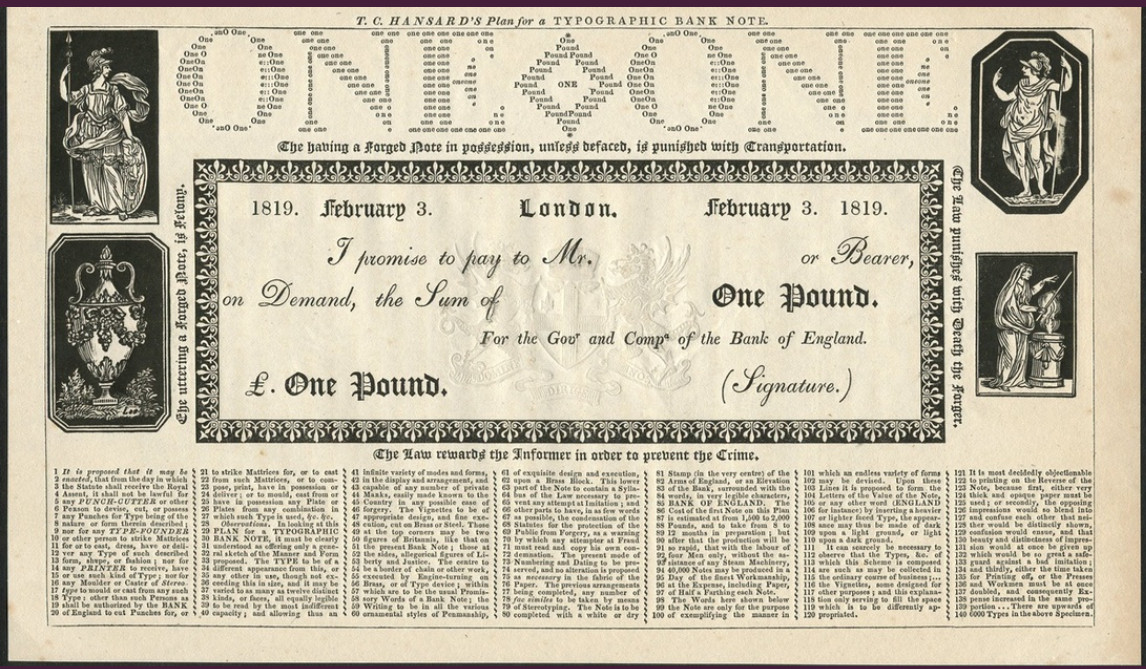
This is not a photograph, it’s an oil painting. Irish-American painter William Harnett (1848–1892) produced works of such startling verisimilitude that his paintings of American currency, like the one below, nearly got him arrested for counterfeiting. In 1886 the Secret Service visited him at his studio:
While one of them was asking my name, the other as suspiciously poking his cane into the corners of my room. ‘Have you got any more of them here?’ he asked, after he had finished a hasty search. ‘More of what?’ I replied. ‘Those counterfeits!’ he answered. Then the other detective, for both were Special Treasury officers, explained their mission. I was suspected of turning out counterfeit bank notes and they had come to arrest me and seize whatever illegal property they could find. They were very polite but extremely firm and I went down-town with them to Chief Drummond’s office. I explained to the chief how I happened to do the work and I showed him the harmless nature of it. Harmless though it was, it was clearly against the law, and I was let go with a warning not to paint any more life-like representations of the national currency — a warning it is almost needless to say that it was conscientiously heeded.
To be fair, Harnett was not representing his work as currency — but the Secret Service was on the trail of an even more ambitious artist.

Con Heir

In 1879 Thérèse Humbert was traveling by railway through France when she met an ailing American millionaire named Robert Crawford. She sought medical care for him, and he showed his gratitude with a handsome bequest, which she kept in a sealed safe.
Or so she said. Humbert and her husband lived luxuriously in Paris for two decades, borrowing money against Crawford’s unseen gift. When suspicious creditors finally sued her, they discovered that Crawford didn’t exist and the safe contained a handful of worthless papers. She was sentenced to five years in prison.
In 1897 Ohio con artist Cassie Chadwick “confessed” to a Cleveland lawyer that she was the illegitimate daughter of Andrew Carnegie and stood to inherit $10 million on his death. She parlayed his sympathy into a series of bank loans and lived lavishly until 1904, when she was unable to repay a Massachusetts banker. Carnegie, who denied her story, attended the trial and saw her sentenced to 10 years in prison. She died two years later in the Ohio State Penitentiary.
Malice Aforethought
On May 31, 1964, Cyril Church beat Sylvia Nott into unconsciousness. Thinking he’d killed her, he dumped her body in a river, where she drowned.
Is this murder? The deliberate act wasn’t fatal, and the fatal act wasn’t deliberate. “His case is that he genuinely and honestly believed that she was dead,” Justice Glyn Jones told the jury. “I direct you that, if that was his genuine and honest belief, then when he threw what he believed to be a dead body into the river, he obviously was not actuated by any intention to cause death or grievous bodily harm; you cannot cause death or serious bodily harm to a corpse.”
They convicted Church of manslaughter.
A Guilty Face
One morning in 1727, York pubkeeper Hannah Williams found that her writing desk had been opened and a sum of money stolen. As waiter Thomas Geddely disappeared at the same time, there was little doubt as to the robber.
Twelve months later, a man calling himself James Crow arrived in York and took a job as a porter. The townspeople immediately accosted him as Geddely, but he insisted that he didn’t know them, that his name was James Crow, and that he was new to York.
Williams was called for, instantly identified him as Geddely, and accused him of robbing her. The man protested his innocence before a justice of the peace but had no alibi and admitted to a history as a vagabond and a petty rogue. At the trial a servant testified that she had seen him at the robbery scene with a poker in his hand. He swore again that his name was James Crow but was convicted and executed.
Some time later Thomas Geddely was arrested in Dublin on a robbery charge. While in custody he confessed to the robbery at York. A York resident who was visiting Ireland at the time declared that the resemblance between the two men was so great “that it was next to impossible for the nicest eye to have distinguished their persons asunder.”
See Mistaken Identity.
Frontier Justice

In 1881 a federal trial judge in the Territory of New Mexico, presiding at Taos in an adobe stable used as a temporary courtroom, passed sentence on murderer José Gonzales. We don’t know the details of Gonzales’ crime, but it must have been extraordinary — here’s the sentence:
José Manuel Miguel Xavier Gonzales, in a few short weeks it will be spring. The snows of winter will flee away, the ice will vanish, and the air will become soft and balmy. In short, José Manuel Miguel Xavier Gonzales, the annual miracle of the years will awaken and come to pass, but you won’t be here.
The rivulet will run its purring course to the sea, the timid desert flowers will put forth their tender shoots, the glorious valleys of this imperial domain will blossom as the rose. Still, you won’t be here to see.
From every tree top some wild woods songster will carol his mating song, butterflies will sport in the sunshine, the busy bee will hum happy as it pursues its accustomed vocation, the gentle breeze will tease the tassels of the wild grasses, and all nature, José Manuel Miguel Xavier Gonzales, will be glad but you. You won’t be here to enjoy it because I command the sheriff or some other officer of the country to lead you out to some remote spot, swing you by the neck from a nodding bough of some sturdy oak, and let you hang until you are dead.
And then, José Manuel Miguel Xavier Gonzales, I further command that such officer or officers retire quickly from your dangling corpse, that vultures may descend from the heavens upon your filthy body until nothing shall remain but bare, bleached bones of a cold-blooded, copper-colored, blood-thirsty, throat-cutting, chili-eating, sheep-herding, murdering son of a bitch.
Cleopatra Mathis discovered the transcript in the records of the U.S. District Court, New Mexico Territory Sessions. She published it in Antaeus in autumn 1976.
Bad Country

Yellowstone National Park doesn’t quite fit in Wyoming — small portions extend into Montana and Idaho. But Congress has placed the legal jurisdiction for the entire park in the District of Wyoming. At the same time, the Sixth Amendment to the U.S. Constitution requires that a jury be “of the State and district wherein the crime shall have been committed.”
Suppose you lure me into the 50 square miles of Yellowstone that lie within Idaho, and suppose you kill me there. The Sixth Amendment requires that the jury be drawn from the state (Idaho) and the district (Wyoming) in which the crime occurred. But the only way to fulfill both those requirements is to draw the jury from the tiny part of Yellowstone that lies in Idaho — and its census population is zero. Without a jury, you can’t be tried. “Assuming that you do not feel like consenting to trial in Cheyenne,” writes Michigan State law professor Brian Kalt, “you should go free.”
“It bears emphasis that the flaw here is really with the District of Wyoming statute, not with the Sixth Amendment,” advises Kalt, whose full paper is here. “The solution is to fix the statute, not eviscerate the Constitution. If we do it quickly enough, no one will get hurt.”
Please don’t actually kill me. (Thanks, Ty.)