“Alternative Endings to an Unwritten Ballad”

I stole through the dungeons, while everyone slept,
Till I came to the cage where the Monster was kept.
There, locked in the arms of a Giant Baboon,
Rigid and smiling, lay … Mrs. RAVOON!

I climbed the clock-tower in the first morning sun
And ’twas midday at least ere my journey was done;
But the clock never sounded the last stroke of noon,
For there, from the clapper, swung Mrs. RAVOON.

I ran through the marsh ‘midst the lightning and thunder,
When a terrible flash split the darkness asunder.
Chewing a rat’s tail and mumbling a rune,
Mad in the moat, squatted Mrs. RAVOON.

I stood by the waters so green and so thick,
And I stirred at the scum with my old, withered stick;
When there rose through the ooze, like a monstrous balloon,
The bloated cadaver of Mrs. RAVOON.

I hauled in the line, and I took my first look
At the half-eaten horror that hung from the hook.
I had dragged from the depths of the limpid lagoon
The luminous body of Mrs. RAVOON.

Facing the fens, I looked back from the shore
Where all had been empty a moment before;
And there, by the light of the Lincolnshire moon,
Immense on the marshes, stood … Mrs. RAVOON!

After this memorable debut in For Love and Money (1956), Paul Dehn’s macabre character has found her way into songs and poems by many writers, even beyond her creator’s death in 1976. They’re cataloged here.

Narrow Meaning

https://archive.org/details/strand-1899-v-18/page/238/mode/2up?view=theater

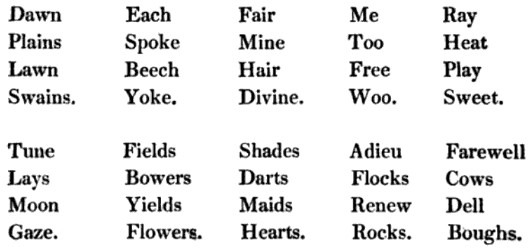
Reader J. William Hook submitted this curiosity to the Strand in August 1899. Holding the page level with the eyes foreshortens the characters and reveals a love poem:

Art thou not dear unto my heart?
Oh, I search that heart and see
And from my bosom tear the part
That beats not true to thee.

But to my bosom thou art dear,
More dear than words can tell,
And if a fault be cherished there,
‘Tis loving thee too well.

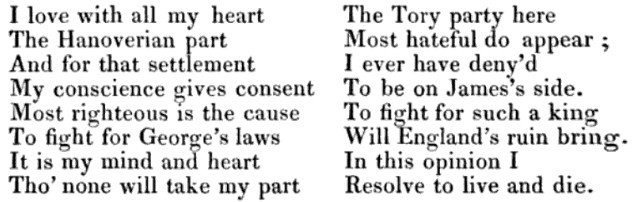
There seems to have been a little vogue for this kind of thing — C. Field submitted a similar image three months later.

A Smile More Brightened

In September 1931 the Weekend Review pointed out the “regrettable omission of any reference to tooth-brushing in the description of Adam and Eve retiring for the night” in Book IV of Paradise Lost. It challenged its readers to improve Milton’s text; polymath Edward Marsh inserted these lines:

[… and eas’d the putting off
These troublesome disguises which wee wear,]
Yet pretermitted not the strait Command,
Eternal, indispensable, to off-cleanse
From their white elephantin Teeth the stains
Left by those tastie Pulps that late they chewd
At supper. First from a salubrious Fount
Our general Mother, stooping, the pure Lymph
Insorb’d, which, mingl’d with tart juices prest
From pungent Herbs, on sprigs of Myrtle smeard,
(Then were not Brushes) scrub’d gumms more impearl’d
Than when young Telephus with Lydia strove
In mutual bite of Shoulder and ruddy Lip.
This done (by Adam too no less) the pair
[Straight side by side were laid …]

Marsh called this “the cleverest thing I ever did.” “The mordacious Telephus and Lydia are ‘of course,’ as the gossip-writers would say, from Horace, Odes, I, xiii. Martin Armstrong, who had set the competition, gave me the first prize, and was good enough to express the hope that future editors of Milton would put my lines in the appropriate place.”

(From Marsh’s 1939 memoir A Number of People.)

“Good and Clever”

If all the good people were clever,
And all clever people were good,
The world would be nicer than ever
We thought that it possibly could.

But somehow ’tis seldom or never
The two hit it off as they should,
The good are so harsh to the clever,
The clever, so rude to the good!

So friends, let it be our endeavour
To make each by each understood;
For few can be good, like the clever,
Or clever, so well as the good.

— Elizabeth Wordsworth

Addendum

Visiting Orchomenus, Greece, in 1810, Lord Byron discovered this entry in the travelers’ book:

Fair Albion, smiling, sees her son depart
To trace the birth and nursery of art:
Noble his object, glorious is his aim;
He comes to Athens, and he — writes his name.

Beneath this Byron wrote:

The modest bard, like many a bard unknown,
Rhymes on our names, but wisely hides his own;
But yet, whoe’er he be, to say no worse,
His name would bring more credit than his verse.

Reunion

In the church of St. Mary Magdalen in Mulbarton, Norfolk, is mounted a copper diptych, a memorial to resident Sarah Scargill, who died in 1680. The left panel remembers Scargill as “a Person of unimitable Devotion, of a most nice and tender Conscience, of sweet Behaviour, and in all Things so faithfull a Servant of God, that I dare contest the Divine Goodness to have rewarded her.” The right panel reads:

Dear Love! one feather’d Minute, and I come,
To lye down in thy dark retiring Room,
And mingle Dust with thine, that we may have,
As when alive, one Bed, so dead, one Grave,
And may my Soule teare through the vaulted Sky,
To be with Thine, to all Eternity.
Oh! how our Bloodless Forms will that Day greet,
With Love Divine, when we again shall meet,
Devest of all contagion of the Flesh,
Full fill’d with ever lasting Joys, and fresh,
In Heaven above, (and’t may be) cast an Eye,
How far Elyzium doth beneath us lye.

Dear! I dis-body and away,
More swift than Wind,
Or flying Hind,
I come, I come, away.
Daniel Scargill.

“Prepopr Splelnig”

In 1999, a letter in New Scientist noted that randomizing letters in the middle of words has little or no effect on readers’ ability to understand text. Noam D. Plum responded with a poem:

The suggetsoin taht chrilden slhuod laern how to sepll
Is a tmie-watse we ohgut to rjeect.
Sicne a jlumbe of leertts raeds pertlecfy wlel
If the frist and the lsat are crrocet.

Wehn an edtoir grembuls, “Yuor seplinlg is ntus!”
Wtih cntoempt he can braley cocneal,
Trehe is no cuase to flcnih; mkae no ifs adns or btus;
Say, “I’ts radnom, sir. Wa’hts the big dael?”

In tihs fsat-minvog wrold, waht we raed dseon’t sictk.
Olny vrey few deliats get strsseed.
If i’ts frsit or it’s lsat we may glncae at it qucik.
Woh’s got tmie to be raenidg the rset?

(Noam D. Plum, “Prepopr Splelnig,” Verbatim 32:1 [Spring 2008], 15. See Half Measures.)

“Earth”

“A planet doesn’t explode of itself,” said drily
The Martian astronomer, gazing off into the air —
“That they were able to do it is proof that highly
Intelligent beings must have been living there.”

— John Hall Wheelock