“The Card Challenge”: Solution
Solution to “The Card Challenge”:

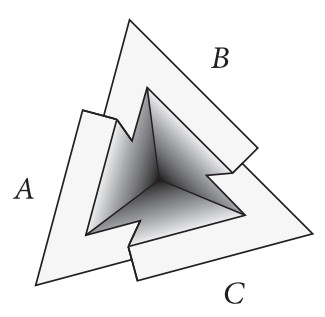
Cut the card as shown and it can be drawn out into an endless chain, with an opening large enough for a man to pass it over his body. “A thin person could use a much smaller card.” From Houdini’s Paper Magic, 1922.
Physical Education
At Bradford, England, a girl, aged 16, met death in an extraordinary manner. While in the playground of her school she was caught by a veritable tornado which carried her into the air. … [A] witness who was waiting for a car in front of the school said he saw the girl in the air, her skirts blown out like a baloon. She was 25 to 30 feet in the air, just above the school balcony (the latter, the coroner remarked, was 20 feet high). … The physician who was called found the girl unconscious and pulseless, suffering from severe concussion of the brain and compound fractures of the lower jaw, right arm, wrist and thigh. It appeared that she was wearing a pair of bloomers with an ordinary skirt but without petticoats. The jury returned a verdict of ‘died as the result of a fall caused by a sudden gust of wind.’
– Journal of the American Medical Association, quoted in Medical Sentinel, June 1911
The Card Challenge
A problem posed by Harry Houdini: Given a piece of cardboard measuring 4″ × 2.5″, cut it so that a person can pass completely through it without tearing it.
Can it be done?
(Solution)
Dead Letters
Spiritualist Ludwig von Guldenstubbe had a no-nonsense approach to communicating with the dead — he left paper and pencil for them in Paris churches and cemeteries.
He got only a few scrawls at first, but apparently word spread through the underworld, and soon more illustrious correspondents turned up. In August 1856 von Guldenstubbe produced the signatures of the emperor Augustus and of Julius Caesar, collected at their statues in the Louvre:

He also received writings from Abélard, who wrote in bad Latin, and Héloïse, in modern French — evidently she’s been taking correspondence courses since the 12th century.
Sadly, it appears that death spoils one’s penmanship — here are writing samples from Louise de La Vallière, the repentant mistress of Louis XIV, before (top) and after dying:

Perhaps that’s understandable, given the circumstances.
In the 10 months between August 1856 and June 1857, von Guldenstubbe says he got more than 500 specimens this way, in the company of more than 50 witnesses — but somehow no one has ever duplicated his results.
“A Crime Story”: Solution
Solution to “A Crime Story”:
Theo is innocent because he says so twice. Then (9) is a lie. Since (9) is a lie, (8) is true. Since (8) is true, (15) is a lie. Since (15) is a lie, (14) is true. Judy is the thief.
In a Word
paraskavedekatriaphobia
n. fear of Friday the 13th
Tall Order

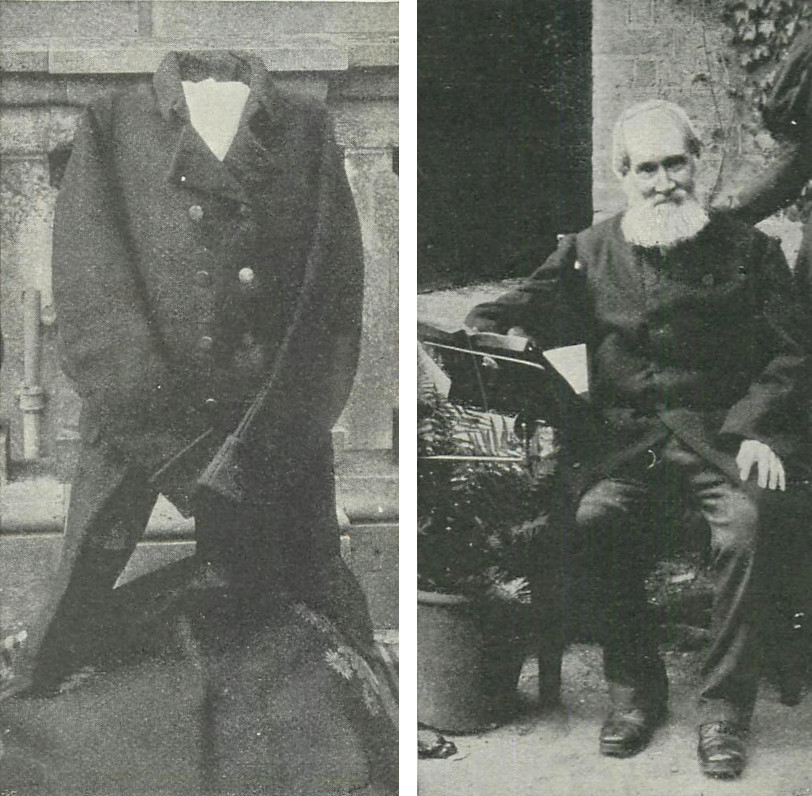
[H]e drew our attention to the vast difference the position of the shoulders make in a man’s height. This he illustrated by walking from the audience with his shoulders in their natural position, until, having traversed half the length of the room, he suddenly raised them, as represented in the accompanying sketches. The effect was quite startling, and very ludicrous.
– Frank Bellew, The Art of Amusing, 1866
Bah!
For the past 25 years, PNC Bank has calculated an annual “Christmas price index,” adding up the total cost of all the gifts mentioned in “The Twelve Days of Christmas.” In 1984 the total was $12,623.10; by 2008 it had risen to $21,080.10.
This assumes that you’d hire the drummers, pipers, lords, ladies, and maids, rather than buying slaves or creating them in some kind of lab. And “Omitting the seven swans a-swimming may be a tempting way for a true love to hold the line on costs,” says the bank, “but one would be advised to proceed with caution.”
Also, the estimates above assume you’ll give 78 gifts total, but strictly speaking that’s not accurate — the song calls for one partridge on day one, a second on day two, etc. Add up all these multiples and you must give 364 gifts altogether, for a total cost of $86,608.51 — or $131,150.76 if you buy online.
“A Crime Story”
From the American journal Scripta Mathematica:
An elementary school teacher in New York state had her purse stolen. The thief had to be Lilian, Judy, David, Theo, or Margaret. When questioned, each child made three statements:
Lilian:
(1) I didn’t take the purse.
(2) I have never in my life stolen anything.
(3) Theo did it.
Judy:
(4) I didn’t take the purse.
(5) My daddy is rich enough, and I have a purse of my own.
(6) Margaret knows who did it.
David:
(7) I didn’t take the purse.
(8) I didn’t know Margaret before I enrolled in this school.
(9) Theo did it.
Theo:
(10) I am not guilty.
(11) Margaret did it.
(12) Lillian is lying when she says I stole the purse.
Margaret:
(13) I didn’t take the teacher’s purse.
(14) Judy is guilty.
(15) David can vouch for me because he has known me since I was born.
Later, each child admitted that two of his statements were true and one was false. Assuming this is true, who stole the purse?
(Solution)
A Mountain’s Ghost

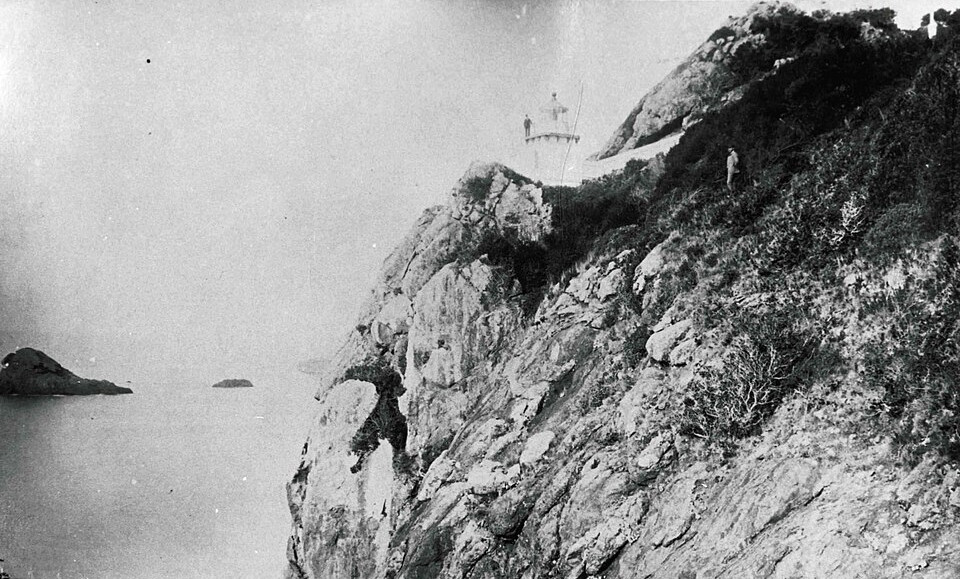
Visit the top of Adam’s Peak in Sri Lanka and you’ll see a striking sight — at sunrise the mountain’s own shadow is caught in the morning mist before you.
“The shadow seemed to rise up and stand in front of us in the air,” wrote a correspondent to Nature in 1886, “with rainbow and spectral arms, and then to fall down suddenly to the earth as the bow disappeared.”
See The Spectre of the Brocken.
(Image: Wikimedia Commons)