“What makes a fire so pleasant is, I think, that it is a live thing in a dead room.” — Sydney Smith

“What makes a fire so pleasant is, I think, that it is a live thing in a dead room.” — Sydney Smith

Advice sent by Philip Stanhope, 4th Earl of Chesterfield (1694–1773), to his son Philip on how to attain success in the world:
“I wish to God,” he wrote in 1750, “that you had as much pleasure in following my advice, as I have in giving it to you.”
(From Letters to His Son on the Art of Becoming a Man of the World and a Gentleman, 1774.)
Hob and Nob live in Gotham, a village stricken with “witch mania.” Rita visits both of them. Hob tells her, “The witch has blighted Bob’s mare,” and Nob tells her, “Maybe the witch killed Cob’s sow.” Hob and Nob themselves don’t suspect any particular person of being a witch, and there’s no definite description (such as “the Gotham witch”) that they both think applies uniquely to some alleged witch. Hob isn’t aware of Cob’s sow, and Nob isn’t aware of Bob’s mare. Rita herself doesn’t believe in witches. She reports the following:
“Hob thinks a witch has blighted Bob’s mare, and Nob wonders whether she killed Cob’s sow.”
How do we make sense of this? The two assertions seem to refer to the same person, but how is this possible if no such person exists? What can it mean to say that one nonexistent object is the same as another?
(P.T. Geach, “Intentional Identity,” Journal of Philosophy 64:20 [1967], 627–32.)
From reader Éric Angelini:
What distinguishes this sequence of integers?
10, 9, 18, 10, 17, 10, 9, 10, 16, 10, 9, 18 …
Adding 9 to each successive digit and inserting a comma after the result reproduces the original sequence:
1 + 9 = 10
0 + 9 = 9
9 + 9 = 18
1 + 9 = 10
8 + 9 = 17, etc.
This example (A369603 in OEIS) is lexicographically the earliest such sequence beginning with 10.
(Thanks, Éric.)

My Aunt Maria asked me to read the life of Dr. Chalmers, which, however, I did not promise to do. Yesterday, Sunday, she was heard through the partition shouting to my Aunt Jane, who is deaf, ‘Think of it! He stood half an hour today to hear the frogs croak, and he wouldn’t read the life of Chalmers.’
— Thoreau, journal, March 28, 1853
Donald Aucamp offered this problem in the Puzzle Corner department of MIT Technology Review in October 2003. Three logicians, A, B, and C, are wearing hats. Each of them knows that a positive integer has been painted on each of the hats, and each of them can see her companions’ integers but not her own. They also know that one of the integers is the sum of the other two. Now they engage in a contest to see which can be the first to determine her own number. A goes first, then B, then C, and so on in a circle until someone correctly names her number. In the first round, all three of them pass, but in the second round A correctly announces that her number is 50. How did she know this, and what were the other numbers?
“Garçon!” the diner was chargin’,
“My butter has been writ large in!”
“But I had to write there,”
Exclaimed waiter Pierre,
“I didn’t have room in the margarine.”
(Thanks, Larry.)

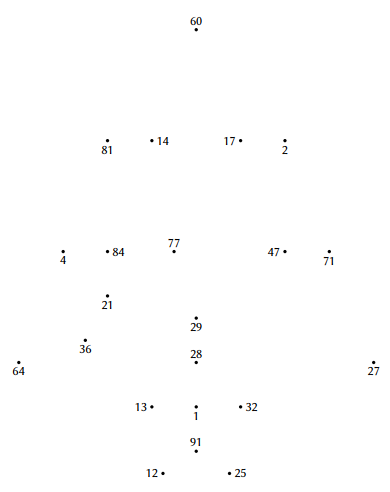
A pretty dissection puzzle by Sam Loyd. Cut this figure into three pieces that will fit together to make a square.

Speaking of swans: By royal prerogative, all mute swans in open water in Britain are the property of the British Crown. Historically the Crown shares ownership with two livery companies, the Worshipful Company of Vintners and the Worshipful Company of Dyers, and so, accordingly, each year in the third week of July three skiffs make their way up the Thames from Sunbury to Abingdon, catching, tagging, and releasing the swans they encounter. Nominally they’re apportioning the birds among themselves; in practice they’re counting them and checking their health.
Magnificently, the Crown’s swans are recorded by the Marker of the Swans, a recognized official in the Royal Household since this tradition began in the 12th century. Queen Elizabeth II attended the Swan Upping ceremony in 2009, as “Seigneur of the Swans,” the first time a reigning monarch had done so. The entire operation was shut down for the first time in 2020, due to COVID-19, but it commenced again the following year.
While we’re at it: All whales and sturgeons caught in Britain become the personal property of the monarch — they are “royal fish.” Plan accordingly.
(Thanks, Nick.)
Some say “If God sees everything before
It happens — and deceived He cannot be —
Then everything must happen, though you swore
The contrary, for He has seen it, He.”
And so I say, if from eternity
God has foreknowledge of our thought and deed,
We’ve no free choice, whatever books we read.
— Chaucer, Troilus and Criseyde