By Henry Dudeney:
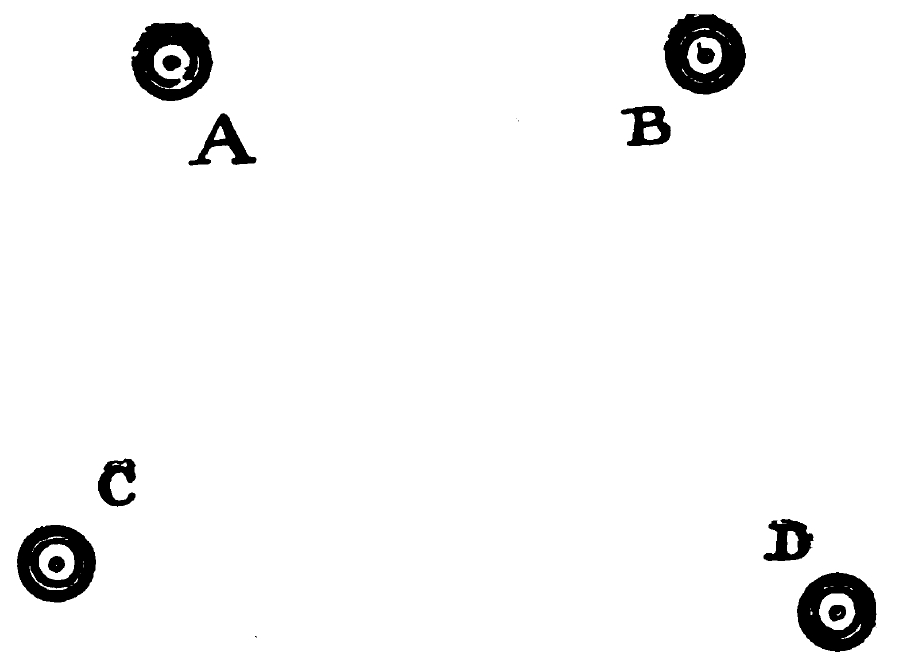
Here is a queer new puzzle that I know will interest my readers considerably. The four draughtsmen are shown exactly as they stood on a square chequered board — not necessarily eight squares by eight — but the ink with which the board was drawn was evanescent, so that all the diagram except the men has disappeared. How many squares were there in the board and how am I to reconstruct it? I know that each man stood in the middle of a square, one on the edge of each side of the board and no man in a corner. It is a real puzzle, until you hit on the method of solution, and then to get the correct answer is absurdly easy.
|
SelectClick for Answer |
Draw a line from A to D. Then draw CE perpendicular to AD, and equal in length to AD. Then E will be the centre of another square. Draw a line from E to B and extend it on both sides. Also draw a line FG through C and parallel to EB and the lines through A and D perpendicular to EB and FG. Now, as H is the centre of a corner square, we can mark off the length HE all round the square and we find the board is 10 × 10.
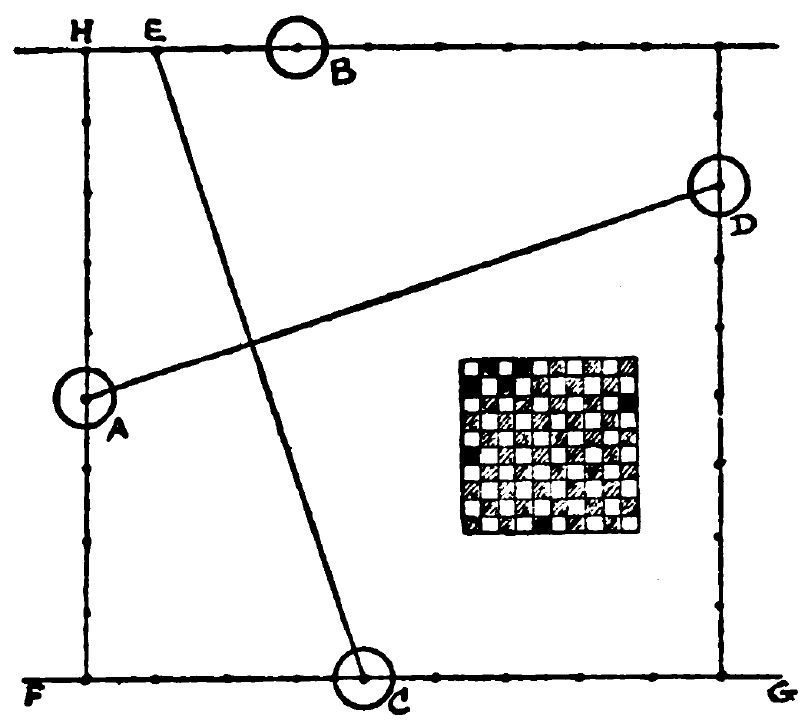
If the size of the men were not given we might subdivide into more squares, but the men would be too large for the squares. As the distance between the centres of squares is the same as the width of the squares, we can now complete the board with ease, as shown in the diagram inset.
[The inset diagram is hard to read, but if rows are numbered and files lettered, I believe the men are on e1, a5, j7, and d10.]
From Modern Puzzles and How to Solve Them, 1926.
|