
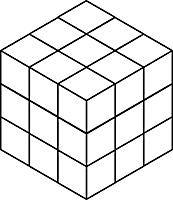
With best play on both sides, conventional tic-tac-toe (noughts and crosses) is always a draw. Played in three dimensions, though, in a 3×3×3 cube, it’s always a win for whichever player manages to take the central cell. In fact, a draw is impossible — there’s no way to fill the “board” with 14 crosses and 13 noughts without completing one or more winning paths.
What if we reverse the object so that the first player to complete such a path loses? Interestingly, in that case seizing the center cell is still the best strategy. Thereafter, whichever cell the second player chooses, the first player should take the cell diametrically opposite. Obviously this can’t create a winning triple that passes through the center, but neither can it create a triple that doesn’t pass through the center, because the second player would necessarily just have completed such a triple himself on the opposite side of the cube.
“So the first player cannot lose,” writes mathematician Solomon Golomb. “Thus, because no draws are possible on the 3×3×3 ‘board,’ he must win!”
(This is similar to the first player’s strategy in Henry Dudeney’s cigar puzzle.)
(Solomon W. Golomb, “Martin Gardner and Ticktacktoe,” in Erik D. Demaine, Martin L. Demaine, and Tom Rodgers, eds., A Lifetime of Puzzles, 2008.)