
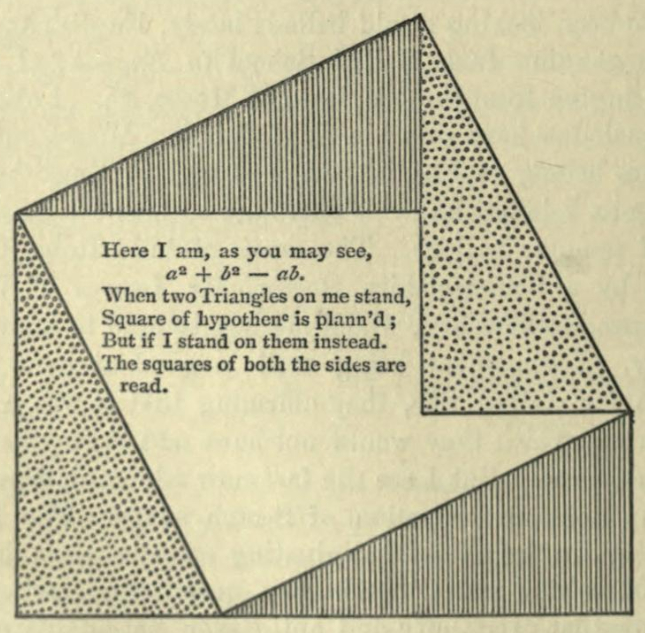
This poem was composed by English mathematician George Biddell Airy, the seventh Astronomer Royal. It’s written from the point of view of the irregular polygon in the middle of the figure. If two congruent right triangles are affixed to the bottom edges of this polygon, the resulting shape has the outline of two adjoining squares of side lengths a and b, the sides of the right triangles. If the same two triangles are instead affixed above the polygon, as shown, the result is a (tilted) square whose side is the length of the triangles’ hypotenuse. This proves the Pythagorean theorem.
“Various proofs come near to this, but none which I can find comes up to it in simplicity,” wrote Augustus De Morgan to William Rowan Hamilton in 1855. “Placing the triangle in four different positions shows the proposition anatomically, without scalpel or nasty smell.”