
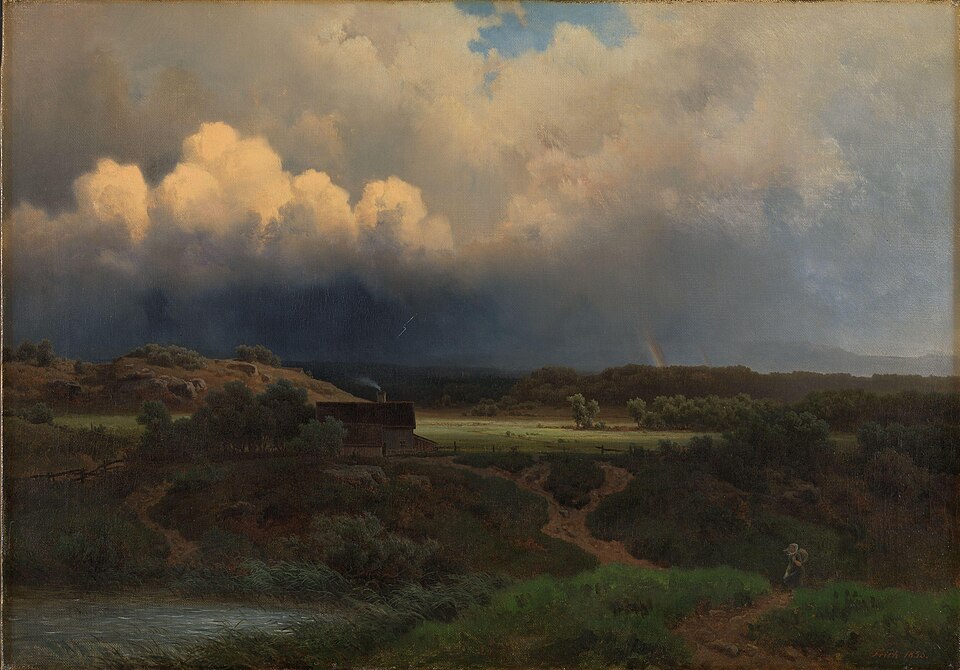
In 1970, Penn State meteorologist Hans Neuberger examined 12,000 European paintings to reconstruct historical climate data between 1400 and 1967. He found a marked increase in darkness and cloud cover between 1550 and 1849, corresponding roughly to the Little Ice Age. Painters in the Mediterranean School depicted bluer skies and clearer conditions than their British counterparts, whose paintings showed overcast skies and lower visibility. No English paintings depicted a completely clear sky.
In 2011, researchers Karen Aplin and Paul Williams quantified the frequency of musical allusions to weather in orchestral music over time. Storms, not surprisingly, were the weather type most frequently represented, followed by wind, cloud, rain, sun, and fog. Of the pieces they chose to study, all those depicting frontal storms were in minor keys, and all those depicting fair weather were in major keys. By a large margin, the most common nationality of weather-depicting composers was British. “This appears to support the stereotypical assumption that people from the UK are more enthusiastic about the weather than their colleagues overseas, although this effect could be due to sampling bias, given that the authors of this paper are both from the UK.”
(Hans Neuberger, “Climate in Art,” Weather 25:2 [February 1970], 46-56; Karen L. Aplin and Paul D. Williams, “Meteorological Phenomena in Western Classical Orchestral Music,” Weather 66:11 [November 2011], 300-306. Here’s a related study looking at popular music.)