
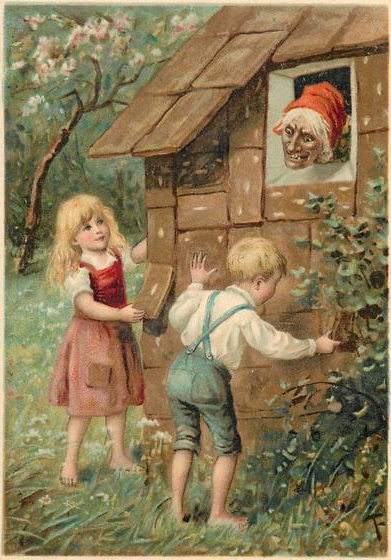
Hansel and Gretl have discovered a gingerbread cottage and are wondering whether to eat some of the tiles on its walls. A witch appears and tells them how they must go about it. “Each of you is to name a whole number between 0 and 100. Hansel’s must be odd and Gretl’s even. No conferring. Whoever chooses the lower number can eat twice that number of gingerbread tiles. Whoever chooses the higher number can eat the lower number.” So, for example, if Hansel chooses 57 and Gretl chooses 30, Hansel will get 30 tiles and Gretl will get 60.
This sounds fine, but the children have just had lessons in game theory and regard this as a non-cooperative game between rational utility maximizers. Gretl knows that Hansel will not choose 99, because 97 would leave him better off if she chose 98 and no worse off if she chose any other number. By the same reasoning, she will avoid 98 and choose 96. In her mind she can follow this train all the way to its end: Rationally, it seems, she must choose 2. Hansel, following it also, finds himself indifferent between 3 and 1. In the end he will receive a paltry two tiles and Gretl either one or four.
Is all of this sound? Gretl says, “There is something radically peculiar about trains of thought which proceed in the subjunctive. You are to work out what you would be rational to do, if I were to choose a number which I shall not choose. I am to do likewise, with each train of thought reproduced inside the other. What happens if either player derails a train by choosing in defiance of it? In that case it becomes radically unclear whether either player still has a rational choice.”
(Martin Hollis, “The Gingerbread Game,” Analysis 54:4 [October 1994], 196-200.)