
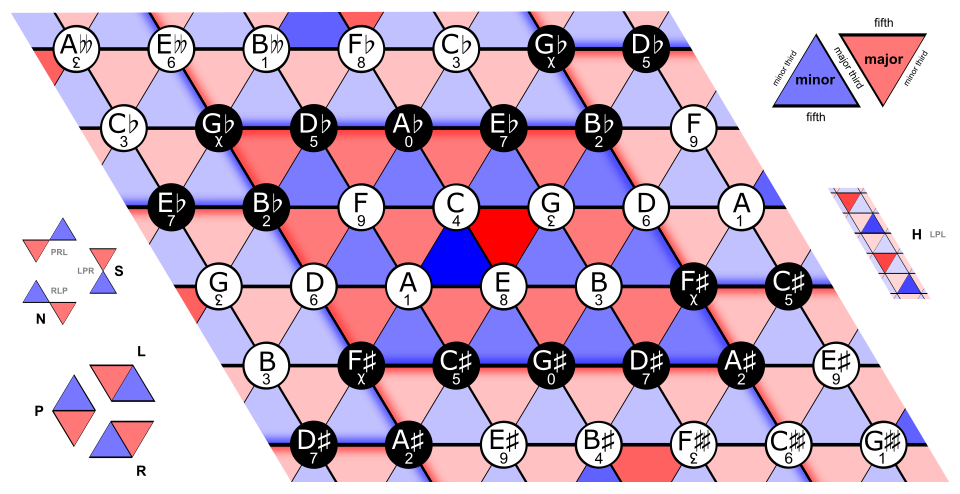
In 1739, Leonhard Euler devised a “tone net” to represent graphically the traditional harmonic relationships in European classical music. In the version above, the dark blue triangle at the center is an A minor triad; the red triangle to its right is the relative major, C; and the red triangle below it is the parallel major, A. Every such pattern is mirrored in all the other keys. The tones are numbered from 0 (A♭) to 11 (G). Major triads are red, and minor are blue. The thinnest lines denote minor thirds, thicker are major thirds, and the thickest horizontal lines are fifths. See this page for further relationships.

The heart of the figure, shown in somewhat darker colors in the diagram, is a parallelogram composed of 24 triangles. The top edge of this parallelogram can be joined to the bottom, which lists the same notes in their enharmonic equivalents, and if the resulting cylinder is twisted slightly then its ends can be joined in the same way, forming a torus.