An Old Story

http://books.google.com/books?id=_g8wAAAAMAAJ

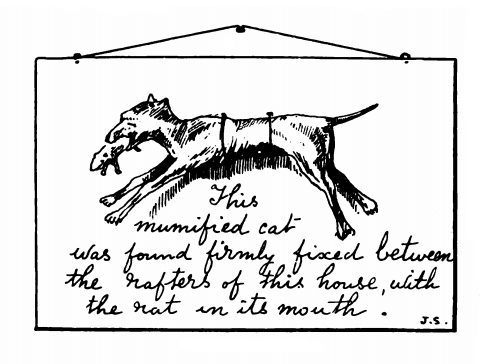
Whenever I passed, some few years ago, a certain shop-window in the West-end of London, I usually had an additional peep at a large card to which was attached a mummified cat grasping a mummified rat firmly in its jaws. If I remember rightly, these animals were discovered, in a preserved, albeit shrunken and dusty, condition, imprisoned between some rafters in the house during repairs. Evidently the unfortunate cat got jammed in its peculiar position accidentally, and being averse to releasing its own prisoner, and thereby being better able to release itself, held it securely until suffocation to both ensued. It was a striking illustration of the powerfulness of determination exercised by even the smaller class of animals.

— James Scott, “Shopkeepers’ Advertising Novelties,” Strand, November 1895
http://commons.wikimedia.org/wiki/File:The_cat_and_the_rat_Christ_Church_Cathedral_in_Dublin_02.JPG
Image: Wikimedia Commons

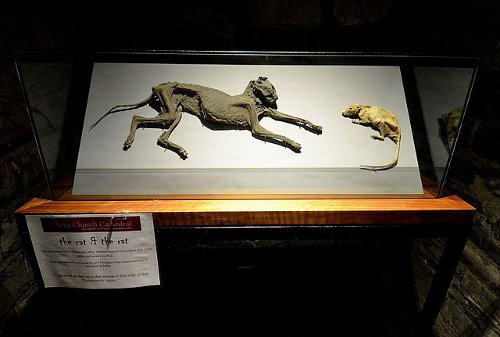
In the 1860s, workers discovered the remains of a cat and a rat behind the organ in Dublin’s Christ Church Cathedral.

There’s no telling how long they’d been there. Their bodies had been desiccated in the dry air of the church.
Self-Determination

http://commons.wikimedia.org/wiki/File:David_-_The_Death_of_Socrates.jpg

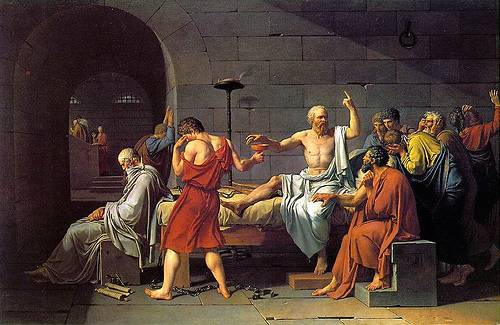
Did Socrates commit suicide? Philosopher R.G. Frey argues that he did. Socrates’ final conversations with Phaedo and his friends show that he intended to drink the hemlock, and he drank it intentionally, knowing its effect and without being forced. It’s true that he had been sentenced to die, but still he chose to accept the cup rather than compel another to take his life.

“The fact that Socrates died a noble and dignified death does not show that he did not commit suicide,” writes Frey, “but rather that suicide need not be ignoble and undignified.”

(R.G. Frey, “Did Socrates Commit Suicide?”, Philosophy 53:203 [January 1978], 106-108.)

Podcast Episode 12: The Great Race, Grace Kelly’s Tomahawk, and Dreadful Penmanship

http://commons.wikimedia.org/wiki/File:1908_New_York_to_Paris_Race,_grid.jpg

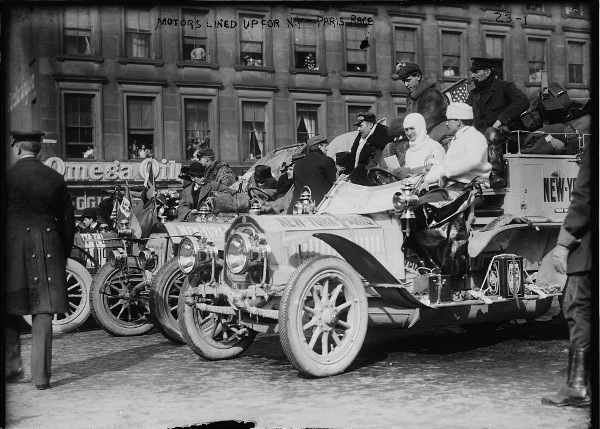
The New York Times proposed an outrageous undertaking in 1908: An automobile race westward from New York to Paris, a journey of 22,000 miles across all of North America and Asia in an era when the motorcar was “the most fragile and capricious thing on earth.” In this episode of the Futility Closet podcast we’ll follow the six teams who took up the challenge and attempted “the most perilous trip ever undertaken by man.”

We’ll also see how a tomahawk linked Alec Guinness and Grace Kelly for 25 years and hear poet Louis Phillips lament his wife’s handwriting.

See full show notes …

Unquote

http://commons.wikimedia.org/wiki/File:Piechowski_Wedding_toast.jpg

“It is most absurdly said, in popular language, of any man, that he is disguised in liquor; for, on the contrary, most men are disguised by sobriety.” — Thomas de Quincey, Confessions of an English Opium-Eater, 1856

The Telltale Mart

The Journal of Portfolio Management published an unlikely article in 1986: “Is Time Travel Impossible? A Financial Proof.”

In it, California economist Marc Reinganum notes that anyone with a time machine would have an enormous incentive to manipulate investments and futures markets, using his knowledge of the future to amass huge profits.

If this were possible at all, it would be happening on such a large scale that interest rates would be driven to zero.

So the fact that we see positive interest rates proves that time travelers don’t exist.