
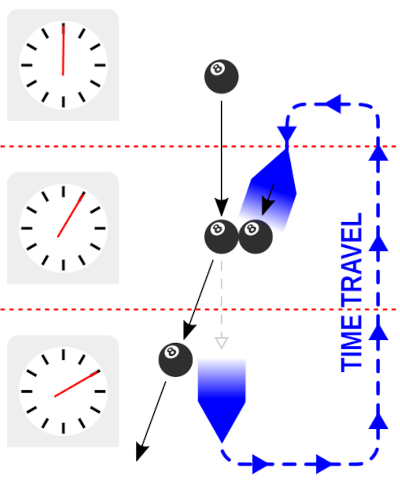

In 1990, physicist Joseph Polchinski described a puzzling situation: Suppose a billiard ball were sent through a traversable wormhole into the past, where it knocked its earlier self off course, away from the wormhole. This is a version of the famous grandfather paradox: How can we explain the ball’s presence where it seems to have prevented its own arrival?
Fortunately, Caltech students Fernando Echeverria and Gunnar Klinkhammer found that self-consistent solutions exist in which the older ball imparts only a glancing blow to its younger self, one that sends it through the hole at just the right angle to deliver a similarly glancing blow to its own forebear, and so on, sparing us from the paradox. (In 1991 the students and Kip Thorne reported that they’d failed to find any initial conditions in which such self-consistent solutions were unavailable, so it’s plausible that they exist for every possible initial trajectory. But this hasn’t been proven.)
Another pleasing possibility is that the older ball knocks the younger out of the way and itself enters the wormhole again. This creates an infinite loop, and some existential bewilderment, but no paradox.