
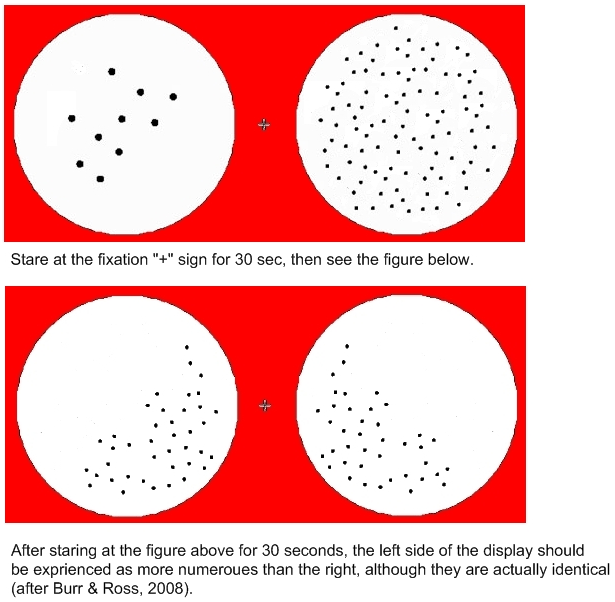

Fixate on the top figure for 30 seconds and then look at the bottom figure. Though the two circles in the lower figure contain the same number of dots, those on the left appear more numerous. This suggests that the visual system has adapted to the number of items seen in the priming phase, and that, like color, number is a primary attribute of vision.
Psychologists David Burr and John Ross write, “We propose that just as we have a direct visual sense of the reddishness of half a dozen ripe cherries, so we do of their sixishness. In other words there are distinct qualia for numerosity, as there are for color, brightness, and contrast.
“One of the more fascinating aspects of this study … is that although the total apparent number of dots is greatly reduced after adaptation, no particular dots seem to be missing. This reinforces old and more recent evidence suggesting that the perceived richness of our perceptual world is very much an illusion.”
(David Burr and John Ross, “A Visual Sense of Number,” Current Biology 18:6 [March 25, 2008], 425-428.)