
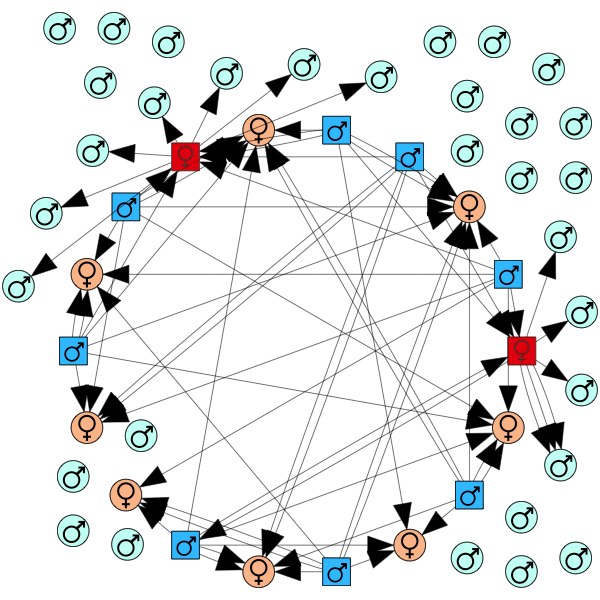
This is dismaying. Suppose that men and women are equally sexist, and imagine a group that’s 80 percent men and 20 percent women. If 20 percent of people (represented as squares above) will make sexist comments to people of the opposite gender, we might expect that the women will receive four times as many sexist comments as the men. In fact they receive 16 times as many. Computer scientist Ian Gent explains:
With 20% women the gender ratio is 1:4. So there are 4 times as many men to make sexist remarks, so 4 times as many sexist remarks are made to women as to men. But there are 4 times fewer women to receive sexist remarks, so each individual woman is four times as likely to receive a given remark than an individual man is. These effects multiply, so in this example the mean number of sexist remarks per woman is 16 times the number per man. This holds in general, so with a gender ratio of 1:r, women will receive r2 times as many sexist remarks as men.
Above, after 70 sexist remarks (arrows) are made at random to members of the opposite gender, the women have received a mean of 5.6 remarks each, the men only 0.35. Gent first described the effect in 2013; the mathematical model was devised by computer scientist Karen Petrie.