
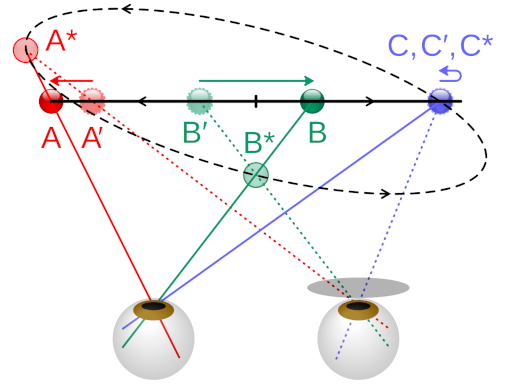

When you view a pendulum swinging laterally before your eyes, your brain understands correctly that the bob is moving in a straight line perpendicular to your line of sight. But if you put a dark filter over one eye, the bob seems to move in an ellipse, swinging somewhat closer to the screened eye.
Apparently the visual system responds more quickly to bright objects than to dim ones, so when the clear eye correctly sees the bob’s position at A, B, and C, the obscured eye sees it at A’, B’, and C’, and the brain reconciles these reports by supposing it’s at A*, B*, and C*. German physicist Carl Pulfrich first described the effect in 1922.