
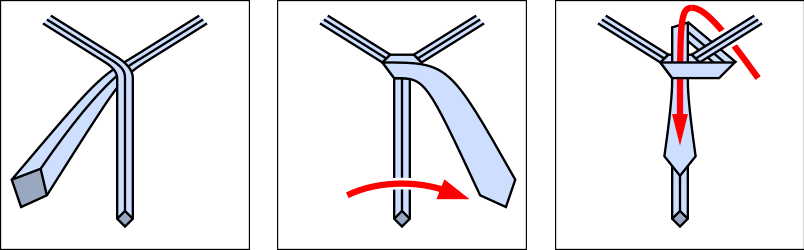

In 1999, while serving as research fellows at Cambridge University’s Cavendish Laboratory, physicists Thomas Fink and Yong Mao made a mathematical study of necktie knots. They published a summary in Nature that year and a detailed exposition in Physica A in 2000.
They found that, if knots are modeled as persistent random walks on a triangular lattice, there are exactly 85 ways to tie a tie. Of the 10 knots they scored as most aesthetic (for symmetry and balance), only four (four-in-hand, Pratt knot, half-Windsor, Windsor) are well known to Western men; interestingly, the simplest of the remainder, the unassuming small knot, above, is popular in the communist youth organization in China.