
The Wallace–Bolyai–Gerwien theorem, first proven in 1807, states that any two polygons of equal area must have a common dissection. That is, there’s always a way to cut up the first one and assemble the pieces to form the second.
But what if the pieces must be connected by hinges? In his “haberdasher” puzzle of 1907, Henry Dudeney showed that it’s possible to convert a triangle into a square by cutting it in pieces and turning it “inside out”:
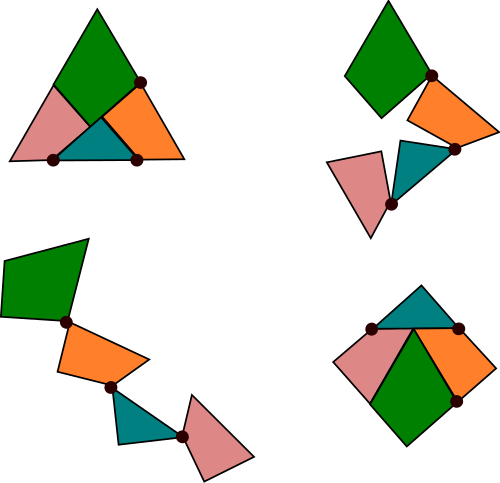

Is it always possible to arrange such a “hinged dissection” between two polygons of equal area? The question remained open until 2007, when Erik Demaine showed that the answer is yes — and provided an algorithm to find it.
02/25/2026 UPDATE: Reader Simon Schneider directed me to this interactive visualization of the Wallace–Bolyai–Gerwien theorem, which lets you draw two polygons and then converts one to the other before your eyes. It’s hypnotizing. Here’s a paper on the dissection algorithm used. (Thanks, Simon.)