
Timeless Reason

In an 1849 letter to his sister, Lewis Carroll asks which is more accurate, a clock that is right once a year or one that has stopped altogether. The stopped clock is more accurate, he says–because it’s correct twice a day.

You might go on to ask, ‘How am I to know when eight o’clock does come? My clock will not tell me.’ Be patient, reader: you know that when eight o’clock comes your clock is right; very good; then your rule is this: keep your eye fixed on your clock, and the very moment it is right it will be eight o’clock.

“‘But–‘ you say. There, that’ll do, reader; the more you argue the farther you get from the point, so it will be as well to stop.”
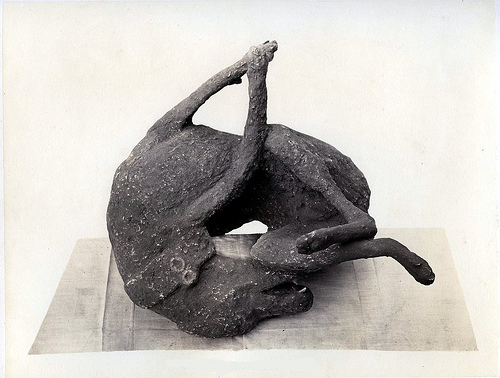
The Dog of Pompeii

http://commons.wikimedia.org/wiki/File:Rive,_Roberto_(18..-1889)_-_n._493_-_Cane_morto_trovato_in_Pompei.jpg

When Vesuvius erupted on Aug. 24, A.D. 79, a Roman fuller named Vesonius Primus fled toward the sea, leaving a watchdog chained to a post in the atrium of his house. It appears that the dog managed to survive the night by climbing continuously atop the mounting ash, but at dawn it reached the limit of its chain and was buried alive.

Like other victims of the eruption, its body left a vacancy in the ash layer, so a plaster cast could be made of its final position.

Jerusalem Syndrome

Between 1980 and 1993, 42 visitors to Israel experienced a peculiar psychotic episode with seven consistent clinical stages:

  1. Anxiety, agitation, nervousness and tension, plus other unspecified reactions.
  2. Declaration of the desire to split away from the group or the family and to tour Jerusalem alone.
  3. A need to be clean and pure: obsession with taking baths and showers; compulsive fingernail and toenail cutting.
  4. Preparation, often with the aid of hotel bed-linen, of a long, ankle-length, togalike gown, which was always white.
  5. The need to scream, shout, or sing out loud psalms, verses from the Bible, religious hymns, or spirituals.
  6. A procession or march to one of Jerusalem’s holy places.
  7. Delivery of a “sermon” in a holy place. The sermon was usually very confused and based on an unrealistic plea to humankind to adopt a more wholesome, moral, simple way of life.

These people had no history of psychiatric illness and arrived as regular tourists, with no special mission in mind. They recovered fairly spontaneously on leaving the country and were reluctant afterward to discuss the episode. No explanation has been found.

(Bar-el Y, et al. (2000) Jerusalem syndrome. British Journal of Psychiatry, 176, 86-90.)